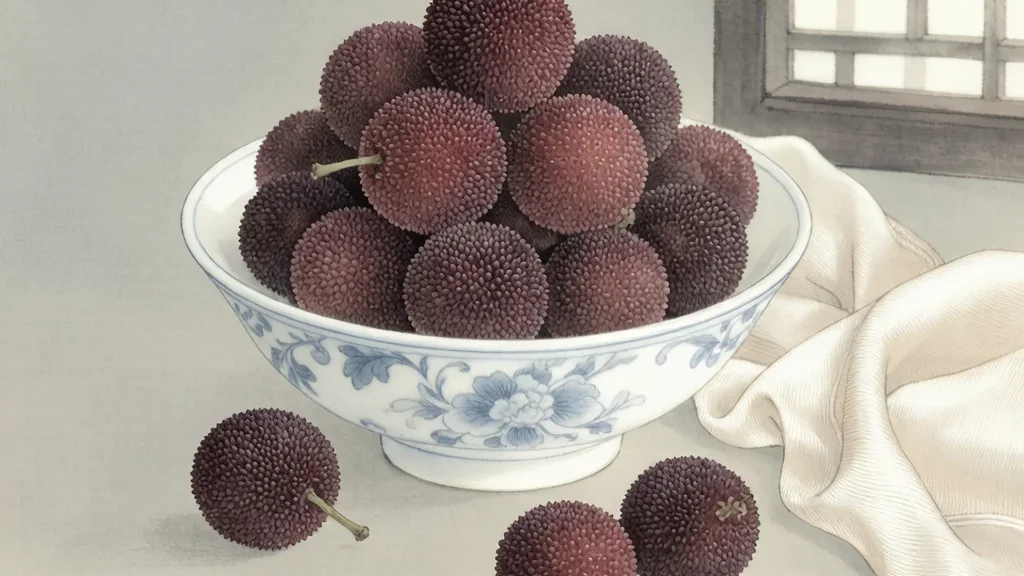
Yang-mei (杨梅, yángméi), often called Chinese bayberry, waxberry, or red bayberry in English, is a small subtropical fruit native to southern and eastern China. Botanically known as Myrica rubra, it bears clusters of deep crimson-to-purple, knobby berries whose sweet-tart flesh surrounds a single central seed. Revered for more than two thousand years as a seasonal delicacy of early summer, the fruit is eaten fresh by the handful, pressed into juice, steeped into fragrant fruit wine, and dried with sugar. Prized for its fleeting freshness, yang-mei has long been a symbol of the brief, humid Mei-yu season and a beloved marker of early summer across the lower Yangtze and Lingnan regions.
Botanical Identity and Appearance
Yang-mei is an evergreen tree of the myrtle family that can reach ten meters or more in height, bearing its fruit on the previous year's wood. The berries themselves are unusual among fruits: rather than a smooth skin, each is covered in tight, fleshy protuberances that give it a raspberry-like texture, though the fruit is not a true aggregate. Ripe berries range from ruddy rose to near-black maroon, with the darkest specimens generally the sweetest.
Inside, the translucent crimson pulp clings to a small hard stone. The edible portion is the juicy outer layer, which bursts easily when bitten. Because the surface is soft and unprotected by a thick rind, the fruit is extraordinarily perishable and must reach the table within a day or two of picking.
Wild trees still grow across southern China, but most fruit sold today comes from cultivated orchards selected over centuries for larger, juicier, less seedy berries. Several named cultivars differ mainly in color, size, and the balance of sugar and acid.
Native Range and Growing Regions
The center of yang-mei cultivation lies in the hilly, warm, and humid parts of Zhejiang, Jiangsu, Fujian, and Hunan provinces, with Zhejiang's Yuyao (余姚) famously celebrated as a "hometown of yang-mei." The tree thrives on acidic, well-drained soils and tolerates the kind of mild, moist climate found along the southeast coast and the lower Yangtze hills.
Yuyao alone hosts sprawling orchards and an annual harvest that draws visitors during the fruit's short peak. Nearby Cixi and Shengzhou, as well as the hills around Hangzhou and the mountains of Fujian and Hunan, are also well known for distinctive local strains prized by connoisseurs.
Because the tree is sensitive to cold and drought, commercial cultivation stays largely within these subtropical belts. Attempts to grow it elsewhere have met limited success, which helps explain why the fresh fruit remains relatively unknown outside East and Southeast Asia.
The Harvest Season
Yang-mei ripens in early to mid summer, typically from late May through June, depending on latitude and altitude. The window is brutally short: a single tree's crop may peak for only a week or two, and the region's whole harvest is essentially over within a month. This brevity is central to the fruit's cultural meaning.
Families often treat the season as an event, driving out to orchards for pick-your-own outings or sending boxes of the fruit as gifts to relatives in the city. The phrase "eating yang-mei" is almost synonymous with the arrival of early summer holidays.
Weather matters enormously. A cool, wet spring can delay and shrink the crop, while a hot spell accelerates ripening and shortens the already narrow window, making each year's fruit a slightly different experience.
Flavor Profile
A good yang-mei is a study in sweet-tart balance. The first impression is bright acidity, quickly followed by a deep berry sweetness and a faint resinous, wine-like note unique to the fruit. Texture is juicy and slightly grainy, closer to a grape's pulp than to a strawberry's seeds.
Riper, darker fruit leans sweeter and softer; lighter red specimens tend to be sharper and crisper. Connoisseurs debate endlessly which is best, but most agree that the perfume and the slight astringency of the skin are part of the charm.
Because the flesh is thin and the seed large, eating yang-mei is an attentive business: one nibbles around the stone, Savoring the juice before discarding the pit. It is a fruit meant to be eaten slowly and fresh.
Culinary Uses
Fresh eating is the classic preparation, often chilled slightly to heighten the juice. Beyond that, yang-mei is pressed into a vivid red juice, cooked down with rock sugar into a syrup or compote, and dried into chewy sweetened "yang-mei gan" that keeps far longer than the fresh fruit.
Perhaps the most famous transformation is yang-mei jiu (杨梅酒), a homemade fruit wine in which the fresh berries are steeped in baijiu or rice liquor with sugar. Over weeks the liquor turns ruby and acquires the fruit's perfume, becoming a popular summertime digestif across the southeast.
Some regions also simmer the fruit into a cooling herbal-style drink believed to "clear heat" in traditional food philosophy, or fold it into ice creams and modern desserts aimed at urban shoppers.
Cultural Significance and the Mei-yu Season
Yang-mei arrives exactly as the plum rains—the Mei-yu (梅雨) front—soak the Yangtze valley, and the two are poetically linked in the Chinese imagination. The fruit's name even shares the character 梅 with mei (plum), reinforcing the association with that damp, lush season.
For centuries the fruit was sent as tribute to imperial courts and praised in poetry for its color and cool sweetness. Local gazetteers from Zhejiang record yang-mei gardens and the excitement of the annual harvest as a fixture of regional life.
Today the fruit anchors summer tourism, with orchard festivals, photo contests, and gift-box commerce turning a fleeting wild berry into a soft symbol of hometown and season.
Storage and the Problem of Freshness
Yang-mei has almost no shelf life. Picked ripe, it bruises and ferments within a day in heat, and its soft surface harbors fruit flies if left uncovered. Traditionally it was eaten where it grew or rushed to market at dawn in woven baskets lined with leaves.
Modern cold chains and express delivery have transformed this. Overnight shipping now carries Zhejiang yang-mei to Beijing and beyond, and some orchards ship sealed, refrigerated boxes the same morning they are picked. Even so, the fruit is best within forty-eight hours.
Drying and wine-making are the oldest answers to perishability, preserving the flavor long after the trees have gone quiet for the year.
Nutrition and Traditional Beliefs
Yang-mei is rich in vitamin C, organic acids, and anthocyanin pigments that give the skin its deep color and act as antioxidants. It is low in calories and high in water, which fits its reputation as a refreshing summer food.
In traditional dietary thinking the fruit is considered cooling and is eaten to counteract summer "heat" and stimulate appetite when the humid weather saps it. At the same time, its acidity means it is enjoyed in moderation, especially on an empty stomach.
Modern nutrition simply notes the fruit's fiber and vitamin content, while warning that the central seed should not be swallowed and that rinsing the berries well is wise given their exposed surface.
Modern Commerce and the Gift Economy
Today yang-mei is as much a commercial product as a wild treat. Premium gift boxes from Yuyao and Cixi are marketed like fine fruit, complete with branding, QR-traceable orchards, and same-day logistics promising arrival before the berries fade.
E-commerce live-streaming has turned the harvest into a spectator event, with hosts broadcasting from orchards as orders pour in. Prices for the finest large, dark berries can be steep, mirroring the fruit's scarcity and short season.
Yet for all the packaging, the essential experience remains the old one: a handful of cold, dripping, sweet-sour berries eaten standing in the summer heat, with the pit spat into the grass.
❓ Frequently Asked Questions
What is yang-mei in English?
It is usually called Chinese bayberry, waxberry, or red bayberry. The botanical name is Myrica rubra, and it is unrelated to the European bay tree.
When is yang-mei in season?
The fresh fruit ripens in early to mid summer, roughly late May through June, with a peak of only one to two weeks in most places.
What does yang-mei taste like?
It is sweet-tart and juicy, with a bright acidity, deep berry sweetness, and a faint wine-like resinous note. The texture is closer to grape pulp than to strawberry.
Why is yang-mei so hard to find fresh?
The soft, rindless berries bruise and ferment within a day or two, so they must be eaten locally or rushed by cold-chain delivery soon after picking.
How is yang-mei eaten besides fresh?
It is pressed into juice, cooked with rock sugar into syrup, dried into chewy sweetened fruit, and steeped in liquor to make yang-mei wine.
Where does the best yang-mei come from?
Zhejiang's Yuyao, Cixi, and Shengzhou hills, plus parts of Fujian and Hunan, are the most celebrated growing regions in China.