← Back to Festival Foods
Festival Foods
Yuanxiao and Tangyuan (元宵): Sweet Rice Balls for the Lantern Festival
✍️ by xiaoyu luo
🗓️ Updated Jul 29, 2026
Last updated: June 2024 · Reading time: 6 min
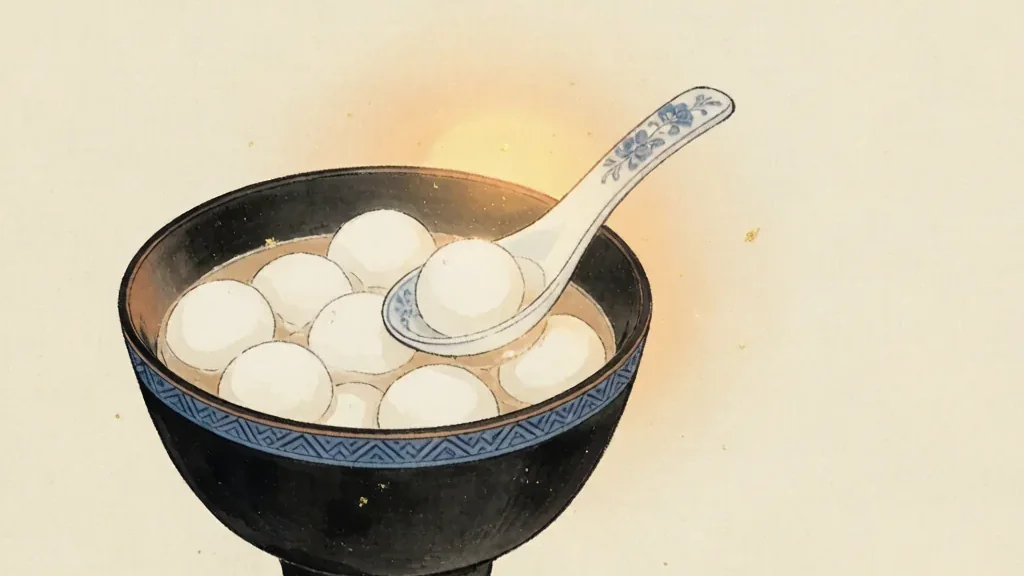
As the first full moon of the lunar new year rises on the fifteenth day of the first month, millions of Chinese families gather to celebrate the Lantern Festival (元宵节, Yuanxiao Jie) by eating a simple yet profoundly symbolic food: round, white glutinous rice balls filled with sweet or savory fillings, floating in a clear, fragrant broth. These rice balls are known as yuanxiao (元宵) in northern China and tangyuan (汤圆) in the south, and while the two terms are often used interchangeably, they refer to distinctly different preparations that reflect the deep culinary divide between China's wheat-eating north and rice-eating south. More than a seasonal treat, these humble dumplings embody the Lantern Festival's central themes of family unity, harmony, and the cyclical wholeness represented by the full moon. Their round shape (圆, yuán) echoes the festival's name (元宵, yuán xiāo) and the Chinese cultural ideal of tuanyuan (团圆), the complete and happy reunion of family members.
The Historical Origins of Lantern Festival Rice Balls
The tradition of eating rice balls during the Lantern Festival dates back at least to the Song Dynasty (960-1279 CE), though legends push its origins considerably earlier. One popular account traces the food to the reign of Emperor Wu of Han (reigned 141-87 BCE), whose beloved court lady, known as Yuanxiao, was forbidden from seeing her family. The wise minister Dongfang Shuo (154-93 BCE) devised a plan: he spread a prophecy that the Fire God would destroy the capital on the fifteenth day of the first month unless the entire city was illuminated with lanterns and everyone ate a specific food — round rice balls. The emperor ordered the celebration, and in the chaos of lantern-lit streets, Yuanxiao was reunited with her family. The earliest reliable culinary reference appears in the Song Dynasty text Shiwu Jiyuan, which describes fupian yuanzi — rice balls cooked in boiling water until they rise to the surface. By the Ming Dynasty, the dish had acquired its modern name and form.
The North-South Divide: Yuanxiao vs. Tangyuan
The distinction between yuanxiao and tangyuan represents one of the most instructive examples of China's north-south culinary divide. Northern yuanxiao are made by a process akin to snowballing: solid fillings — typically a hardened mixture of sugar, sesame, peanuts, and lard — are cut into small cubes, moistened, and repeatedly shaken in a large flat basket filled with dry glutinous rice flour. As the filling cubes tumble, they accumulate layer upon layer of flour, gradually growing into spheres. This process can take dozens of iterations over several hours. The resulting yuanxiao have a rough, slightly floury surface and a dense, chewy texture. Southern tangyuan, by contrast, are made by wrapping filling in a pliable dough — similar to the technique used for Japanese mochi. The dough, made from glutinous rice flour kneaded with warm water, is pinched into small cups, filled, and sealed by hand. This produces tangyuan with a smooth, glossy surface and a softer, more delicate texture.
Regional Varieties and Signature Preparations
Across China's diverse culinary landscape, yuanxiao and tangyuan have developed countless local variations. In Ningbo, Zhejiang Province — widely considered the birthplace of tangyuan — the Ningbo tangyuan features a filling of black sesame paste mixed with lard and sugar, wrapped in paper-thin glutinous rice dough and served in a soup of fermented rice and osmanthus flowers. In Chengdu, Sichuan Province, lai tangyuan, named after their creator Lai Yuanxin who began selling them in 1894, are notable for their exceptionally thin skin and a filling that incorporates Sichuan's famous brown sugar. In Fuzhou, Fujian Province, jiujiu tangyuan are tinted pink with red yeast rice and served in a ginger-infused syrup. The Chaoshan region of Guangdong is famous for duck mother twist tangyuan, whose name derives from their oval rather than round shape, said to resemble a duck egg. Perhaps the most visually striking variation comes from Nanjing, where yuhua shi tangyuan are marbled with vegetable dyes to resemble the city's famous Yuhua pebble stones.
Contemporary Culture, Commercialization, and Global Spread
In modern China, yuanxiao and tangyuan have been transformed by industrialization and commercialization while retaining their cultural significance. The market leader is Sanquan Foods, founded in 1992 by Chen Zemin, who invented the first machine for mass-producing frozen tangyuan. Sanquan's innovation made tangyuan available year-round rather than only during the Lantern Festival, and the company now produces over 300 varieties, including novelties like fruit tangyuan with mango or strawberry filling and crystal tangyuan made with tapioca starch for a translucent appearance. The Chinese frozen tangyuan market was valued at approximately 15 billion RMB (US$2.1 billion) in 2022. The global Chinese diaspora has carried yuanxiao and tangyuan to every continent. In Singapore and Malaysia, tangyuan are sold year-round at hawker centers. In the United States, frozen tangyuan are available in Asian supermarkets nationwide, and restaurants in cities with large Chinese populations feature handmade tangyuan on their dessert menus.
Regional Variations
Like many traditional Chinese foods, Yuanxiao/tangyuan (元宵/汤圆) varies significantly by region. In the south the preparation may be sweeter or incorporate local ingredients such as red bean paste or sesame, while northern versions tend toward simpler, more savory fillings. Each family also has its own closely guarded recipe, passed down from grandmother to grandchild. What unites them all is the belief that sharing this food during the festival brings good fortune and strengthens the bonds between generations.
❓ Frequently Asked Questions
Q: What is Yuanxiao?
A: Yuanxiao is a traditional Chinese food with deep cultural significance. Made from carefully selected ingredients, it has been enjoyed for centuries and is closely associated with Chinese festivals and family gatherings.
Q: When do people traditionally eat Yuanxiao?
A: Yuanxiao is traditionally eaten during specific festivals and occasions in the Chinese calendar. Its consumption is tied to seasonal celebrations and carries auspicious meanings.
Q: How is Yuanxiao made?
A: Yuanxiao is prepared using traditional techniques that have been refined over generations. The preparation process itself is often a family activity that brings people together.
Q: What is the cultural significance of Yuanxiao?
A: Yuanxiao carries deep cultural symbolism in Chinese tradition. Its shape, ingredients, and the occasions when it is eaten all convey meaningful messages about prosperity, reunion, and good fortune.
Q: What are the regional varieties of Yuanxiao?
A: Different regions of China have developed their own unique variations of Yuanxiao, reflecting local ingredients and culinary traditions. Each variety offers a distinct taste experience.
Q: Why are yuanxiao and tangyuan boiled and served in liquid?
A: The rice balls are cooked by simmering in water or broth until they float to the surface, which signals they are done. Serving them in a light soup, often with fermented rice or osmanthus, keeps the delicate dumplings moist and turns the dish into a warm bowl suited to the cold first-month holiday. The floating moment also gave the food one of its oldest names, 'floating round sons.'
Key Terms
元宵 / 汤圆
yuán xiāo / tāng yuán
团圆 (tuán yuán)Family reunion, the ideal symbolized by the round shape of the rice balls.
元宵节 (Yuánxiāo Jié)Lantern Festival, observed on the fifteenth day of the first lunar month.
糯米 (nuò mǐ)Glutinous rice, the grain milled into flour for the dough.
芝麻 (zhī ma)Sesame, a classic sweet filling for the rice balls.
桂花 (guì huā)Osmanthus flower, used to scent the broth the balls are served in.
浮圆子 (fú yuán zǐ)An early Song-era name for the rice balls, meaning 'floating round sons'.
宁波 (Níngbō)The Zhejiang city widely regarded as the birthplace of tangyuan.
Fun Facts
- The world's largest tangyuan was made in 2014 in Changsha, Hunan Province, weighing 2,580 kilograms with a diameter of 1.6 meters — it used 1,000 kg of glutinous rice flour and 800 kg of sesame filling and fed over 10,000 people.
- In northern China, the phrase yuanxiao became politically sensitive during the early 20th century because it is homophonous with Yuan Xiao, meaning Yuan eliminated — a reference to the warlord Yuan Shikai, who supposedly banned the term during his brief presidency (1915-1916).
- The viscosity and chewiness of tangyuan dough are determined by the ratio of amylopectin to amylose in glutinous rice starch, and food scientists at South China University of Technology have identified that the ideal ratio for traditional texture is approximately 98% amylopectin.
- In southern China, tangyuan are also eaten at the winter solstice and at weddings, where their roundness stands for unity and a complete family.
- Eating yuanxiao traditionally marks the formal end of the Chinese New Year period, closing two weeks of celebrations on the first full moon.
- In parts of Fujian and Taiwan, a savory tangyuan is filled with minced pork, shrimp, and vegetables rather than sweet paste.
The Symbolism of the Round Shape
The round form of yuanxiao and tangyuan is never accidental. In Chinese culture the circle has no beginning and no end, a shape that stands for completeness, continuity, and the reunion of family members scattered by work or distance. The word for 'round,' yuan, sounds exactly like the word for 'reunion,' tuanyuan, so a bowl of round rice balls quietly speaks a wish that the family will be whole. The festival itself falls on the first full moon of the year, when the moon is at its roundest and brightest, mirroring the food on the table. Lanterns, too, are round, reinforcing the same idea from every side of the courtyard. To eat the balls is therefore to take in a small, sweet version of the larger hope that the coming year will be full and unbroken.
Lantern Customs of the Night
The food is only half of the Lantern Festival. After the evening meal of rice balls, families step outside to walk among lanterns of every shape, rabbits, dragons, boats, and palaces, strung along streets and bridges. A favorite pastime is the lantern riddle, where a written puzzle is pasted on a lantern and passersby guess the answer for a small prize. In many towns people release floating lanterns onto rivers or light spinning lanterns on poles, sending points of light into the dark. Lion and dragon dances wind through neighborhoods to the beat of drums, and children carry small lanterns of their own. The custom of lighting the night traces back to the Han dynasty, when the emperor ordered lamps lit to honor the Buddha and to welcome the spring. Today the glow of countless lanterns turning the night into day remains the most visible sign that the new year's celebrations have reached their bright conclusion.
Making Tangyuan at Home
Making tangyuan is easier than many Chinese festival foods and is well suited to a home kitchen. A basic dough is made by mixing glutinous rice flour with warm water until it forms a soft, pliable ball that yields slightly to the touch. Small portions are pinched into cups, filled with a sweet paste of black sesame, peanut, or red bean, then sealed and rolled between the palms into smooth spheres. The balls are slipped into gently boiling water and lifted out once they rise, then served in a lightly sweet broth. Northern yuanxiao use a different method, tumbling a hardened filling in dry flour, but the home cook almost always makes the southern style. Because the work is simple and repetitive, it is often done as a family, with several generations at one table shaping the dumplings together, a small ritual of togetherness that fits the food's meaning perfectly.