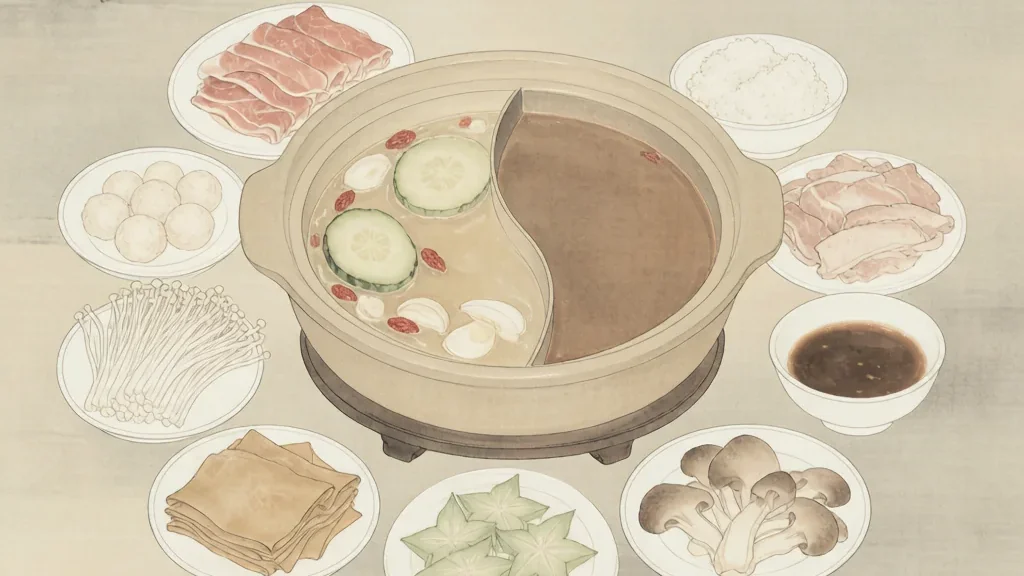
Maocai (冒菜) is the solo hot pot adventure — a personal bowl of boiled meats, tofu, and vegetables swimming in a numbing, spicy Sichuan broth. Born on the streets of Chengdu, it takes everything people love about communal hot pot and distills it into a single, fast, affordable bowl. You pick your ingredients, a cook blanches them in a fragrant broth, and they arrive topped with crimson chili oil, tongue-tingling Sichuan peppercorn, and a shower of aromatics. It is comfort food, street food, and a one-bowl feast all at once.
Origin & History
Maocai emerged from the alleyways and night markets of Chengdu, Sichuan's laid-back provincial capital, during the 1990s. Vendors noticed that not everyone wanted to sit down for a long, social hot pot meal. They wanted the same bold mala flavors but fast, cheap, and for one. So cooks began blanching assorted ingredients to order and serving them in a single bowl — a portable, personal hot pot for busy workers and students.
The dish rode the national wave of Sichuan-flavor mania that swept China in the 2000s. As chilies and numbing peppercorns conquered palates from Harbin to Hong Kong, maocai shops multiplied in office towers, university towns, and train stations. Today it is one of the country's most beloved casual meals, and one of the youngest dishes in a cuisine with millennia of history.
What "冒" Really Means
The name reveals the method. The character 冒 (mào) literally means "to emit," "to rise," or in cooking terms, "to scald or blanch." In a maocai kitchen, a mesh basket of ingredients is plunged into a rolling, simmering broth — "mao-ed" — until just cooked through. The word 菜 (cài) simply means "vegetables" or "dish," so 冒菜 is, quite literally, "blanched dish."
This single character is what separates maocai from 火锅 (huǒ guō, "fire pot"), where food is cooked slowly at the table. Maocai is done entirely by the cook, in moments, behind the counter. You never touch the heat. You just receive the finished bowl — hot, fragrant, and ready to eat.
The Ingredients System
Like hot pot, maocai is built on choice. Shops display a glittering refrigerator case of raw ingredients, and you fill a basket by hand, priced by weight. Classics include beef meatballs, quail eggs, fish fillets, and beef tripe (毛肚, máo dǔ); vegetarians reach for tofu, tofu skin, and glass noodles. Crunchy lotus root, potato slices, wood ear fungus, and enoki mushrooms add texture and balance the richness.
The cook blanches everything in sequence, respecting cooking times — delicate greens for seconds, dense meats a little longer. Nothing is overcooked. When the basket comes up, the ingredients are arranged in a wide bowl, then flooded with broth and finished with oil and aromatics. The result is a custom bowl that is never quite the same twice.
The Broth & Cooking Method
A great maocai lives or dies by its broth. Cooks simmer beef or pork bones for hours with a spice bouquet: star anise, cassia bark, fennel, ginger, dried chilies, and, crucially, Sichuan peppercorns (花椒, huā jiāo). Many add 豆瓣酱 (dòu bàn jiàng), fermented broad-bean paste, for a deep, funky umami. The same liquid both cooks the food and becomes the sauce at the bottom of your bowl.
The cooking itself is swift. Ingredients go into a perforated basket and are "mao-ed" in the bubbling stock, then lifted out in one confident motion. Skilled cooks choreograph dozens of baskets at once, each timed to perfection. The broth is replenished and re-spiced through the day, growing richer with every batch — the mark of a shop that takes its craft seriously.
The Signature Topping
What transforms plain boiled food into maocai is the finish. Just before serving, the cook crowns the bowl with 红油 (hóng yóu), fragrant red chili oil that glows like lava. A spoonful of crushed 花椒 (huā jiāo) brings the signature 麻 (má) numbing tingle that makes lips buzz without burning. Together they deliver 麻辣 (má là) — the defining numbness-and-heat of Sichuan.
Aromatics complete the picture: 蒜泥 (suàn ní) raw garlic paste for bite, toasted 芝麻 (zhī ma) sesame for nuttiness, and a flurry of scallion and crushed peanuts for freshness and crunch. Eaten together, the broth, oil, and toppings create layers of flavor — savory, spicy, numbing, and bright — in every spoonful.
Maocai vs Malatang vs Hotpot
Maocai is constantly confused with its cousins. 火锅 (huǒ guō, hot pot) is a social event: a pot bubbles at your table and you cook as you eat. 麻辣烫 (má là tàng, "numbing-spicy scald") threads ingredients on skewers and cooks them in a shared light broth you drink as soup. Maocai sits between them — kitchen-prepared, individually portioned, and eaten from a single bowl.
The real difference is the broth's job. In hot pot it is only a cooking medium; in malatang it is the soup itself; in maocai it is concentrated and used mostly as a clinging sauce under the chili oil. All three share the mala DNA, but maocai is the fastest, most personal, and most portable of the trio.
Regional & Style Variations
The two Sichuan giants put their own spin on maocai. Chengdu-style is mellow and fragrant, balancing numbness with a rounded, almost sweet broth. Chongqing-style turns up the heat and the ferocity, leaning on heavy chili and a darker, oilier finish. Within either city you also choose wet or dry: wet (汤, tāng) arrives in broth, while dry-mixed (干拌, gān bàn) is drained and tossed in chili oil and spices like a salad.
Beyond Sichuan, maocai adapts to local taste. In the north it gains cabbage and lamb; in Guangdong the broth turns lighter with seafood. Some shops offer a "qing tang" (清汤, clear) non-spicy version for children and the heat-shy. However it is dressed, the format — pick, blanch, top, eat — stays reassuringly the same.
Modern Chains & Delivery Culture
Maocai found its true golden age with the food-delivery boom of the 2010s. Because it is already a finished bowl, it ships beautifully: broth is packed separately so noodles and vegetables arrive crisp, then you pour and stir at home. Apps turned neighborhood shops into citywide favorites, and maocai became a staple lunch for office workers and a late-night comfort for students.
Chains formalized the experience. Brands standardized the by-weight model, the spice-scale slider (from "not spicy" to "Sichuan local"), and the add-on tray of toppings. Clean, fast, and photogenic, maocai slots perfectly into modern life — a full meal in under fifteen minutes, no reservation, no fuss, no leftover pots to scrub.
Maocai Goes Global
As Sichuan cuisine conquered the world, maocai traveled with it. Chinatowns from Sydney to Toronto now serve it, and overseas students homesick for Chengdu flavor recreate it in dorm kitchens. A handful of international chains have opened in major cities, marketing it as "personal hot pot" or "Sichuan bowl" to curious locals who want the thrill without the communal commitment.
Its appeal is universal: customizable, quick, affordable, and explosively flavorful. Food bloggers and delivery apps have turned the crimson bowl into a social-media star. Whether eaten on a Chengdu stool or a London desk, maocai delivers the same promise — a solo adventure in spice, one delicious bowl at a time.
❓ Frequently Asked Questions
📝 Chinese Vocabulary
冒菜 — : blanched dish; Sichuan solo hot pot.
火锅 — : hot pot; communal tabletop cooking.
麻辣烫 — : malatang; skewer hot pot eaten as soup.
红油 — : red chili oil; the signature glossy topping.
花椒 — : Sichuan peppercorn; source of the numbing 麻 tingle.
冒 — : to scald or blanch; the cooking method and name-giver.
成都 — : Chengdu; the Sichuan capital where maocai was born.
麻辣 — : numbing-and-spicy; the defining Sichuan flavor profile.
蒜泥 — : mashed garlic paste; a pungent finishing aromatic.
干拌 — : dry-mixed; maocai tossed in oil rather than served in broth.
🎉 Fun Facts
- Maocai was invented in Chengdu in the 1990s, making it one of the youngest dishes in Chinese cuisine.
- A single maocai shop can stock over 60 ingredients, all priced by weight.
- The character 冒 (mào) means "to scald," so the name literally describes the cooking method.
- Maocai ships so well that delivery apps often pack the broth separately to keep noodles crisp.
- Some fans call it "the gateway to Sichuan cuisine" because you can tune the spice to your level.
- Chongqing-style maocai is noticeably fiercer and oilier than the mellow Chengdu original.
- The dry-mixed (干拌) version contains no broth at all — it is tossed like a spicy salad.
- Maocai has gone global, served in Chinatowns from Toronto to Sydney as "personal hot pot."