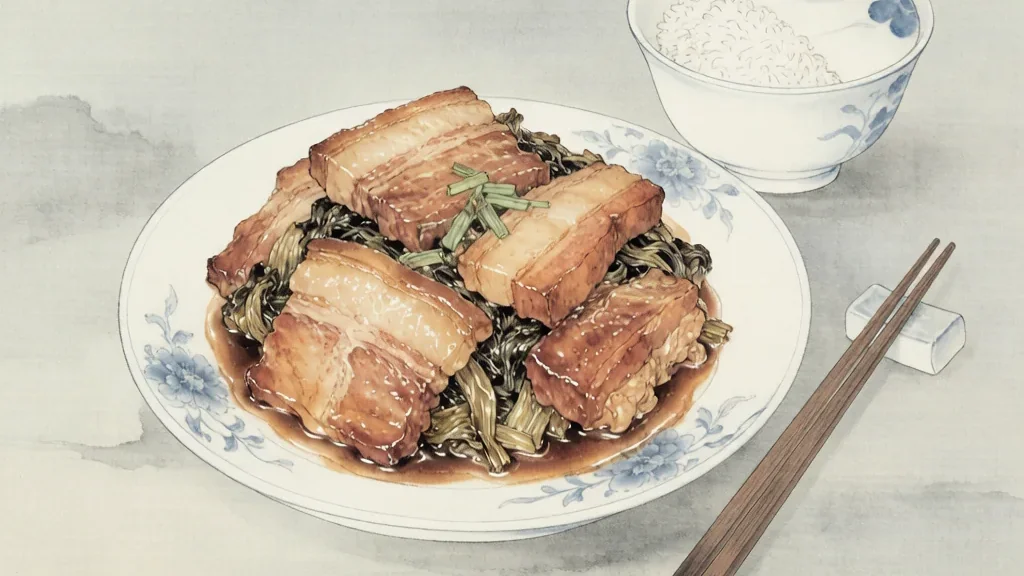
Meicai kourou (梅菜扣肉), often translated as "steamed pork with preserved mustard greens," is one of the most beloved braised dishes of southern Chinese home cooking and a near-mandatory centerpiece of the Lunar New Year table in Hakka and Cantonese households. The dish pairs thick slabs of pork belly with meicai—a salted, sun-dried leaf mustard that has been fermented into a deep, savory black-green preserve—then steams the two together for hours until the fat turns translucent and the meat nearly melts. Its layered, inverted presentation and its association with reunion feasts have made it a symbol of prosperity and togetherness, while its long shelf life once made it a practical way to carry flavor far from home.
Origins in Hakka Culinary Tradition
The dish is most often traced to the Hakka (客家), the "guest people" who migrated southward through China over many centuries and developed a cuisine built on preservation, thrift, and deep savory flavor. Meicai itself is strongly associated with Huizhou and Meizhou in Guangdong, where leaf mustard was harvested, salted, and pressed dry in the sun to survive lean seasons. Pork belly, the fatty cut that poorer households could afford and that rewards slow cooking, became its natural partner.
Hakka cooking prizes dishes that can be prepared ahead and reheated without losing quality, and meicai kourou fits that logic perfectly. A cook could assemble the bowl, steam it gently, and set it aside; the flavors only improved on the second or third reheating, which suited the long, multi-day rhythm of a New Year celebration.
The Making of Meicai
Meicai (梅菜) begins as a specific variety of leaf mustard grown through the cool season. After harvesting, the leaves are washed, blanched or wilted, heavily salted, and then spread out to dry repeatedly under the sun. Over days the chlorophyll breaks down and a controlled fermentation develops the characteristic dark color and pungent, almost smoky umami. Some regional versions add soy or spices during curing.
Good meicai is never simply salty; it carries a rounded, slightly sweet savoriness that cuts through pork fat. Before cooking, the preserve is rinsed and sometimes briefly soaked to tame its salinity, then chopped and often stir-fried with aromatics such as ginger, garlic, and a little sugar to build a fragrant bed for the meat.
Preparing the Pork Belly
The pork component starts as a single, unrolled slab of belly with the skin on. Cooks typically blanch it to clean the meat, then fry or sear the skin side in hot oil until it bubbles and browns—a step that helps the skin turn gelatinous and glossy after steaming. A coat of dark soy or maltose sometimes darkens the surface.
Once cooled, the belly is sliced into thick, even pieces, each showing the clean alternation of fat and lean. These slices are stood on edge, skin down, around the inside of a deep bowl, then packed with the prepared meicai. The arrangement matters: when the bowl is inverted onto a plate at the table, the glossy meat fans out over a mound of fragrant greens.
The Long Steam
What transforms the dish is time. The assembled bowl is steamed—traditionally over a wok, sometimes for two hours or more—so the pork collagen breaks down and the fat renders into the greens below. The meicai absorbs the rendered pork fat and its own salt, becoming richer, while the meat absorbs the greens' earthy savor.
Because the bowl is covered, the pork essentially braises in its own juices and steam rather than in added liquid. The result is a dish that is intensely savory yet not greasy, with a texture that yields to a chopstick. Many families steam it a day ahead and re-steam it before serving, a practice that deepens the flavor.
Symbolism on the Festival Table
During Spring Festival, meicai kourou is more than food. The round, stacked presentation recalls coins and abundance, and the pork's fat—once a sign of wealth—reads as good fortune. Serving it to visiting relatives affirms hospitality and continuity with ancestral practice.
In Hakka and Cantonese diaspora communities, the dish anchors the reunion dinner (团年饭) alongside dishes whose names pun on luck and prosperity. Its make-ahead nature is also practical: a host can present an impressive centerpiece without cooking at the moment guests arrive.
Regional and Family Variations
While Guangdong styles dominate the popular image, neighboring Jiangxi and Fujian have their own preserved-mustard-and-pork braises, and the seasoning shifts from household to household. Some cooks add fermented black beans, dried shrimp, or a splash of rice wine; others press the greens with a little rock sugar to balance bitterness.
In Meizhou, the recognized homeland of Hakka culture, local meicai is prized and protected as a regional specialty, and tourist kitchens demonstrate the traditional sun-drying yards. The dish thus travels between humble home cooking and localized pride in a distinctive agricultural product.
Serving and Eating
Meicai kourou is almost always served hot, turned out of its bowl so the meat faces up. It is eaten with plain steamed rice, which soaks up the concentrated juices, and it is rich enough that a single bowl feeds several people as one of many shared dishes.
Because it is fatty and dense, it is typically balanced on the table by lighter vegetable dishes, a clear soup, and perhaps a plate of preserved vegetables. The greens at the bottom are often the most sought-after part, having collected the pork's rendered flavor during the long steam.
Preservation Logic and Modern Life
The dish's logic is preservation: salted greens and fatty pork both keep well, and steaming sterilizes and tenderizes. Before refrigeration, this combination let families enjoy meat flavor long after slaughter season and fed travelers on migration routes.
Today the dish survives as comfort food and festival ritual rather than necessity. Vacuum-sealed prepared versions and restaurant banquet menus keep it visible, but the homemade bowl—assembled by an elder and steamed while the family gathers—remains the cultural ideal. It is a dish that tastes of both thrift and celebration.
Nutrition and Contemporary Taste
Modern diners often note the dish's richness, and nutrition-conscious cooks trim the belly, reduce salt, or pair smaller portions with more vegetables. Still, its appeal lies precisely in indulgence reserved for special occasions, which is part of why it reads as festive rather than everyday.
Chefs experimenting with the canon sometimes deconstruct it—serving the pork as a refined cube beside a purée of meicai—but the classic inverted bowl endures. For most families, the measure of a good meicai kourou is simply whether the meat "melts" and the greens have taken on the pork's soul.
❓ Frequently Asked Questions
What is meicai kourou?
It is a southern Chinese dish of pork belly steamed with salted, sun-dried leaf mustard (meicai), traditionally inverted from a bowl so the meat fans over the greens.
Is it a Hakka dish?
It is strongly associated with Hakka cuisine of Guangdong and with Meizhou in particular, though similar preserved-vegetable pork braises exist across several southern provinces.
Why is it served at New Year?
Its rich, layered presentation symbolizes abundance and prosperity, and it can be made ahead and reheated, suiting the multi-day festival.
Is meicai very salty?
It is a salted preserve, but cooks rinse and sometimes soak it before use and balance it with sugar and aromatics, so the finished dish is savory rather than sharply salty.
Can it be made less rich?
Yes; many modern cooks use a leaner cut, reduce oil, and serve smaller portions with vegetables, though the classic version is meant as an occasional indulgence.
How do you eat it?
Serve it hot over steamed rice, scooping the meat and the flavorful greens together; it is shared as one of several dishes on the table.