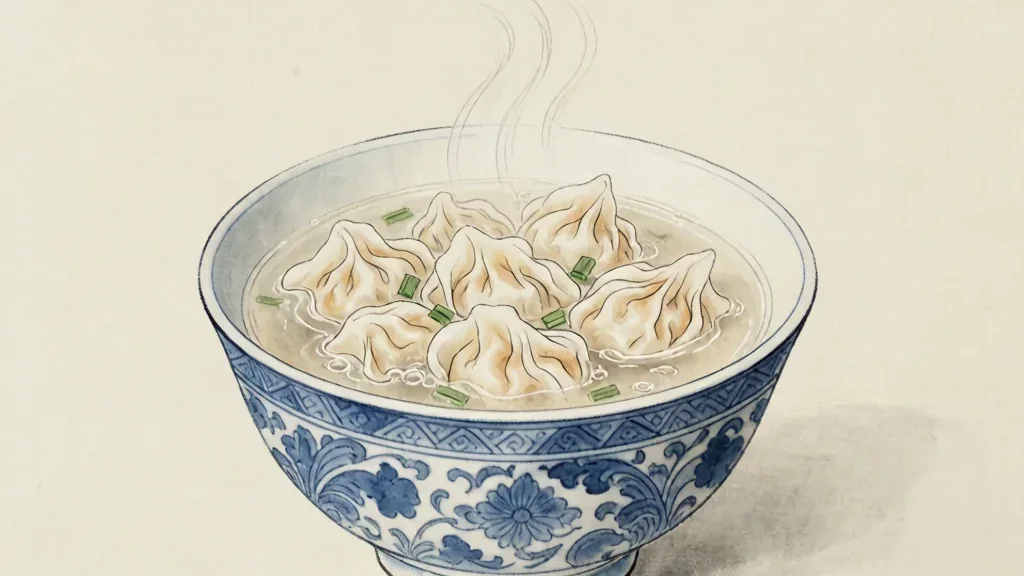
Shaped like a tiny envelope and named for the "swallowing of clouds," the 馄饨 () is one of China's most ancient and adaptable foods. Western menus usually call it a "wonton," but that word barely captures the range: a delicate dumpling of thin dough wrapped around a small filling, served in clear broth, dry with sauce, or fried to a crisp. Across regions the wonton changes shape, size, and seasoning, yet it always keeps its essential lightness. Few dishes illustrate China's genius for wrapping and soup as elegantly as this little "swimming dumpling."
Wonton, Huntun, and the Cloud Name
The name 馄饨 is thought to echo an old word for "chaos" or "formlessness," and folk etymology links it to clouds (云, ) because the wrapped dumpling floats like a cloud in broth. Unlike a jiaozi, a wonton uses a much thinner square of dough and a smaller filling, so the wrapper becomes a noticeable, silky part of the bite rather than a thick skin.
Historically the wonton predates many filled dumplings, appearing in records from the Han dynasty onward. It was originally a food for the winter solstice and later a year-round street snack. The thin wrapper demands care: too much filling and it bursts; too little and it tastes of mere dough. Master wrappers fold a single square around a dab of pork in two or three deft moves, producing dozens per minute.
Regional Styles of Wonton
In Cantonese cuisine, 云吞 () are plump, filled with shrimp and pork, and served in a clear pork-and-shrimp broth with thin egg noodles — the famous wonton noodle soup. The wrappers are often tinted yellow with egg. Sichuan offers 红油抄手 (), "red oil copied hands," drowned in a spicy, numbing chili-and-Sichuan-pepper sauce rather than broth.
Shanghai and the Yangtze region favor smaller wontons, sometimes with a tiny shrimp or just pork, served in a light soup with scallion. Northern styles can be larger and heartier, occasionally filled with beef. The variety shows how one template — wrapper plus filling plus serving liquid — supports completely different eating experiences from region to region.
Broth, Sauce, and Frying
Most wontons begin in broth. A good wonton soup broth is clear and savory, often made from pork bones, dried shrimp, and sometimes a little ginger, simmered until clean-tasting rather than cloudy. The wontons cook directly in the broth for two or three minutes, then arrive with a scatter of chopped scallion and a drop of sesame oil.
Dry and fried versions broaden the appeal. Sichuan red-oil wontons are a meal of contrasting textures — slippery wrapper, tender filling, fiery sauce. Fried wontons, popular as a dim sum or appetizer, turn the wrapper crisp and golden; they are dipped in sweet-and-sour or chili sauce. Each method showcases a different face of the same humble parcel.
How Wontons Are Wrapped
Wrapping a wonton is quicker than folding a jiaozi. A small ball of filling sits in the center of a thin square wrapper. The cook can simply bring two opposite corners together and pinch, or fold the square into a triangle and then curl the ends. Cantonese "shrimp wontons" are often tied in a loose bundle that traps broth inside. The goal is a tight seal so the filling stays put during cooking.
Because the dough is thin, wontons cook almost instantly and are best fresh. Home cooks often buy ready-made squares, but making the dough from egg and flour yields a superior, more elastic wrapper. A dusting of cornstarch between layers prevents sticking, and a tray of neatly folded wontons ready for the pot is a common sight in Chinese kitchens at festival time.
Wonton in Festivals and Daily Life
Historically, wontons were eaten at the winter solstice, a time when warm, round foods symbolized the closing of the year and the return of longer days. Today they are an everyday comfort: a late-night bowl at a noodle shop, a quick lunch, or a soothing meal for someone feeling unwell. The light broth is easy on the stomach, which is why wonton soup is a go-to remedy food.
In Hong Kong and Guangdong, the wonton noodle shop is a cultural institution, with decades-old establishments famous for their shrimp filling and springy noodles. Eating there is a ritual of efficiency and craft — order, watch the wontons drop into the boiling pot, and receive a steaming bowl within minutes. It is fast food elevated by skill.
Nutrition and Modern Takes
A bowl of wonton soup is relatively light: the thin wrapper means less dough than a wheat noodle or bun, and the broth adds hydration and warmth with modest calories. Shrimp-and-pork fillings provide lean protein. Of course, fried or heavily sauced versions add fat and heat, so the cooking method matters.
Modern variations include chicken or vegetarian fillings, gluten-free wrappers, and even fusion wontons with cheese or kimchi. Yet the classic remains best: a clear broth, a delicate wrapper, and a small, flavorful filling. The wonton proves that small things, made with care, can deliver outsized comfort — a cloud you can hold in a spoon.
Wonton in the Winter Solstice Tradition
Long before it became an everyday noodle-shop item, the wonton was a food of the winter solstice. Round, warm, and easy to swallow, it fit the season's logic of closing the year and welcoming the return of light, much like tangyuan and dumplings did elsewhere. Historical records note wontons eaten on this day as a comforting, auspicious bite. The custom has faded in cities, but in some regions the association lingers, and the wonton's rounded form still reads as a small symbol of completeness. Knowing this older role adds a layer to the humble bowl: what looks like a quick snack was once a seasonal ritual, a warm circle eaten at the cold turning point of the year.
The Cantonese Wonton Noodle Shop
In Hong Kong and Guangdong, the wonton noodle shop is a beloved institution built on two skills: a springy, thin egg noodle and a shrimp-and-pork wonton with a delicate, yielding wrapper. The best broth is clear and clean-tasting, simmered from pork bones and dried shrimp, never cloudy. A proper bowl arrives within minutes, order, watch the wontons drop, eat, a model of fast food elevated by craft. Decades-old shops guard their recipes and noodle-making methods, and a great bowl is a point of neighborhood pride. For locals it is breakfast, lunch, late-night remedy, and comfort all at once, and for visitors it is one of the purest tastes of southern Chinese street perfection.
❓ Frequently Asked Questions
📝 Chinese Vocabulary
馄饨 — : wonton, a thin-skinned dumpling.
云吞 — : Cantonese wonton.
红油抄手 — : Sichuan red-oil wontons.
云 — : cloud.
汤 — : soup or broth.
抄手 — : The Sichuan name for wonton, as in red-oil chaoshou.
虾 — : Shrimp, the key filling in Cantonese wonton.
猪肉 — : Pork, the common meat filling in wontons.
🎉 Fun Facts
- The name huntun is playfully linked to "clouds" because the dumplings float like clouds in soup.
- Wontons were historically eaten at the winter solstice as a warm, round symbol of the year's turning.
- Cantonese wonton noodle shops in Hong Kong are celebrated cultural institutions with century-old recipes.
- A skilled wrapper can fold dozens of wontons per minute thanks to the simple square wrapper.
- In Sichuan, red-oil chaoshou is often eaten as a late-night snack or banquet opener, and the sauce recipe of chili oil, sesame, soy, and vinegar is a point of family pride.
- A well-made Cantonese wonton should float and turn translucent when cooked, a quick visual cue that the thin wrapper and shrimp filling are done just right.