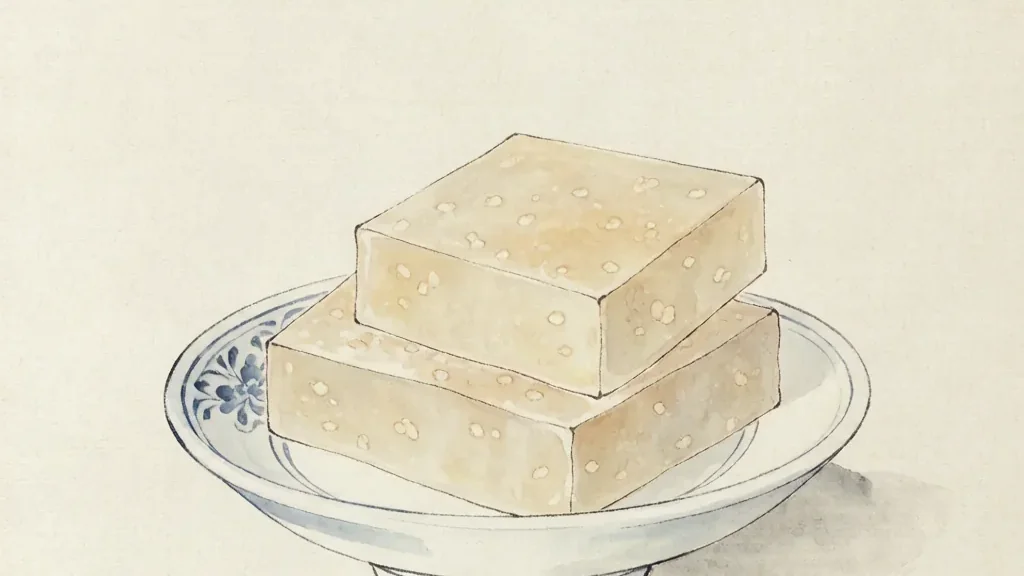
In the kitchen of a Chinese home preparing for New Year, amid the flurry of dumpling wrapping and fish scaling, sits a humble slab that seems almost too simple for its importance. It's pale, dense, and slightly translucent — a cake made from nothing more than glutinous rice flour, sugar, and water, steamed until it becomes something between a solid and a gel. This is nian gao, the New Year cake whose name contains a wish so powerful that eating it feels like swallowing a promise.
The Sweetest Pun in Chinese Cuisine
The genius of nian gao lies in its name, a linguistic double meaning that captures the Chinese love of wordplay and auspicious symbolism. The characters 年糕 (nián gāo) literally mean "year cake." But pronounce them slightly differently — 年高 (nián gāo), meaning "year high" — and the humble cake transforms into a wish for elevation and advancement. The most common New Year greeting involving nian gao is "年年高升" (nián nián gāo shēng): "May you rise higher with each passing year."
This is no mere pun — it's a philosophy baked into food. When a child receives a piece of nian gao from their elders on New Year's morning, they are not just being fed. They are being given a blessing: may your grades rise, may your career ascend, may your life trajectory point ever upward. The sticky, chewy texture of the cake reinforces the message — it "sticks" good fortune to you, preventing it from slipping away.
The tradition stretches back at least 1,500 years to the Northern and Southern Dynasties period, when historical texts first mention a glutinous rice cake offered during the New Year. Over the centuries, nian gao evolved from a simple offering to the Kitchen God — meant to sweeten his lips so he would give a favorable report to the Jade Emperor — into the beloved holiday staple it is today.
From Batter to Blessing: How Nian Gao Is Made
The making of nian gao is a study in patience and transformation. Unlike Western cakes that rise through chemical leaveners or whipped eggs, nian gao achieves its distinctive texture through the unique properties of glutinous rice flour. When this flour is mixed with liquid and heated, the starch molecules absorb water and swell, creating a dense, chewy, almost rubbery texture that the Chinese describe as "Q" — a springy resistance between the teeth that is immensely satisfying.
The traditional method begins with soaking glutinous rice overnight, then grinding it into a fine paste using a stone mill. Modern home cooks typically use commercially produced glutinous rice flour, which produces equally good results with far less effort. The flour is mixed with water and sugar — brown sugar slabs that must be dissolved first, lending a caramel-like depth that white sugar cannot match — to form a thick batter. This batter is poured into a round cake tin and steamed for hours until it sets into a firm, glossy mass.
Fresh from the steamer, nian gao is almost too soft to handle, a wobbly disk that threatens to collapse under its own weight. But as it cools, it firms into a sliceable cake that can be stored for weeks. This longevity was crucial in the days before refrigeration — nian gao made before the New Year could last through the entire Spring Festival period, providing sustenance during the days when markets were closed and cooking was minimized.
The Great Divide: Sweet vs. Savory Nian Gao
In southern China, particularly Shanghai, nian gao undergoes a dramatic transformation into a savory dish. Shanghai-style stir-fried nian gao (上海炒年糕) is comfort food of the highest order — sliced rice cakes tossed in a screaming-hot wok with shredded pork, Napa cabbage, and a savory sauce of soy sauce and Shaoxing wine. The rice cake slices absorb the flavors while retaining their signature chewiness.
In Korea, this savory approach finds its parallel in tteokbokki, the beloved street food of rice cakes simmered in spicy gochujang sauce. Both descend from the ancient East Asian tradition of pounding and steaming glutinous rice into cakes — a reminder that food traditions migrate and transform across borders.
Regional Variations and the Kitchen God
Travel through China during New Year, and nian gao takes many forms. Guangdong enriches the cake with coconut milk for tropical fragrance and a creamier texture. Fujian incorporates taro for a nutty flavor and lavender tint. Northern China uses millet instead of rice, studded with jujubes. Leftover sweet nian gao is often sliced, dipped in egg, and pan-fried until the exterior crisps while the interior softens into a molten, stretchy center.
Nian gao also plays a starring role with the Kitchen God (灶神). On the 23rd day of the 12th lunar month, the Kitchen God ascends to heaven to deliver his annual report. Families offer him nian gao — its stickiness is meant to sweeten his mouth or literally seal his lips so he cannot speak ill of the household. Every year, as the cake steams and the house fills with its sweet fragrance, families participate in a ritual connecting them to centuries of ancestors who performed the same act, speaking the same wish: may this year be higher than the last.
Storing and Serving Nian Gao
One reason nian gao suits the New Year is its remarkable keeping quality. A freshly steamed cake is soft and almost too moist to slice, but as it cools it firms into a loaf that can sit for weeks without spoiling, a real advantage in the days when markets closed for the holiday. Families slice it as needed, often pan-frying the pieces so the outside crisps while the inside turns chewy and stretchy. The cake is usually served at room temperature or gently warmed, never drowned in sauce, so its subtle brown-sugar sweetness comes through. Because it stores so well, nian gao became both a festive centerpiece and a practical pantry food, sustaining households through the long Spring Festival break and symbolizing abundance that lasts.
The Art of Stir-Fried Nian Gao
The savory Shanghai style transforms the same rice cake into a quick wok dish. Sliced nian gao is dropped into a screaming-hot wok with shredded pork, napa cabbage, scallion, and a splash of soy and Shaoxing wine, then tossed just until the slices soften and drink up the sauce. The skill lies in timing: the rice cake must turn tender without dissolving into mush, so the slices are added late and moved constantly. The result is chewy, savory, and deeply comforting, a weeknight meal as much as a holiday one. Unlike the sweet steamed cake, stir-fried nian gao shows the ingredient's savory potential, proving that one humble rice cake can speak two completely different culinary dialects.
Nian Gao's Cousins Across Asia
China is not alone in pounding and steaming glutinous rice into celebratory cakes. In Korea, tteok forms the basis of tteokbokki, rice cakes simmered in spicy gochujang sauce, while Japan's mochi and Southeast Asia's myriad sticky rice cakes share the same ancestral technique. These foods all rely on the springy, sticky quality of glutinous rice and often carry festive or auspicious meaning, much like nian gao's wish for a rising year. The family resemblance reveals how a single food idea migrated and transformed across East and Southeast Asia. Eating nian gao thus connects a Chinese New Year table to a much older, wider tradition of sticky rice celebration that spans many languages and borders.
Nian Gao in Modern Celebration
In contemporary China, nian gao has kept its festive role while gaining modern convenience. Supermarkets sell pre-sliced, vacuum-packed cakes that microwave in minutes, and gift boxes of elaborately molded nian gao circulate as New Year presents. Creative flavors, taro, cheese, even chocolate-filled, appear alongside the traditional brown-sugar version, aimed at younger eaters. Yet the symbolism endures: the cake is still offered to elders, set on altars, and spoken of with the wish that each year rise higher than the last. The food has adapted to busy urban life without losing its core message. Whether handmade in a village or bought in a city supermarket, nian gao remains a small, sweet promise carried from one generation to the next.
❓ Frequently Asked Questions
📝 Chinese Vocabulary
- 年糕 (niángāo) — New Year glutinous rice cake; a homophone for "year high"
- 年年高升 (nián nián gāo shēng) — "May you rise higher each year," the blessing associated with nian gao
- 灶神 (Zào Shén) — The Kitchen God, who receives offerings of nian gao before reporting to heaven
- 炒年糕 (chǎo niángāo) — Stir-fried nian gao, the savory Shanghai-style preparation
- 糯米 (nuòmǐ) — Glutinous rice, the essential ingredient in nian gao
🎉 Fun Facts
- In some Chinese villages, nian gao was traditionally made in enormous batches — one recorded cake from Zhejiang province weighed over 500 pounds and required a team of strong men to lift it into the steamer.
- The Chinese word for "cake" (糕, gāo) is homophonous with "tall" or "high" (高, gāo) in dozens of food names — radish cake (萝卜糕), taro cake (芋头糕), and water chestnut cake (马蹄糕) all carry wishes for advancement.
- Nian gao is one of the few Chinese festival foods that appears in both sweet and savory forms with completely different cultural meanings — the sweet version for New Year wishes, the savory stir-fried version for everyday comfort.
- In many families, a whole nian gao is given as a New Year gift wrapped in red paper, symbolizing the wish that the recipient's year will rise.
- Because nian gao is so dense and sticky, it is traditionally cut with a soaked thread or a very sharp knife rather than a dull blade, which would tear it.
- The savory Shanghai version is often cooked with napa cabbage and sliced pork, and the rice cake absorbs the savory sauce while staying chewy.