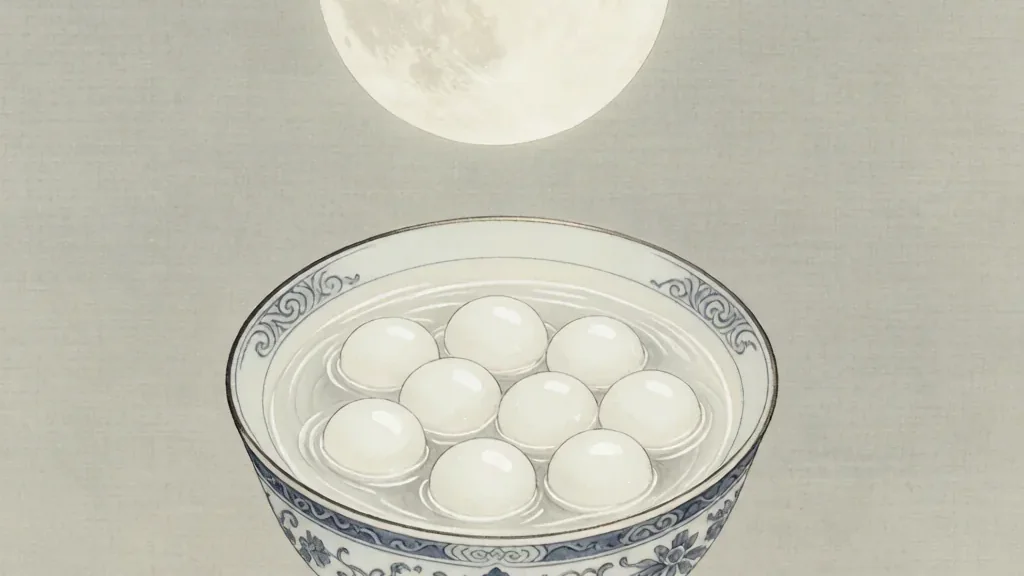
Picture a porcelain bowl filled with a clear, faintly sweet soup, floating within it a cluster of pristine white spheres. As your spoon breaks through the tender, chewy exterior, a river of molten black sesame paste flows out, filling the air with its nutty, caramelized fragrance. This is tangyuan — perhaps the most poetic food in all of Chinese cuisine, where shape itself becomes a philosophy and sweetness carries the weight of a thousand reunions.
Yuanxiao or Tangyuan? The Great Name Debate
Before we dive into the steaming bowl, let's clear up a confusion that has puzzled even native Chinese speakers for generations. In northern China, these glutinous rice balls are called yuanxiao (元宵); in the south, they're tangyuan (汤圆). The difference is not merely linguistic — it's a matter of production method, texture, and cultural identity.
Northern yuanxiao are made by a fascinating process that resembles panning for gold. The filling — typically a firm cube of solidified sesame paste, red bean, or crushed peanuts — is repeatedly tossed in a basket filled with dry glutinous rice flour, with occasional spritzes of water to build up layers. Each toss adds another dusting of flour, creating a slightly uneven, rustic sphere with a denser, chewier texture. Southern tangyuan, by contrast, are wrapped like tiny dumplings: a dough made from glutinous rice flour and water is kneaded into a smooth skin, then wrapped around a softer filling and rolled into a perfect ball.
The result? Northern yuanxiao are hearty, substantial, and release their filling in a dramatic burst when bitten. Southern tangyuan are silkier, more delicate, with a thinner skin that melts on the tongue. Both are delicious. Both are correct. And both represent the beautiful regional diversity that makes Chinese cuisine endlessly fascinating.
The Festival of Lanterns and Light
Tangyuan's most sacred occasion is the Lantern Festival (元宵节, Yuánxiāo Jié), which falls on the fifteenth day of the first lunar month — the first full moon of the New Year. This festival marks the official end of the Spring Festival celebrations, and it's a night of breathtaking beauty: thousands of lanterns illuminate streets and parks, riddles written on slips of paper challenge the clever, and lion dances shake the ground with drums and cymbals.
The roundness of tangyuan mirrors the roundness of the full moon overhead, and both symbolize the same thing: tuányuán (团圆), the Chinese ideal of family togetherness and completeness. The very word "tangyuan" is a near-homophone for "tuányuán," embedding the concept of reunion into the food's name. When a family gathers to eat tangyuan on Lantern Festival night, they are not merely sharing dessert — they are performing an act of cosmic alignment, bringing their own small circle into harmony with the great circle of the moon.
The tradition dates back to the Song Dynasty (960–1279 CE), when a sweet dumpling called "fúyuánzi" gained popularity in the imperial court. A scholar named Zhou Mi recorded that people in the capital would "make flour balls with sweet fillings and boil them in water" during the Lantern Festival. Over the centuries, this imperial delicacy trickled down to common households, evolving into the tangyuan we know today.
A Tale of Two Flavors: Sweet vs. Savory
The sweet tangyuan is the undisputed champion of the dessert world. Black sesame paste, made by grinding toasted black sesame seeds with lard and sugar until they form a glossy, intensely aromatic filling, is the most iconic. When the tangyuan is boiled, the lard melts, creating that legendary lava-like flow. Red bean paste offers a gentler sweetness, its earthy notes complementing the neutral canvas of the glutinous rice. Peanut and walnut variations bring their own nutty dimensions to the experience.
But here's where things get interesting — and where many Western food lovers are caught off guard. In many regions of China, particularly in Shanghai and the Yangtze River Delta, tangyuan go savory. These are not the same delicate spheres floating in clear soup, but substantial parcels filled with minced pork, finely chopped vegetables, and sometimes a whisper of Shaoxing wine. The dough is the same, but the experience is entirely different — more like a tender meatball wrapped in a chewy cocoon, swimming in a broth made from the very water that cooked them.
Some families prepare both sweet and savory versions on the same night, eating the savory ones first as part of the main meal, then the sweet ones as dessert. Others take sides in a friendly culinary civil war, with savory loyalists insisting their version is more sophisticated and sweet devotees countering that only sweetness can capture the joy of reunion.
Colors, Shapes, and Creative Variations
Traditional tangyuan are snowy white, but modern kitchens embrace natural colorings: purple sweet potato for violet, matcha for jade green, pumpkin for golden glow. Some southern regions shape tangyuan into small animals — fish for abundance, rabbits for the moon. The soup itself is often lightly sweetened with rock sugar and perfumed with osmanthus flowers, those tiny golden blossoms that smell of apricots and honey. Fermented glutinous rice (jiǔniàng) adds a gentle warmth, while ginger-infused syrup cuts through the richness.
Beyond the Lantern Festival
While the Lantern Festival remains tangyuan's starring moment, these glutinous rice balls appear at weddings to symbolize a "round" and harmonious marriage, and during the Winter Solstice to mark the turning of the year. There's a saying: "After eating tangyuan, you are one year older." In some regions, the Lantern Festival — not the birthday — once marked the advancement of age.
In the end, tangyuan teaches something profound about Chinese food philosophy. The ingredients are humble — glutinous rice flour, water, sesame seeds. Yet through tradition, they become vessels for the deepest human longing: the desire to be together, to be whole, to be complete. Every sphere is a small prayer for reunion, every bowl a miniature universe where family orbits around the table like planets around a star.
The Craft of the Filling
The magic of a sweet tangyuan is its molten center, and making it is a small craft. Black sesame seeds are toasted until fragrant, then ground with sugar and a little pork fat or oil into a glossy paste that melts into liquid when heated. Red bean filling is cooked down slowly to a smooth, earthy sweetness, while peanut and walnut versions add their own nutty depth. The key is balancing moisture so the filling stays soft enough to pipe yet firm enough to wrap. When the ball is boiled, the fat melts and the center becomes a warm, flowing sauce that spills on the first bite. This hidden lava is what makes tangyuan feel like a tiny, edible surprise rather than a plain rice dumpling.
Tangyuan in the Diaspora and Modern Life
For Chinese communities abroad, tangyuan is a portable piece of home. Lunar New Year and Lantern Festival events at temples and community centers often end with a shared bowl, and Asian supermarkets stock frozen versions year-round for quick cooking. Modern makers tint the skins with sweet potato, matcha, or pumpkin, and some venues serve tangyuan in warm ginger syrup or even in a cocktail for adults. Yet the core meaning travels intact: the round ball still stands for reunion and completeness, wherever the table happens to be. Whether handmade by an overseas grandmother or microwaved from a package, tangyuan carries the same quiet wish for family togetherness across any distance.
Tangyuan at the Winter Solstice and Weddings
Beyond the Lantern Festival, tangyuan marks other turning points. At the Winter Solstice, families eat them to mark the year's longest night and the return of lengthening days, with a saying that eating tangyuan makes you one year older. At weddings, sweet tangyuan symbolize a round, harmonious marriage and are served to wish the couple unity. The same humble rice ball thus carries wishes for growth, reunion, and partnership at life's hinges. Its presence at both solemn and joyful moments shows how a simple food can hold a great deal of meaning, turning an ordinary dessert into a small, shared prayer for a whole and happy life.
❓ Frequently Asked Questions
📝 Chinese Vocabulary
- 汤圆 (tāngyuán) — Glutinous rice balls in soup; the southern term
- 元宵 (yuánxiāo) — Glutinous rice balls; the northern term, also the name of the Lantern Festival
- 团圆 (tuányuán) — Family reunion; a near-homophone of tangyuan
- 桂花 (guìhuā) — Osmanthus flowers, often used to perfume tangyuan soup
- 酒酿 (jiǔniàng) — Fermented glutinous rice, sometimes added to tangyuan soup for warmth
🎉 Fun Facts
- In 2020, a restaurant in Chengdu created a giant tangyuan weighing over 2,200 pounds to celebrate the Lantern Festival — it required a crane to lift it into the cooking pot.
- During the Ming Dynasty, tangyuan were sometimes called "yuán xiāo" after the festival, but one emperor renamed them because "yuán xiāo" sounded like "yuán xiāo" (袁消), meaning "the elimination of Yuan" — his own surname.
- The world record for the most tangyuan eaten in three minutes is held by a man from Sichuan who consumed 42 glutinous rice balls — a feat that would challenge even the most stretchable stomach.
- In the Yangtze Delta, savory tangyuan filled with pork and vegetables are a normal main-course option, not a novelty, showing how one food spans sweet and savory across China.
- Families often make tangyuan together on Lantern Festival eve, and the round shape is pointed out to children as a symbol of the whole family sitting in a circle.
- Because tangyuan are slippery and round, some regions have a playful riddle tradition at Lantern Festival where guessing the filling is part of the fun.