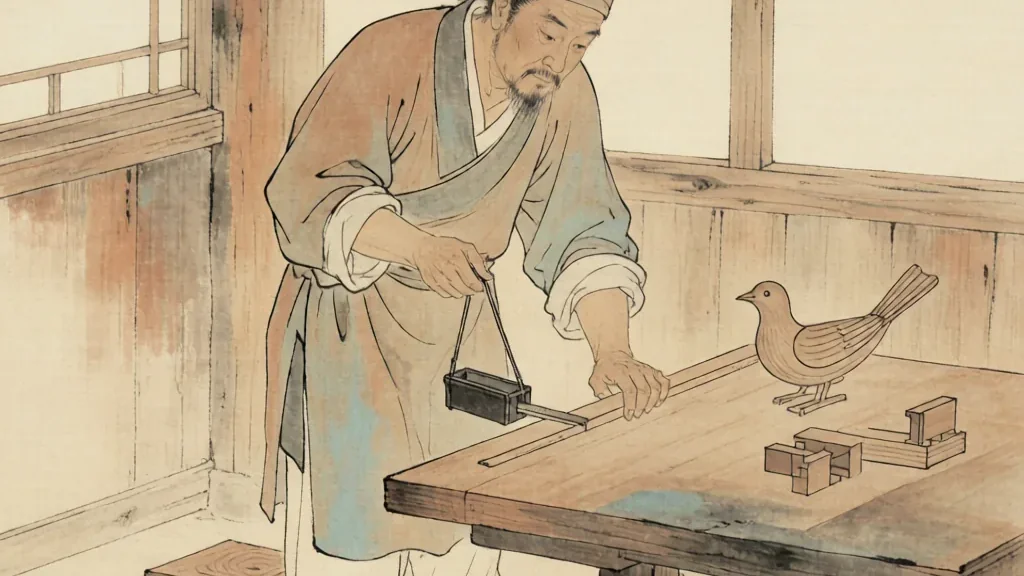
In every carpenter's workshop across China, you will find a small shrine or at least a whispered prayer before a difficult job begins. The recipient of this reverence is not a god of mythology but a mortal craftsman who lived during the Spring and Autumn Period: Lu Ban, the undisputed patron saint of Chinese builders, carpenters, and inventors. For over two and a half millennia, his name has been synonymous with craftsmanship, ingenuity, and the transformative power of practical invention.
Lu Ban occupies a unique position in Chinese cultural history. Unlike the philosophers and poets whose words filled ancient scrolls, Lu Ban's legacy is written in wood and stone, in the joints of a thousand-year-old pagoda and the graceful curve of a temple roof. He represents a tradition often overlooked in histories that favor the brush over the chisel: the tradition of the maker, the builder, the person who solves problems not with abstract reasoning but with calloused hands and a mind attuned to the physical world. His inventions—many of which remain in use today—touched every aspect of Chinese life, from the houses people lived in to the tools they used, from the bridges they crossed to the locks that secured their doors.
The Craftsman of Lu
Lu Ban was born Gongshu Ban around 507 BCE in the state of Lu, from which his common name is derived—"Ban of Lu." His family were artisans, and from his earliest years, young Gongshu was immersed in the world of tools, materials, and construction techniques. According to traditional accounts, he showed extraordinary aptitude for making things with his hands, demonstrating a natural understanding of mechanics and materials that surpassed his teachers.
The Spring and Autumn Period in which Lu Ban lived was an age of intense competition among the feudal states. Warfare was constant, cities were expanding, and the demand for skilled craftsmen was enormous. Fortifications needed to be built, siege engines designed, palaces constructed, and agricultural implements improved. It was an environment that rewarded practical innovation, and Lu Ban rose to the challenge with a series of inventions that would transform Chinese technology.
What distinguished Lu Ban from other craftsmen of his era was not merely his skill but his approach to problem-solving. The legends surrounding his inventions consistently portray him as an acute observer of nature who drew inspiration from the world around him. A leaf with serrated edges cutting his finger led to the saw. A mother bird feeding her young through a hole in a fence inspired the wedge and mortise joint. This ability to learn from nature and translate natural principles into practical tools made Lu Ban not just a craftsman but a proto-scientist—someone who understood that the physical world operated according to discoverable rules.
The Invention of the Saw and Other Tools
The most famous story about Lu Ban concerns the invention of the saw. According to legend, Lu Ban was working on a construction project for the king of Lu, tasked with cutting large quantities of timber. The work was slow and exhausting, with laborers using axes to fell trees and chop wood to size. One day, while climbing a hillside, Lu Ban's hand brushed against a blade of grass with serrated edges, cutting his skin. Examining the leaf closely, he noticed the tiny teeth along its margin and suddenly understood: a tool with similar teeth could cut through wood far more efficiently than a smooth blade.
Inspired by this observation, Lu Ban forged a strip of iron with teeth along one edge, creating the first saw. The tool revolutionized woodworking, allowing craftsmen to cut wood with precision and speed that had been impossible before. While archaeologists now know that saws existed in various forms long before Lu Ban's time—copper saws have been found in Egyptian tombs dating to 3000 BCE—the legend captures an essential truth about Lu Ban's contribution: he systematized and improved existing technologies, turning crude implements into refined, effective tools that could be widely adopted.
The saw was far from Lu Ban's only invention. He is credited with creating the carpenter's square (曲尺, qūchǐ), the ink marker or "ink fountain" (墨斗, mòdǒu) used for snapping straight lines on wood, the hand plane (刨子, bàozi) for smoothing surfaces, and the drill (钻, zuàn) for boring holes. Together, these tools formed the basic toolkit of the Chinese carpenter—a toolkit that remained essentially unchanged until the introduction of power tools in the 20th century. The ink marker, in particular, became a symbol of the carpenter's craft: a small pot of ink with a string that, when pulled taut and snapped against a surface, leaves a perfectly straight line. To this day, carpenters in China and across East Asia use tools that Lu Ban would instantly recognize.
Military Engineering and the Cloud Ladder
Lu Ban's talents extended beyond peaceful construction into the realm of military engineering, where he became equally legendary. The state of Chu, a powerful kingdom that was Lu's neighbor, recruited him to design siege weapons for their campaign against the state of Song. Lu Ban responded by creating a series of innovative war machines that transformed siege warfare.
His most famous military invention was the "cloud ladder" (云梯, yúntī)—a massive, mobile siege tower that could be wheeled up to enemy walls, allowing attackers to scale fortifications that had previously been impregnable. The cloud ladder was an engineering marvel of its time: tall enough to reach the top of city walls, sturdy enough to support armed soldiers, yet mobile enough to be positioned quickly during an assault. It gave the state of Chu a decisive advantage in siege warfare and demonstrated that Lu Ban's ingenuity could be turned to destructive as well as constructive purposes.
According to a famous story preserved in the Mohist text Mozi, Lu Ban's military inventions nearly led to catastrophe. The philosopher Mozi, hearing that Chu planned to use Lu Ban's cloud ladders to attack Song, traveled for ten days and nights to intervene. In a dramatic confrontation before the King of Chu, Mozi demonstrated defensive countermeasures that could neutralize each of Lu Ban's siege weapons. When Lu Ban suggested killing Mozi to eliminate the opposition, Mozi revealed that he had already taught his defensive techniques to three hundred disciples stationed in Song. The King of Chu, realizing the attack would fail, abandoned the campaign. This encounter between two of ancient China's greatest technical minds—Lu Ban the inventor and Mozi the defender—remains one of the most compelling episodes in Chinese intellectual history, illustrating both the power and the peril of technological innovation.
Architecture Without Nails
Perhaps Lu Ban's most enduring contribution to Chinese culture lies in the architectural principles he developed, particularly the art of timber-frame construction using interlocking joints rather than metal fasteners. Chinese traditional architecture, with its sweeping roofs, elaborate bracket sets (斗拱, dǒugǒng), and intricate joinery, owes an enormous debt to the techniques Lu Ban pioneered.
The mortise-and-tenon joint (榫卯, sǔn mǎo), one of the fundamental techniques attributed to Lu Ban, allows two pieces of wood to be joined without nails or glue. The tenon (a projecting piece) fits precisely into the mortise (a corresponding cavity), creating a connection that is both strong and flexible—able to withstand earthquakes that would shatter rigid, nail-based construction. This technique, refined over centuries, is the reason that Chinese wooden structures can stand for over a thousand years, as demonstrated by the 67-meter-tall wooden pagoda of Yingxian, built in 1056 and still standing today.
The legendary Lu Ban Jing (鲁班经), or "Classic of Lu Ban"—a manual of carpentry and construction compiled centuries after his death—preserves many of the techniques and principles associated with his name. The book covers everything from the proportions of buildings to the selection of auspicious dates for construction, from the proper use of the carpenter's square to the rituals that should accompany the raising of a roof beam. For generations of Chinese craftsmen, the Lu Ban Jing was both a technical manual and a sacred text, passed down from master to apprentice as part of an oral and written tradition that connected each new generation to the legendary founder of their craft.
From Craftsman to Cultural Icon
Over the centuries, Lu Ban transcended his historical origins to become something more than a man. In Chinese folk religion, he is venerated as a deity—the God of Carpentry and Construction. Temples dedicated to Lu Ban can be found throughout China and across the Chinese diaspora, where craftsmen and builders offer incense and prayers before beginning major projects. His birthday, celebrated on the 13th day of the sixth lunar month, is a traditional holiday for those in the construction trades.
The Lu Ban Prize, established in 1987, is China's highest honor for construction engineering quality—essentially China's equivalent of architecture awards given in other countries. The Lu Ban lock (鲁班锁, Lǔbān suǒ), a three-dimensional interlocking puzzle made of wooden pieces that fit together without fasteners, has become a popular educational toy that teaches spatial reasoning and the principles of joinery. In modern Chinese, the phrase "brandishing an axe before Lu Ban's door" (班门弄斧, bān mén nòng fǔ) warns against showing off one's mediocre skills before a true master—a testament to how deeply his name is embedded in the language itself.
In an age of digital design and automated manufacturing, Lu Ban's legacy reminds us of the enduring value of hands-on craftsmanship. The tools he invented, the techniques he developed, and the philosophy of practical problem-solving he embodied remain relevant in a world where the relationship between maker and material is increasingly mediated by screens and software. As China's traditional timber-frame architecture gains recognition on the UNESCO Intangible Cultural Heritage list, the spirit of Lu Ban—observant, inventive, and deeply respectful of materials—continues to inspire new generations of makers, builders, and creators.
Lu Ban and the Builder's Guilds
Lu Ban's lasting power came not only from his inventions but from the communities of craftsmen who claimed him as founder. For centuries, Chinese carpenters, masons, and joiners organized themselves into guilds that met, trained apprentices, and set standards of work. These groups kept his name alive through ritual: before a major build they might offer incense and recite his deeds, asking for skill and safety. The guild system turned a historical engineer into a patron spirit who watched over every workshop. In this social form his influence was practical as well as symbolic, since the guilds were how techniques passed from master to apprentice and how a shared craft identity was maintained across regions and generations.
Lu Ban's Principles of Good Design
Behind the stories of single inventions lies a consistent philosophy of making. Lu Ban is remembered for tools and structures that fit their purpose with minimal waste: a joint that holds without nails, a square that makes every angle true, a ladder that reaches yet rolls. This preference for economy, fit, and function over ornament is the quiet core of his reputation. It also explains why later engineers respected him; he solved problems by reading the logic of materials rather than imposing force. In an age that often praised the brush over the chisel, Lu Ban stands for the dignity of useful design, the idea that a well-made hinge or roof beam is itself a kind of wisdom worth honoring.
Lu Ban in World Craft History
Seen against the wider world, Lu Ban belongs to a small company of ancient master-builders, figures like the engineers of Greece or the architects of medieval cathedral lodges, whose names became synonyms for craft itself. What makes him unusual is how completely a real technician was fused with a protective deity, so that engineering and devotion shared one figure. His emphasis on learning from nature, the saw suggested by a toothed leaf, also anticipates the modern idea of biomimicry. While we cannot credit him with every tool later attributed to him, the tradition around his name preserved practical knowledge across more than two thousand years, a remarkable feat of cultural transmission that any history of technology must reckon with.
❓ Frequently Asked Questions
📝 Chinese Vocabulary
- 鲁班 (Lǔ Bān) — Lu Ban, the legendary craftsman and patron saint of Chinese builders
- 墨斗 (Mòdǒu) — The ink marker, a traditional carpenter's tool for snapping straight lines
- 榫卯 (Sǔn Mǎo) — Mortise and tenon joinery, the nail-free construction technique attributed to Lu Ban
- 云梯 (Yúntī) — The "cloud ladder," Lu Ban's innovative mobile siege tower
- 鲁班经 (Lǔbān Jīng) — The "Classic of Lu Ban," the traditional manual of carpentry and construction
🎉 Fun Facts
- Lu Ban is said to have invented the wooden bird—a kite-like flying machine that could stay airborne for three days. While likely mythological, this story inspired generations of Chinese inventors to dream of flight.
- The "Lu Ban lock," a 3D wooden puzzle using interlocking joints without any fasteners, has become so popular that international puzzle competitions now feature it, and mathematicians study its topological properties.
- China's highest construction quality award is named the Lu Ban Prize, and winning it is considered the ultimate professional honor for Chinese architects and builders—equivalent to receiving an architecture Oscar.
- In older craft guilds, apprentice carpenters would honor Lu Ban at the start of their training, treating him as a spiritual master of the trade.
- His carpenter's square became a metaphor in Chinese for correctness and proper measure, not merely a physical tool.
- Legends credit Lu Ban with designing efficient water-lifting and milling devices, showing his interest reached beyond buildings to everyday machinery.