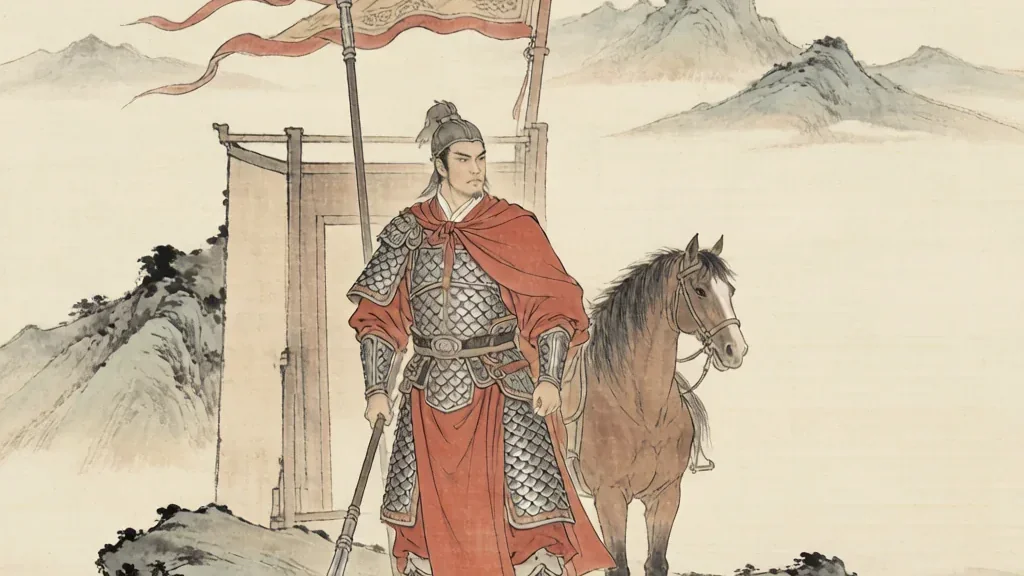
In the pantheon of Chinese heroes, few figures shine as brightly — or as tragically — as Yue Fei. Born to a poor farming family in 1103 CE, he rose to become the most celebrated general of the Southern Song Dynasty, a warrior whose name alone struck fear into enemy armies. Yet his story is not merely one of military glory. It is a story of unwavering loyalty in the face of betrayal, of principle over self-preservation, and of a death so unjust that it has echoed through Chinese history for nearly a thousand years.
Today, Yue Fei is remembered not only as a brilliant general but as the embodiment of Chinese patriotism. His name is synonymous with loyalty to one's country. Statues of him stand in temples across China, and before one of them — at his tomb in Hangzhou — kneel iron statues of the men who betrayed him, spat upon by visitors generation after generation. The tattoo on his back, inked by his own mother, has become one of the most powerful symbols in Chinese culture: four characters that read "Serve the country with utmost loyalty" — 尽忠报国.
The Birth of a Hero
Yue Fei's birth was marked by omens, according to legend. A great bird, a peng, was said to have landed on the roof of his family's home as he was born, and his parents named him Fei — meaning "to fly" — in honor of the bird. The infant Yue Fei was almost lost to disaster when the Yellow River flooded, sweeping away his family's home. His mother saved him by holding him inside a large clay jar that floated on the floodwaters until they reached safety.
Despite his family's poverty, Yue Fei's parents ensured he received an education. His father taught him to read and write, and he studied the Confucian classics and military strategy with equal passion. His physical training was equally rigorous. He learned archery from the famous master Zhou Tong, developing such skill that he could shoot arrows with both hands with deadly accuracy. He also mastered spear techniques and unarmed combat, becoming formidable in every form of martial arts practiced in his time.
The most famous moment of Yue Fei's youth came when Jurchen invaders from the north threatened the Song Dynasty. As he prepared to join the army, his mother called him before her. She had him remove his shirt, and with a needle she tattooed four characters onto his back: 尽忠报国 — "Serve the country with utmost loyalty." Some versions of the story say she used vinegar and ink to make the tattoo permanent. The pain must have been excruciating, but Yue Fei did not flinch. His mother's lesson was clear: his life belonged to his country, and his first duty was loyalty.
Rise to Command
Yue Fei enlisted in the Song army around 1122 and quickly distinguished himself. In his first major engagement, he led a small force of a hundred men against a much larger bandit army, defeating them through superior tactics. His reputation grew with each campaign. He was known for his strict discipline — his army, called the "Yue Family Army," was famous for never harming civilians, a rarity in an era when soldiers routinely looted and pillaged.
His soldiers lived by a simple code: "Freeze to death rather than tear down houses for firewood; starve to death rather than steal food." This discipline won the hearts of the common people, who welcomed Yue Fei's army wherever it marched. It also made his soldiers fiercely loyal to him. They knew he cared for them as a father cares for his children. He shared their hardships, ate the same food, and personally tended to the wounded.
By the late 1130s, Yue Fei had become the most successful general in the Song army. He had defeated multiple rebellions and, most importantly, had won a series of stunning victories against the Jurchen Jin Dynasty, which had conquered northern China and driven the Song court south of the Yangtze River. Yue Fei dreamed of nothing less than recovering the lost northern territories and restoring the Song Dynasty to its former glory.
The Art of War in Practice
Yue Fei was a tactical genius who put into practice many of the principles Sun Tzu had described centuries earlier. He emphasized mobility, intelligence, and psychological warfare. He famously used deception to defeat larger armies, once having his soldiers light twice as many campfires as they actually needed, making the enemy believe his force was much larger than it actually was.
His most famous military innovation was the "hooked spear" formation, developed to counter the Jin cavalry's devastating "Iron Pagoda" heavy cavalry and "Horse-and-Chariot" formations. The hooked spears could cut the horses' legs, bringing down both horse and rider, while infantry with heavy blades finished off the dismounted cavalrymen. This tactical innovation neutralized the Jin's greatest military advantage and enabled Yue Fei to win battles that seemed impossible.
At the Battle of Yancheng in 1140, Yue Fei's army faced the Jin's elite "Iron Pagoda" cavalry of fifteen thousand men. Using his hooked spear tactics and the ferocious courage of his troops, Yue Fei shattered the Jin cavalry and won a decisive victory. He pursued the retreating Jin forces all the way to the outskirts of the old Song capital of Kaifeng. For the first time, the recovery of northern China seemed within reach.
The Poem of a Patriot
In the midst of his military campaigns, Yue Fei wrote one of the most famous poems in Chinese literature. "Man Jiang Hong" — "The River All Red" — is a ci poem of fierce patriotism and frustrated ambition. Its opening lines are among the most quoted in Chinese culture: "My hair bristles with rage, I lean on the railing / The drizzling rain has ceased. / I lift my eyes toward the sky and utter a long, deep sigh / My heart is filled with fierce emotion."
The poem expresses Yue Fei's burning desire to recover the lost northern territories and his impatience with the cautious, appeasement-minded officials at the Song court. "I have yet to achieve anything for my country / My hair has already turned gray," he laments. The final lines are a vow of vengeance: "I shall feast on the flesh of the invaders and laugh as I drink their blood. / Let us start anew and recover our lost mountains and rivers."
For centuries, "Man Jiang Hong" has been recited by Chinese patriots in times of national crisis. It was a rallying cry during the Japanese invasion of the 1930s and 1940s. It is still taught to every Chinese schoolchild. The poem captures the essence of Yue Fei's character: passionate, uncompromising, and utterly devoted to his country.
Betrayal and Martyrdom
Yue Fei's military success, tragically, became the cause of his downfall. At the Song court, a powerful faction led by the Grand Chancellor Qin Hui advocated for peace with the Jin at any price. They feared that Yue Fei's continued victories would prolong the war and threaten their own political power. The weak Emperor Gaozong, who had reasons of his own to fear the return of the former emperor captured by the Jin, sided with the peace faction.
In 1141, with Yue Fei's army at the gates of Kaifeng and total victory within reach, he received a shocking order: withdraw immediately. Twelve gold medals were dispatched in rapid succession — the medieval equivalent of an emergency recall — making it unmistakably clear that the emperor demanded his return. Yue Fei's officers urged him to ignore the order and continue the campaign, arguing that a general in the field could disregard commands from a distant court.
Yue Fei refused. His mother had taught him loyalty, and he would not betray that principle even when obedience meant abandoning everything he had fought for. "For ten years my soldiers have fought," he said, weeping. "Now in a single day it is all thrown away." He ordered the withdrawal. The Jin forces retook the territory he had liberated, and the chance to reunify China was lost forever.
Back at court, Qin Hui had Yue Fei arrested on trumped-up charges of treason. The evidence was fabricated, the trial a sham. When asked to confess, Yue Fei tore open his shirt to reveal the tattoo on his back: "Serve the country with utmost loyalty." The judges were momentarily silenced, but Qin Hui was determined. On January 27, 1142, Yue Fei was executed in prison — strangled, according to some accounts, poisoned according to others. He was thirty-nine years old. His son Yue Yun and his loyal general Zhang Xian were executed alongside him.
Redemption and Immortality
The injustice of Yue Fei's death was so blatant that it could not stand. Twenty years later, the next emperor posthumously pardoned him and restored his honors. A temple was built at his tomb by West Lake in Hangzhou, where visitors still come to pay their respects. Before the tomb kneel four iron statues — Qin Hui, his wife Lady Wang, and two other conspirators — their hands bound behind their backs, their heads bowed in eternal shame. For centuries, visitors have spat on these statues, and a popular couplet at the site reads: "The green hills are fortunate to bury a loyal general's bones; the white iron is innocent to be cast into traitors' statues."
Yue Fei's legacy transcends his historical moment. He became the archetype of the loyal minister betrayed by corrupt officials — a figure as central to Chinese culture as Joan of Arc is to French culture. His story has been told and retold in operas, novels, films, and television series. The Beijing Opera repertoire includes multiple plays about his life, and his image appears in martial arts temples across the world.
Perhaps most remarkably, Yue Fei is revered as a deity in Chinese folk religion. Temples dedicated to him can be found throughout China and in overseas Chinese communities. He is often depicted alongside Guan Yu, the god of war from the Three Kingdoms era, as one of the great martial deities of Chinese tradition. The two figures represent complementary ideals: Guan Yu embodies brotherhood and righteousness, while Yue Fei embodies loyalty and patriotism.
In an age of cynicism and self-interest, the story of Yue Fei remains powerful. He reminds us that some principles are worth dying for, that loyalty is not weakness but strength, and that the judgment of history, though it may be delayed, will ultimately vindicate the righteous. The general who could have been emperor but chose to be a martyr is, in the end, more immortal than any emperor.
The Song-Jin Struggle for the North
The drama of Yue Fei's life unfolded against the larger Song-Jin war. The Jurchen Jin had seized northern China in 1127, capturing the Song capital and the emperor, and pushed the court south of the Yangtze. For the Southern Song, recovering the north was both a strategic need and a matter of honor, but the court was divided between hawks who wanted war and officials who preferred peace at any price. Yue Fei was the foremost hawk, winning battles that made recovery seem possible by 1140. The Jin, for their part, fielded the elite Iron Pagoda cavalry and relied on steppe tactics the Song found hard to counter. This was not a border skirmish but a fight over the destiny of China, which is why one general's recall resonated so loudly. The lost north became the wound at the heart of Southern Song politics for generations.
Yue Fei in Modern Memory
Yue Fei's appeal did not fade with the empire. In the twentieth century his poems and his motto were adopted as tools of patriotic education, taught to schoolchildren as models of loyalty to the nation. During wars and national crises his image appeared on posters and in films as a call to resistance, and his tomb in Hangzhou remained a site where citizens enacted loyalty by condemning his betrayers. Communist-era manuals and television dramas kept his story alive, sometimes reframing his devotion from loyalty to a ruler into devotion to the people. Statues and operas still circulate his name across the Chinese-speaking world. Few medieval generals enjoy such continuous fame, and the reason is clear: his life supplies a simple, stirring script of talent, principle, and betrayal that each generation can redeploy for its own sense of duty.
❓ Frequently Asked Questions
📝 Chinese Vocabulary
- 尽忠报国 (jìn zhōng bào guó) — "Serve the country with utmost loyalty"; Yue Fei's famous tattoo
- 满江红 (Mǎn Jiāng Hóng) — "The River All Red"; Yue Fei's immortal patriotic poem
- 秦桧 (Qín Huì) — Qin Hui; the chancellor who betrayed Yue Fei
- 岳家军 (Yuè Jiā Jūn) — "Yue Family Army"; Yue Fei's famously disciplined troops
- 精忠报国 (jīng zhōng bào guó) — A later variant of Yue Fei's motto, used on banners given by the emperor
🎉 Fun Facts
- Before Yue Fei's tomb in Hangzhou, four iron statues of his betrayers kneel in shame. A sign nearby famously reads: "Please do not spit" — because for centuries, visitors did exactly that.
- Yue Fei's "Man Jiang Hong" poem is so deeply embedded in Chinese culture that it was set to music and sung as a patriotic anthem during the war against Japan in the 1930s and 1940s.
- In Chinese folk religion, Yue Fei is worshipped as a door god alongside Guan Yu — his image is believed to protect homes from evil spirits.
- Yue Fei's strict rule that his troops would rather freeze than tear down a house for firewood made the Yue Family Army welcome wherever it went, rare among armies of the time.
- The cone-shaped Iron Pagoda cavalry he faced were heavily armored horsemen, and his hooked-spear tactic of cutting their horses' legs became a classic textbook example of using infantry against cavalry.
- Yue Fei was also respected as a calligrapher, and his surviving handwritten letters show a careful, forceful hand that matched his disciplined character.