Most idioms are warnings. A smaller and quieter group are encouragements — small lanterns lit against the dark of regret. The Chinese idiom 亡羊补牢 (wáng yáng bǔ láo), "mending the fold after sheep are lost," belongs to the second group, and its gentleness is part of why it has endured for over two thousand years. It speaks to the moment every person eventually faces: the moment when something has already gone wrong, when the loss is real, and when the only question left is whether anything can still be salvaged. The idiom answers, with the calm of long experience: yes.
The story comes from the "Zhan Guo Ce" (战国策), the "Strategies of the Warring States," the same Han Dynasty compilation that gave us the tale of drawing legs on a snake. But where that parable warns against doing too much, this one counsels against doing nothing. Together, they form a kind of paired wisdom: do not ruin a finished thing with excess, and do not abandon a broken thing to despair. Both mistakes, in their way, come from the same source — a failure to see a situation clearly.
The Shepherd and the Hole in the Fence
The parable is set in the state of Chu (楚国) during the Warring States period, and it appears in a speech delivered by a minister named Zhuang Xin to King Xiang of Chu. The king, the story goes, had been neglecting the affairs of his realm. He trusted corrupt ministers, ignored the warnings of his advisers, and spent his days in pleasure while the powerful state of Qin pressed against Chu's borders. Zhuang Xin had warned him repeatedly, and repeatedly the king had dismissed him. Finally, in frustration, Zhuang Xin told the king a simple story.
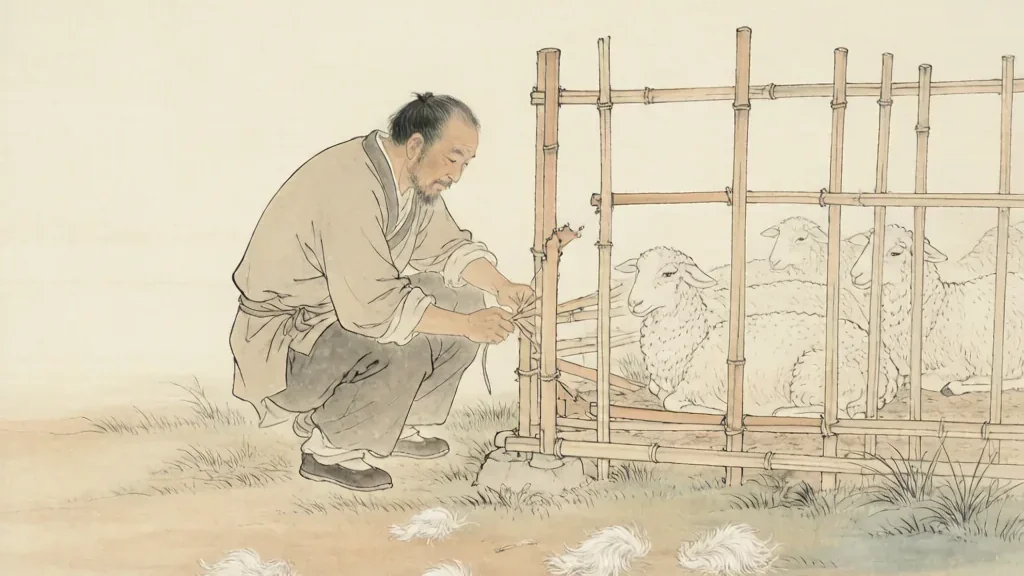
There was, he said, a shepherd who owned a flock of sheep and a fold — a fenced enclosure — to keep them safe at night. One morning, the shepherd noticed that one of his sheep was missing. He searched the fence and found a hole, small but clearly the work of a wolf that had slipped in during the night, seized a sheep, and slipped out again. The shepherd's neighbor urged him to repair the hole immediately. "The wolf will come back tonight," the neighbor said. "Mend the fold now, before you lose another."
The shepherd shook his head. "The sheep is already gone," he said. "What is the use of mending the fold now? The loss is done." And so he left the hole as it was, went about his day, and tried not to think about the missing sheep.
The Second Night
The next morning, the shepherd woke to find that another sheep was missing. The wolf had returned, as the neighbor had warned, slipped through the same hole, and taken another victim. Now the shepherd stood in his emptying fold, the loss no longer a single sheep but two, and understood with a sick clarity what his stubbornness had cost him. The neighbor came by, saw the disaster, and said nothing — there was no need. The shepherd hung his head.
"You were right," he said at last. "I should have mended it yesterday." And then, rather than sink further into regret, he did the thing that the entire idiom exists to praise. He went and found tools. He repaired the hole. He made the fold stronger than it had been before, and from that night onward, no wolf ever took another sheep.
Zhuang Xin turned to the king and delivered the line that would become immortal: "亡羊补牢,未为迟也" — "Mending the fold after the sheep are lost is not yet too late." The king's neglect had already cost Chu territory and treasure, the minister was saying. But Chu still existed. The kingdom could still be repaired. The only true disaster would be to refuse the repair out of shame for the loss.
The Politics of Late Action
The political context of the story matters. Zhuang Xin was not merely offering comfort. He was making a sharp argument against a particular kind of fatalism that infected failing states — the belief that once decline had begun, nothing could be done. Kings who had lost battles often concluded that the war was over. Ministers who had been ignored often stopped speaking. The temptation, when a mistake had been made, was to let the mistake stand as if it were destiny.
Zhuang Xin's parable rejected that logic entirely. Loss is not destiny. A hole in a fence is a fact, not a fate. The wolf that came last night is a problem to be solved, not a sentence to be served. The shepherd who mends the fold after the second sheep is gone is not a fool for having waited. He is a wise man for having finally acted. The idiom's quiet radicalism lies in this: it does not deny the loss. It denies that the loss is the end of the story.
Why the Idiom Endures
亡羊补牢 has lasted because the situation it describes is universal. Every life contains moments of regret that arrive too late for prevention but not too late for repair. The student who fails an exam can still study for the next one. The friend who has let a friendship lapse can still reach out. The parent who has been absent can still show up. The smoker who has smoked for twenty years can still quit today. In each case, the question is not whether the past could have been different — it cannot — but whether the future will be different. And that question, the idiom insists, is always ours to answer.
The phrase is often paired with its mirror image, "亡羊得牛" (wáng yáng dé niú, "losing a sheep and gaining an ox"), which describes an unexpected blessing that more than compensates for a loss. The two together sketch a complete philosophy of adversity: do not pretend the loss did not happen, but do not conclude that the loss is the whole story. Mend the fold. Stay alert. The future may yet surprise you.
In modern Chinese, the idiom appears in speeches, advice columns, business writing, and quiet conversations between friends. It is spoken to those who have made a mistake and cannot undo it, and it carries the gentle weight of two thousand years of accumulated human experience. The sheep are gone. The hole is still there. The hammer is in your hand. What you do next — that is the whole of the rest of your life.
The Shame That Blocks the Repair
Why do people fail to mend the fold? Often not because the fix is hard, but because the loss is embarrassing. The shepherd's first instinct was to ignore the missing sheep rather than admit the hole and his oversight. Shame freezes action: we would rather the problem stay hidden than expose it by repairing it. The idiom pushes against that reflex. Zhuang Xin's point to the king was that pride in the past cannot block repair in the present. In daily life this shows up when a student hides a failing grade, a worker hides a bug, a friend hides a rift, each preferring silence to the vulnerable act of fixing. The idiom's gift is permission to act despite the embarrassment, because the alternative is a second lost sheep.
Correction and Prevention as a Pair
No single idiom covers the whole of mistake management, so Chinese speakers pair two. 未雨绸缪 urges prevention while the sky is clear, the careful mending of roofs and relationships before storms arrive. 亡羊补牢 urges correction once the storm has already struck, the prompt repair that stops further loss. Read together they remove the excuse of timing: if you prepared, good; if you did not, you are still not helpless. The pairing also softens a harsh streak in some advice cultures that blame the victim for every loss. By honoring both the preventer and the late mender, the tradition accepts that humans miss things and yet can still respond well. The fold, once mended, guards the next flock.
A Proverb for Health and Recovery
Doctors and health educators in China often reach for this idiom. A patient diagnosed with a chronic condition may have neglected their body for years, the 'lost sheep' of prior habit, yet the lesson is that the 'fold' can still be mended: change diet, move more, quit smoking, keep appointments. The loss is real and cannot be undone, but further decline is not inevitable. The phrase is gentle where blame would be counterproductive, and it frames the new routine as repair rather than punishment. Families use it too, urging an ailing relative not to collapse into regret but to begin the concrete work of getting better. In this context the idiom becomes a small engine of behavior change, turning a fable about a fence into a counsel of second chances.
The Fold in Organizations and Teams
Modern workplaces have rediscovered the shepherd's logic under names like post-mortem and root-cause analysis. When a project fails, a healthy team asks not only who to blame but what in the system let the sheep escape, then patches the process so it cannot happen the same way twice. The idiom is essentially an ancient endorsement of learning organizations: treat every loss as information about a weak point, and convert regret into redesign. Companies that 'mend the fold' after incidents build resilience; those that hide losses repeat them. King Xiang's court, warned yet slow to act, is the cautionary version of a firm that ignores its own post-mortems. Seen this way, a rural fable about a wolf and a fence is also a manual for institutional memory.
❓ Frequently Asked Questions
📝 Chinese Vocabulary
亡羊补牢 — : "To lose a sheep and mend the fold" — to take corrective action after a loss, with the understanding that it is never too late to prevent further harm.
未为迟也 — : "It is not yet too late" — the famous concluding line of the original parable, often quoted on its own.
庄辛 — : The Chu minister who told the parable to King Xiang of Chu in a famous speech preserved in the "Zhan Guo Ce."
羊圈 — : "Sheepfold" — the fenced enclosure whose broken wall is the central image of the story.
楚襄王 — : King Xiang of Chu, the negligent ruler to whom Zhuang Xin directed the parable.
亡羊得牛 — : To lose a sheep and gain an ox; an unexpected blessing that more than compensates for a loss.
战国策 — : Strategies of the Warring States, the compilation that preserves Zhuang Xin's speech to King Xiang of Chu.
楚 — : The state of Chu, whose neglect Zhuang Xin warned about using the shepherd's tale.
🎉 Fun Facts
- The full line from the "Zhan Guo Ce" is "亡羊而补牢,未为迟也" — the "而" (and then) emphasizes that mending follows loss as a deliberate second act, not as an afterthought.
- Zhuang Xin's speech to King Xiang of Chu is considered one of the masterpieces of Warring States political rhetoric, and he reportedly offered to die if his advice did not prove correct within months — a wager the king did not take him up on.
- The idiom is sometimes used in Chinese medical contexts to encourage patients to adopt healthy habits after a diagnosis — the "lost sheep" being the prior neglect, and the "mended fold" being the new lifestyle.
- The English proverb "better late than never" captures the spirit of the idiom but lacks its concrete imagery, which is one reason the Chinese version remains so memorable.
- Chinese speakers often set 亡羊补牢 beside 未雨绸缪, mending the roof before the rain, one the cure after loss and the other the prevention before trouble.
- In project-management slang the phrase jokes that a missed deadline, the 'lost sheep,' should at least trigger a process fix, the 'mended fold,' rather than mere blame.