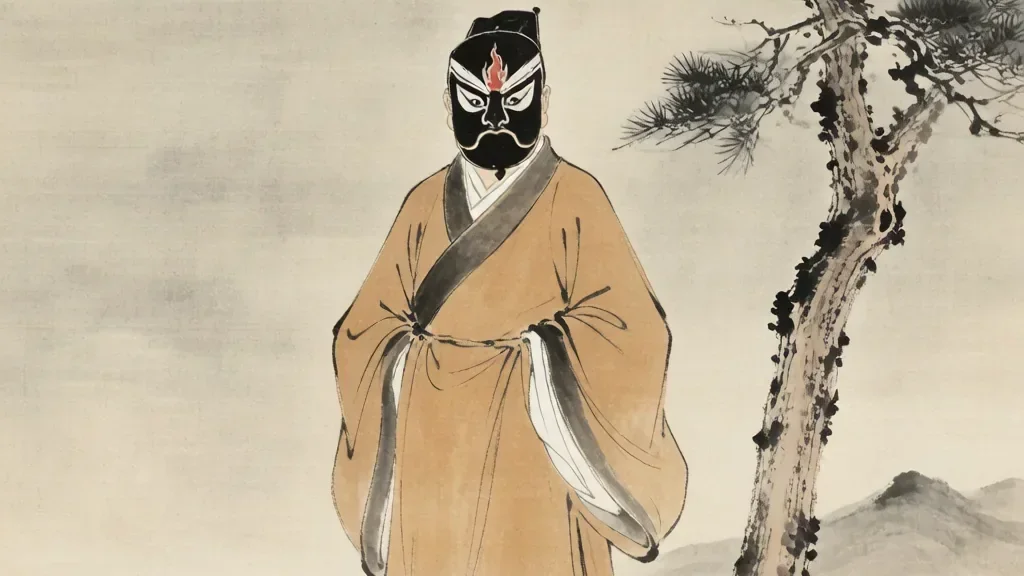
Bao Zheng, honored in folklore as Bao Qingtian ("Bao of the Clear Sky") and later worshipped as a god of justice, was a real Song-dynasty official whose reputation for relentless impartiality grew into legend. As a magistrate he became famous for punishing the powerful as readily as the poor, for trusting evidence over status, and for resisting corruption even when it meant opposing the throne's favorites. Centuries of plays, novels, and oral tales turned the historical judge into a culture-hero who stands for the dream that the law can be fair. In temples he is invoked by those who seek redress, and his dark facial mark in opera signals a face that cannot hide truth.
The Historical Bao Zheng
Bao Zheng lived during the Northern Song dynasty and served in a series of offices, rising to posts that brought him close to the imperial court. Historical records praise his frugality, his filial devotion, and his fearless remonstrance with high officials, including relatives of the emperor.
Colleagues reportedly grew nervous when he was on duty because he would not bend. Yet he was not a mere scold; he was known for careful investigation and for a deep reluctance to convict the innocent, traits that the legend magnified into near-miraculous perspicacity.
Why He Became a Legend
The gap between Bao Zheng's fairness and the frequent unfairness of real courts made him a natural folk hero. Ordinary people, who often found the law tilted toward the rich, told and retold stories in which "Bao the Just" exposed the hidden crimes of the mighty.
Storytellers added magic to his honesty: a crescent mark on his forehead that could see into the underworld, a sword granted by the throne to execute even princes, and the company of supernatural assistants who fetched the souls of the dead to testify. The blend of fact and fantasy cemented his status as justice incarnate.
Famous Cases in Folklore
The cycle of "Bao Gong an" (Lord Bao's cases) includes tales of wronged women, forged wills, swapped babies, and murders covered up by officials. In each, Bao Zheng reads clues others miss and refuses to close the case until the truth is laid bare.
One well-loved motif is his willingness to judge the dead: he descends (in story) to the underworld or summons ghosts to court, showing that no crime escapes him, in this life or the next. These plots taught audiences that diligence and courage, not rank, decide justice.
Symbols in Opera and Art
On the Chinese stage, Bao Zheng is painted with a black or moon-shaped mark on the forehead and a stern black face — the color of iron, suggesting an unbending will. He wears the robe of a senior judge and carries the imperial sword that authorizes him to act against anyone.
The "Black-Faced Bao" of opera is instantly recognizable and beloved, a figure whose very appearance promises that the powerless will get a hearing. His image in woodblock prints and temple statues carries the same reassuring gravity.
His Supernatural Assistants
Folklore gives Bao Zheng otherworldly helpers: a ghost-detection official and a judge of the dead who can compel spirits to speak. With them he solves crimes that reach beyond the living world, blending courtroom drama with the fantasy of cosmic account-keeping.
These companions reflect the belief that true justice requires seeing what ordinary eyes cannot. The helpers also lighten the tales, providing comic relief and a bridge between the human yamen and the courts of the afterlife.
Deification as a God of Justice
Because his name meant fairness, people began to worship Bao Zheng as a deity who answers prayers for justice, especially from the wronged and the poor. Small shrines and temple halls honor him as a divine magistrate who still hears petitions.
In this role he joins other judge-figures of Chinese religion, bridging the human love of equity and the hope that, where earthly courts fail, a higher one prevails. Devotees may pray not only for legal victory but for the courage to do right.
Moral Lessons Carried
The Bao Zheng stories teach concrete values: that no one is above the law, that evidence must trump favor, and that an official's first duty is to the people, not to patrons. These lessons had practical weight in a society where magistrates held great discretion.
They also model integrity for ordinary citizens — the virtue of speaking truth to power. Generations learned from Bao that a single honest person can bend an unjust system, a message that kept his legend alive across dynasties.
Bao Zheng in Popular Media
From traditional opera to modern television serials, Bao Zheng remains a staple of Chinese entertainment. Each era rewrites his cases to reflect its own concerns with corruption and fairness, proving the figure's flexibility as a moral touchstone.
The enduring appeal lies in his simplicity: a man who merely does his job without fear. That ideal, endlessly retold, turns a Song official into a permanent symbol of the rule of law as the Chinese imagination wishes it to be.
Legacy and Cultural Meaning
Bao Zheng matters because he names a hope deeper than any one case: that justice is possible and that power should serve the law. His worship and his stories together form a people's commentary on authority and its abuse.
In a world still wrestling with corruption, the Clear-Sky Judge stands as a reminder that integrity is remembered longer than office. The crescent on his brow, legend says, still watches — and the wronged still call his name.
❓ Frequently Asked Questions
Was Bao Zheng a real person?
Yes; he was a Northern Song official recorded as incorruptible and fearless, later enlarged by legend into a god of justice.
Why is he called "Bao Qingtian"?
The title means "Bao of the Clear Sky," praising his fair judgments that left the sky "clear" of clouds of injustice.
What is the crescent on his forehead?
In opera and folklore it is a mark granting him insight into hidden truth, even into the underworld.
How did he become a god?
His legend of perfect fairness led people to worship him as a divine magistrate who still hears petitions for justice.
What do his stories teach?
That evidence should trump status, that no one is above the law, and that officials must serve the people.
Where is he popular today?
Across Chinese culture, in operas, TV serials, and temples where the wronged seek redress.