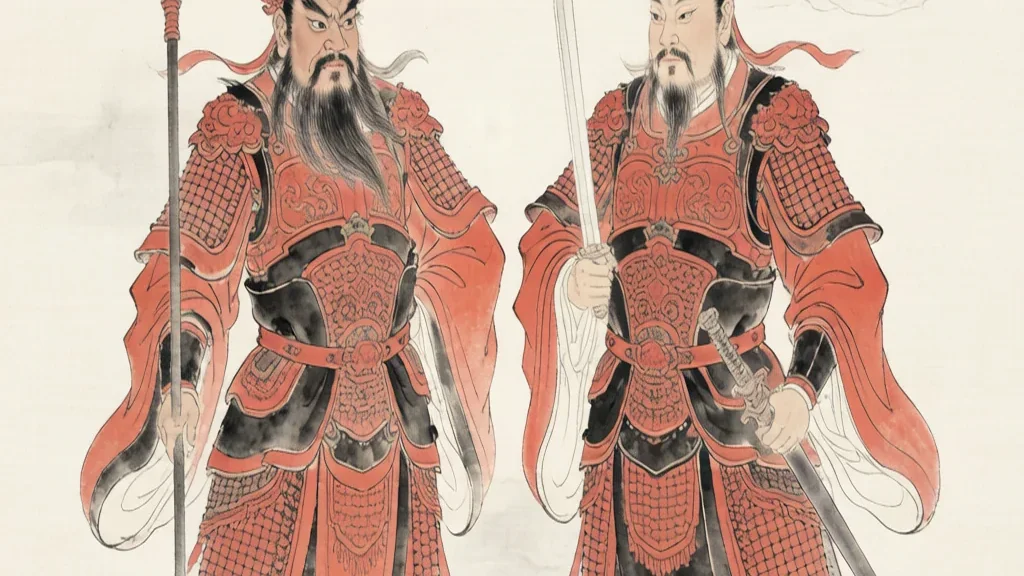
Shen Tu (神荼) and Yu Lei (郁垒) are the twin brothers credited as the very first Door Gods of China, guarding the threshold against wandering ghosts in the misty dawn of myth. Recorded as early as the Han dynasty, their legend explains why Chinese homes paste protective figures on their gates at New Year. Though later overshadowed by the Tang generals Qin and Yuchi, the two brothers remain the primordial guardians at the root of a tradition that has lasted two thousand years.
The Founding Legend
The tale appears in the " Lunheng " and " Fengsu Tongyi " of the Han period. On a spirit-mountain called Dushuo (度朔), a giant peach tree spread its branches over a ghost-gate. Every night spirits roamed the world; at dawn they returned through that gate. Two brothers, Shen Tu and Yu Lei, stood there with reed ropes.
Any ghost that had harmed a person they caught with the rope and fed to a tiger. The Jade Emperor, impressed, appointed them guardians of the ghost-gate, and people began drawing their images on doors to keep evil spirits away.
The Peach Tree and the Ghost-Gate
The giant peach tree is central. Peach wood was believed to repel evil, and the brothers' post beneath it tied the door-charm to the tree's power. Later customs of hanging peach-wood planks (桃符, tao fu) on gates descend directly from this image.
The "ghost-gate" (鬼门) on Dushuo mountain became the mythic source of all returning spirits, a kind of customs post between worlds. The brothers' job there was border control of the most absolute kind — deciding who may re-enter the realm of the living.
From Myth to Door Charm
Practical protection began with writing the brothers' names on peach-wood slips hung on the door. Over time the names gave way to their drawn images, and finally to printed Door God pairs. The evolution runs from word to picture to mass print.
This progression shows how a cosmic border myth filtered down into everyday domestic object. By the Tang dynasty the brothers shared the role with human generals, but their claim as "first" Door Gods was never forgotten.
Shen Tu and Yu Lei Versus Qin and Yuchi
The Tang emperors promoted Generals Qin Shubao and Yuchi Jingde as Door Gods after a tale of them guarding Taizong's sleep. These martial heroes suited a courtly, historical taste, and their images spread widely on city doors.
Yet Shen Tu and Yu Lei kept seniority in liturgy and folklore. Many households used the brothers for inner or symbolic protection while the generals stood at the outer gate — a layered guardianship drawing on both mythic and historical authority.
Ritual and the Peach-Wood Charm
The peach-wood charm (tao fu) bearing their names was the direct ancestor of the Spring Festival couplet. On the eve of the new year, families replaced old charms with new, fresh wood, a gesture of renewal that doubled as spiritual hygiene.
Even after paper prints took over, the association of peach with protection survived in folk medicine and amulets. The brothers thus seeded a whole vocabulary of threshold defense centered on the peach.
Symbolism of the Twin Guardians
Two brothers rather than one express balance and mutual vigilance. Their reed rope and tiger show that guarding is active capture, not passive staring — a sharper edge than later serene Door Gods. They are hunters of the returning dead.
The pair also embodies the oldest Chinese idea of the door as a controlled boundary. To live safely is to control what may cross the threshold, and the brothers are the original officers of that control.
Legacy in Culture
Shen Tu and Yu Lei live on in reference and ritual. Scholarly accounts of the New Year still cite them as the origin of Door Gods, and their names appear in idioms and classical allusions to vigilance and protection.
In folk art they occasionally resurface as the "primordial" pair, robed and solemn, distinct from the boisterous Tang generals. Their quiet survival proves that the first guardians are never fully replaced, only joined.
Connection to Broader Door Lore
Their story connects to Zhong Kui and the whole family of threshold protectors. Where Zhong Kui roams and the Tang generals stand, the brothers originate the very concept that the door needs a named, watchful guardian against the spirit world.
Understanding Shen Tu and Yu Lei is thus understanding the grammar of Chinese home protection: a boundary defended by figures whose names and images turn a piece of wood into a gate that evil cannot cross.
The Brothers in Later Folklore
Even after the Tang generals rose, Shen Tu and Yu Lei kept a place in seasonal and scholarly retellings of the New Year's origins. Storytellers opened the door-guard tale with the brothers on Dushuo mountain, framing the later figures as successors rather than replacements.
In some regional customs the first pair of Door God prints pasted each year was understood to honor them implicitly, a nod to the source even when Qin and Yuchi filled the visible leaves. The brothers thus survived as founding ancestors of the whole threshold-protecting tradition.
Their quiet endurance shows a Chinese habit of layering gods: new favorites are added without erasing the old. The primordial twins remain, ghost-gate keepers in the deep background of every guarded home, still on duty.
❓ Frequently Asked Questions
Who were Shen Tu and Yu Lei?
They were twin brothers of Chinese myth, recorded in Han dynasty texts as the first Door Gods. They guarded the ghost-gate on Dushuo mountain, catching harmful spirits with a reed rope.
What is the ghost-gate story?
On Dushuo mountain a giant peach tree shaded a gate where night-roaming ghosts returned at dawn. The brothers stood there, seizing wicked ghosts and feeding them to a tiger, appointed by the Jade Emperor.
How did they become door charms?
People wrote their names on peach-wood slips (tao fu) hung on gates for protection. Over time this became drawn images and then printed Door God pairs pasted at New Year.
How are they different from Qin and Yuchi?
Qin and Yuchi are Tang historical generals promoted as Door Gods later. Shen Tu and Yu Lei are the primordial mythic pair, retaining seniority in folklore even as the generals spread on city doors.
Why peach wood?
The brothers' post was under a giant peach tree, and peach wood was believed to repel evil. This made peach the core protective material for door charms and later amulets.
Are they still remembered?
Yes. They are cited in scholarly accounts of the New Year as the origin of Door Gods, and their names survive in allusions to vigilance and threshold protection.