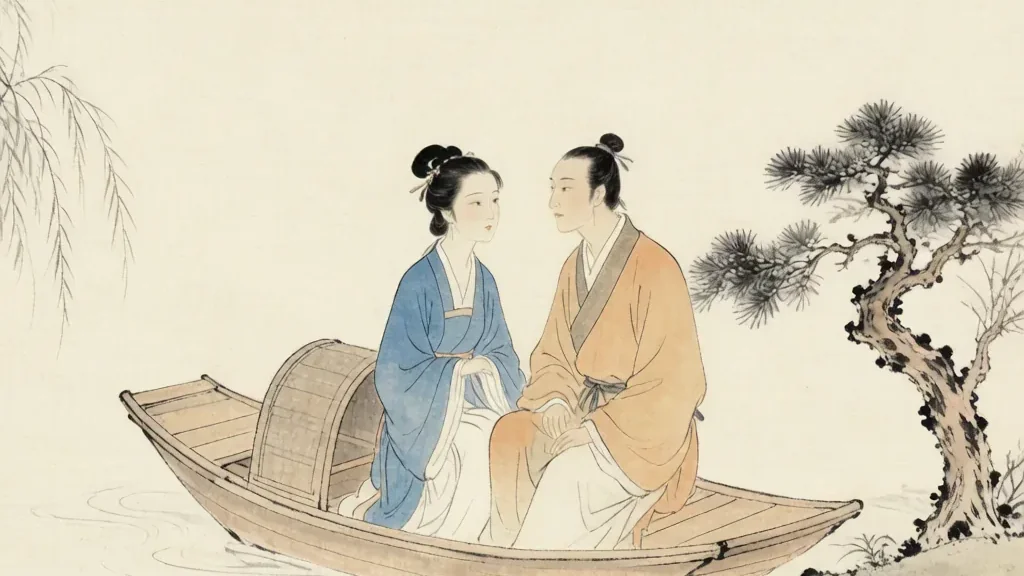
Every culture has its tragic love story — the tale of two souls who found each other against all odds, only to be torn apart by the world around them. The West has Romeo and Juliet. The Persian world has Layla and Majnun. And China has the Butterfly Lovers, the story of Liang Shanbo and Zhu Yingtai, a romance so enduring that it has been called "the Chinese Romeo and Juliet" — though it predates Shakespeare's play by at least seven centuries.
The story of Liang Shanbo and Zhu Yingtai (梁山伯与祝英台), often shortened to "Liang Zhu" (梁祝), is one of China's Four Great Folktales, alongside the White Snake, Meng Jiangnu Weeping at the Great Wall, and the Cowherd and the Weaver Girl. It has been told and retold for over a thousand years, in opera and film, in ballet and symphony, in poetry and prose. At its heart is a simple, devastating truth: that love, when denied, does not die — it transforms.
A Girl Disguised as a Boy
The story begins in the Eastern Jin dynasty, during the 4th century CE, in a society where the roles of men and women were strictly defined. Women were expected to remain at home, to marry whom their parents chose, to live their lives within the walls of domesticity. Education, for women, was a rare privilege, and the opportunity to study at a formal academy was virtually unheard of.
Zhu Yingtai was not content with this fate. The daughter of a wealthy family in Shangyu, Zhejiang, she was brilliant, curious, and fiercely intelligent. From a young age, she devoured every book she could find, taught herself the classics, and dreamed of the kind of education that was reserved for boys. When she was sixteen, she could no longer contain her ambition. She begged her father to let her attend the famous academy in Hangzhou, where scholars from across the land gathered to study.
Her father refused, of course. It was unthinkable. A young woman, traveling alone, living among men, studying alongside them? The scandal would ruin the family. But Zhu Yingtai was not one to accept refusal. She devised a plan: she would disguise herself as a boy. She cut her hair, donned men's clothing, and presented herself to her father as a visiting scholar. When he saw how convincing she was, he finally relented — on the condition that she maintain her disguise at all costs.
And so Zhu Yingtai set out for Hangzhou, her hair bound in a man's topknot, her robes concealing her identity, her heart pounding with a mixture of excitement and fear. She was finally going to learn.
Three Years as Brothers
At the academy, Zhu Yingtai met Liang Shanbo. He was a kind, earnest young man from a modest family in nearby Yin County. He was not wealthy, not well-connected, but he was genuine, hardworking, and warm-hearted. The two became fast friends, and as they studied together, shared meals, and spent their days in each other's company, their bond deepened into something far stronger than friendship.
For three years, they were inseparable. They shared a room, studied by candlelight late into the night, and walked the academy grounds together, discussing philosophy, poetry, and the future. Liang Shanbo, trusting and innocent, never suspected that his closest friend was a woman. Zhu Yingtai, for her part, fell deeply in love with him — his kindness, his integrity, his gentle nature. She wanted more than anything to tell him the truth, to reveal herself and declare her feelings. But she feared his reaction, feared the scandal, feared losing the friendship that had become the most precious thing in her life.
Instead, she dropped hints. She spoke of having a "sister" at home, a twin who was exactly like her in every way, and suggested that Liang Shanbo should come to visit and perhaps marry this sister. Liang, oblivious and endearingly slow to understand, agreed — he would visit, he would meet this sister, and perhaps, in time, they would marry. He did not realize that the "sister" was Zhu Yingtai herself, and that she was offering him her own heart.
The Devastating Truth
Their time at the academy came to an end. Zhu Yingtai received a letter from her father summoning her home — a summons she could not refuse. She left, her heart breaking, still unable to tell Liang the truth. She left behind a message urging him to visit her "sister" soon.
Months passed before Liang Shanbo finally made the journey to the Zhu family home. When he arrived and asked to meet Zhu Yingtai's "sister," the servants led him to a reception room — and there, stepping out in women's robes, was his closest friend. The truth hit him like a thunderbolt. The companion he had loved as a brother was a woman. And everything she had said, every hint she had dropped, every reference to her "sister" — it all made sense now.
In that moment, Liang Shanbo realized something else: he loved Zhu Yingtai. Not as a brother, not as a friend, but with the full force of romantic love that had been building for three years without his understanding. He proposed immediately, declaring his love and asking her to marry him.
But it was too late. While Liang had been slow to act, Zhu Yingtai's parents had not. They had already arranged for her to marry Ma Wencai, the son of a powerful and wealthy official. In the society of the Eastern Jin, a marriage arranged by parents was not a suggestion — it was a command. Zhu Yingtai protested, wept, begged, but her father was immovable. The marriage would take place. Her own desires were irrelevant.
A Death of Grief
Liang Shanbo returned home a broken man. The revelation of Zhu Yingtai's true identity, the realization of his love, and the impossibility of their union crushed him. He fell ill, and his illness worsened steadily. The doctors could find no cause and no cure — for his disease was not of the body but of the heart. On his deathbed, he asked his family to bury him at the foot of a particular hill, along the road where Zhu Yingtai's wedding procession would pass. And then he died.
When news of Liang's death reached Zhu Yingtai, her composure shattered. She had lost the only man she would ever love, and the marriage to Ma Wencai now felt like a death sentence of her own. But she was a filial daughter, and she could not refuse her father's command. The wedding proceeded. On the day of the ceremony, the bridal procession made its way along the road — and there, at the foot of the hill Liang had chosen, Zhu Yingtai ordered the bearers to stop.
She stepped from her bridal palanquin, walked to Liang's grave, and threw herself upon the earth. The sky darkened. The wind howled. And then, with a crack like thunder, the tomb split open. Without hesitation, Zhu Yingtai threw herself into the grave. The earth closed over her, and the storm passed.
The Transformation
When the mourners and wedding guests gathered their courage to open the tomb, they found no bodies. In their place, two butterflies emerged — one larger, one smaller, dancing around each other in the warm sunlight. They rose into the air, circled the grave three times, and then flew away together, never to be separated again.
In that final transformation, the story of Liang Shanbo and Zhu Yingtai transcends its tragedy. Death, which had seemed to defeat them, becomes instead a liberation. The societal constraints that kept them apart — gender, class, parental authority — fall away in the face of a love so pure that it reshapes the very nature of existence. They do not merely die for love; they are reborn through it, transformed into creatures of beauty and freedom, united forever in a form that no human authority can touch.
A Story That Endures
The Butterfly Lovers has resonated with Chinese audiences for over a millennium because it speaks to something universal and something specifically Chinese at the same time. Universally, it is a story of love denied, of two people whose only crime was to find each other in a world that would not let them be together. But specifically, it is a critique of the rigid social structures of traditional China — the arranged marriage, the absolute authority of parents, the limited roles available to women, the gap between rich and poor.
Zhu Yingtai, in particular, has become an icon of Chinese feminism. Her decision to disguise herself as a man to pursue an education, her intellectual equality with (and superiority to) her male peers, her refusal to accept a loveless marriage — all of these make her a remarkably modern figure, a woman who refused to be defined by the limitations her society imposed upon her. She is, in many ways, more subversive in her defiance than Juliet, who largely accepts the roles prescribed to her.
The story has been adapted into every major art form China has produced. The most famous adaptation is the "Liang Zhu Violin Concerto," composed in 1959 by He Zhanhao and Chen Gang. Blending Western orchestral form with Chinese melodies and instruments, the concerto has become one of the most famous pieces of Chinese music ever written, performed by orchestras around the world. The final movement, which depicts the transformation into butterflies, is a soaring, bittersweet melody that captures the essence of the story — the triumph of love over death, of beauty over sorrow.
The Butterflies Still Fly
Today, the story of Liang Shanbo and Zhu Yingtai remains as beloved as ever. Their tomb in Ningbo, Zhejiang, is a major tourist site and a popular destination for couples, who come to pray for a love as enduring as theirs. The Liang Zhu Cultural Festival, held annually in Yixing, celebrates the story with opera performances, art exhibitions, and butterfly releases. Countless films, television series, and stage adaptations continue to retell the tale for new generations.
And in the gardens and fields of China, when two butterflies are seen dancing together in the sunlight, the old people still smile and nod. For they know, as everyone knows, that those butterflies are Liang Shanbo and Zhu Yingtai — still together, still in love, still free.
Zhu Yingtai as a Feminist Icon
Zhu Yingtai stands out among Chinese heroines because her rebellion is intellectual as much as romantic. By disguising herself to study, she claims a space reserved for men and proves herself the equal of any classmate, turning the pursuit of learning into an act of defiance. Later readers have celebrated her as a forerunner of women's claims to education and self-determination, a figure who would not let birth decide her limits. Her tragedy arises precisely because society cannot accommodate a woman of her ability and desire, which makes her protest all the sharper. Unlike passive victims of folklore, she acts, chooses, and sacrifices. That blend of cleverness, courage, and quiet subversion is why she still speaks to audiences concerned with gender and freedom.
❓ Frequently Asked Questions
📝 Chinese Vocabulary
梁祝 — : The shortened name for the Butterfly Lovers story, combining the surnames of Liang Shanbo and Zhu Yingtai.
化蝶 — : "Transform into butterflies" — the famous final scene of the story, symbolizing love's triumph over death.
祝英台 — : The female protagonist, who disguised herself as a man to pursue an education.
梁山伯 — : The male protagonist, Zhu Yingtai's classmate and true love.
同窗 — : Schoolmates, literally sharing a window, the phrase for Liang Shanbo and Zhu Yingtai's three years of study as brothers.
马文才 — : Ma Wencai, the powerful official's son to whom Zhu Yingtai was betrothed against her will.
越剧 — : Yue opera, the regional form whose performances of the Butterfly Lovers became the best-loved musical version.
宜兴 — : Yixing, the city in Jiangsu that hosts an annual Liang Zhu cultural festival with opera and butterfly releases.
🎉 Fun Facts
- The Liang Zhu story is believed to have originated in the 4th century CE, making it over 1,700 years old — predating Shakespeare's Romeo and Juliet by more than 1,200 years.
- The "Liang Zhu Violin Concerto" (1959) is one of the most famous Chinese classical compositions ever written and has been performed by leading orchestras worldwide.
- Unlike Romeo and Juliet, the Butterfly Lovers story has no villain — the tragedy is driven entirely by social conventions and the absolute authority of parents over their children's marriages.
- In China, the image of two butterflies flying together has become a cultural symbol of eternal love, appearing on wedding decorations, embroidery, and traditional art for centuries.
- The Liang Zhu violin concerto structures its three movements around meeting, grief, and the butterfly transformation, mirroring the tale's emotional arc.
- The story has been adapted into films, television dramas, and animations across East Asia, including versions made in Japan and Korea.
💞 Check Love Compatibility
The Butterfly Lovers show how love transcends all barriers. Discover how compatible you and your partner are according to Chinese zodiac wisdom.
Check Compatibility →