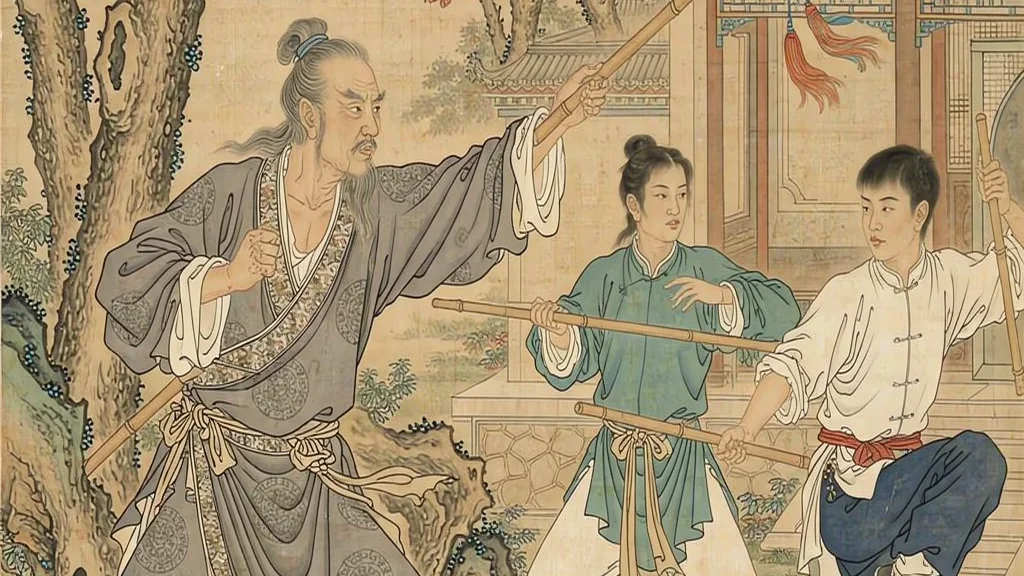
Choy Li Fut is a southern Chinese martial art founded in the Qing dynasty by Chan Heung in the Guangdong region. Combining the long-range power of Choy Gar, the balanced footwork of Li Gar, and the circular strength of Fut Gar (Buddhist family), the style is known for its wide, flowing movements, powerful fist and palm strikes, and the use of a long staff and broadsword. As one of the most popular southern kung fu systems, Choy Li Fut spread widely through overseas Chinese communities, especially in Southeast Asia, North America, and Europe, where it remains a gateway style for many beginning students of Cantonese martial arts.
Founding by Chan Heung
The art was created by Chan Heung (Chen Xiang), who was born in the early nineteenth century in King Mui village, in present-day Xinhui, Guangdong. According to lineage records, he studied Choy Gar boxing under his uncle Chan Yuen-wu, Li Gar under Li Yau-san, and the Buddhist-derived Fut Gar under the monk Qingyuan, synthesizing them into a single system.
Chan Heung is said to have spent roughly two decades gathering these teachings before formalizing Choy Li Fut around the mid-1800s. The name honors his three principal teachers and their lineages rather than claiming a single source, which was a respectful way to acknowledge diverse instruction.
The new style met a practical need in southern villages: a comprehensive method that blended the strengths of several arts while remaining teachable to large groups of villagers for self-defense and community solidarity.
The Three Lineages in the Name
"Choy" refers to Choy Gar, associated with long, swinging arm movements and strong horse stances. "Li" refers to Li Gar, known for balanced, grounded postures and steady advances. "Fut" refers to Fut Gar, the "Buddhist family" style linked to the temples and monastic boxing of the south.
By naming the art after all three, Chan Heung signaled that his system was an integration rather than a replacement. Students learn to switch between the explosive reach of Choy, the stability of Li, and the circular flows of Fut depending on the situation.
This synthetic approach is characteristic of many southern kung fu systems, which often emerged from the practical exchange of village teachers rather than from a single monastery or clan.
Characteristics of Movement
Choy Li Fut is visually distinctive for its large, circular motions. Practitioners swing the arms in wide arcs, generating momentum that culminates in powerful strikes. The body twists at the waist, and the stance shifts to add the weight of the whole frame to each blow.
Unlike the very low, narrow stances of some southern arts, Choy Li Fut uses a moderately deep, mobile horse stance that allows quick lateral movement. The footwork emphasizes "bridging" — stepping to control the opponent's center while keeping one's own base solid.
The style also trains the "寻找" of distance: because the arms travel in big circles, a single motion can defend, off-balance, and then strike, making the art fluid and economical despite its expansive appearance.
Stances and Footwork
The foundational stance is the "ma bu" horse stance, trained extensively for leg conditioning and root. From it, students learn the "bow stance" (gong bu) for forward attacks and the "cat stance" (xu bu) for defensive weighting.
Choy Li Fut footwork is notable for its "swing step," where the rear foot kicks out and around to generate rotational power in the hips. This gives the art its characteristic spinning palm and turning fist techniques.
Mobility is a core value: teachers frequently remind students that a rooted stance is useless if one cannot move. Forms therefore include frequent directional changes to build the habit of repositioning while maintaining balance.
Hand Techniques and Strikes
The system is rich in palm strikes, fist strikes, and "kicks" delivered mostly below the waist, consistent with southern preference for stable low kicks. The "ging" (power) is delivered through relaxed acceleration rather than stiff force.
Signature moves include the "bar arm" deflection followed by a straight punch, and the "looking-for-the-bridge" method of contacting the opponent's forearm to feel and control their structure. These are drilled in two-person sets called "chi sao"-like sensitivity drills, though less famous than wing chun's version.
Because the style favors circular generation, many strikes arrive from unexpected angles, making Choy Li Fut effective against opponents who expect straight punches. The wide arcs also build shoulder and back strength useful for weapon work.
Weapons Training
Choy Li Fut is famous for its staff (gun) and broadsword (dao) methods. The long staff form teaches the same whole-body power as the empty hand but at greater range, and is considered essential for understanding the art's mechanics.
The "look-for-the-bridge" staff drill pairs students so they learn to control an opponent's weapon with their own, a practical skill in the era when villagers carried staffs for travel safety. The broadsword forms emphasize committed, powerful cuts backed by stance rotation.
Other weapons in the curriculum may include the spear, the double broadsword, and the butterfly knives, depending on lineage. Weapon training is not ornamental; it reinforces timing, distance, and the explosive release taught in the bare-hand sets.
Forms Curriculum
The core solo forms begin with "small polymerization" routines that isolate basic strikes, then progress to the "long bridge" and "short bridge" sets differentiating reach. Advanced students learn the "Buddha's head" forms associated with the Fut Gar influence.
Each form is a catalogue of applications, and traditional teaching decodes the movements with a partner so the student understands the fighting logic behind the choreography. Forms are thus both conditioning and a living textbook of technique.
Because Chan Heung designed the system for group instruction, the forms are structured so that a village class can practice in unison, fostering community discipline alongside martial skill.
Spread Through the Diaspora
Like many southern arts, Choy Li Fut traveled with emigrants from Guangdong. In the nineteenth and twentieth centuries, practitioners carried it to Hong Kong, Malaysia, Singapore, and the Americas, where it took root in Chinatown associations.
Overseas schools often doubled as cultural and mutual-aid societies, teaching language, values, and self-defense under one roof. This social role helped the art survive far from its village origins and gave it a reputation as a community-building practice.
Today international federations coordinate tournaments and grading, though many traditionalists still emphasize lineage authenticity and the original King Mui teachings over standardized sport versions.
Training Philosophy and Modern Legacy
Choy Li Fut philosophy stresses "gong" (skill through hard work) and "de" (virtue). Students are taught that martial ability must be tempered by respect, humility, and responsibility to the community, reflecting Confucian and Buddhist influences.
Modern practitioners value the art for fitness, cultural connection, and self-defense. Its flowing, full-body movements are accessible to older students, while its power generation challenges even athletic beginners.
The style's enduring appeal lies in its balance: rooted yet mobile, hard yet circular, traditional yet open to newcomers. As a southern synthesis, Choy Li Fut remains a vivid example of how Chinese martial arts adapt across generations and continents.
❓ Frequently Asked Questions
Who founded Choy Li Fut?
It was founded by Chan Heung in Guangdong in the nineteenth century, synthesizing the Choy, Li, and Fut family styles he studied under different teachers.
What does the name mean?
It combines the names of three lineages: Choy Gar (long-arm), Li Gar (balanced), and Fut Gar (Buddhist family), reflecting the art's synthetic origin.
Is Choy Li Fut a northern or southern style?
It is a southern style from Guangdong, characterized by stable stances, low kicks, and circular power generation typical of south China boxing.
What weapons does it use?
The staff and broadsword are most associated with the style, with spear and butterfly knives appearing in some lineages as well.
Why did it spread overseas so successfully?
Emigrants from Guangdong carried it abroad, and overseas schools served as community and cultural centers, helping the art take root in diaspora neighborhoods.
Is Choy Li Fut good for beginners?
Yes; its flowing, full-body movements are accessible to many fitness levels, and its group-form structure makes it approachable for new students.