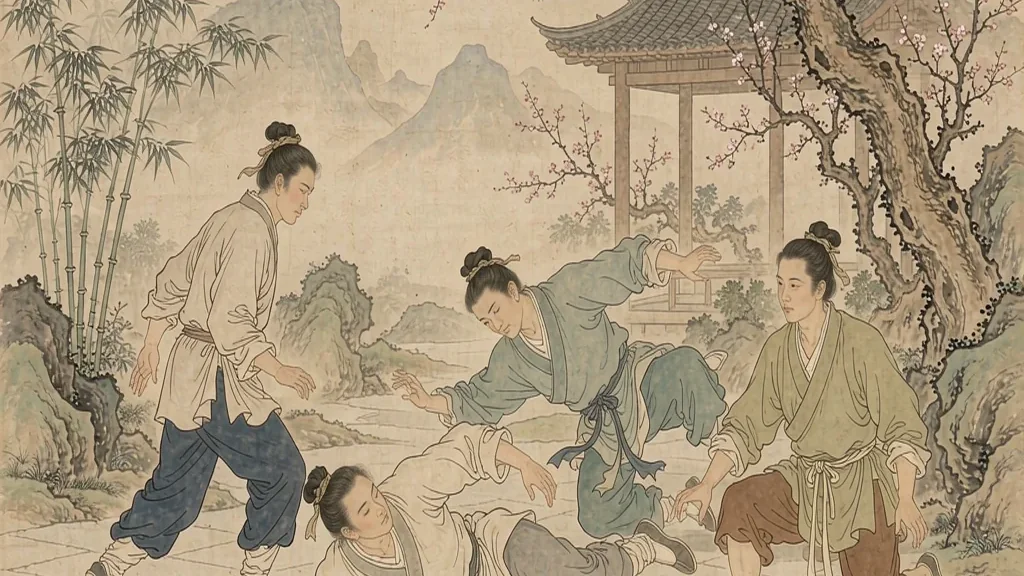
Ditanquan, commonly called "Ground Boxing" or "Floor Tumbling Boxing," is a northern Chinese martial art distinguished by its extensive use of ground rolls, sweeps, falls, and low-lying attacks. Unlike styles that keep the fighter upright, Ditanquan deliberately takes the body to the floor to evade, trip, and strike from below—an approach that looks acrobatic yet carries a clear close-combat logic. It is often grouped with the more airborne Fanziquan as part of China's tumbling boxing tradition, but its emphasis is firmly on the earth.
Place Among Tumbling Arts
Ditanquan belongs to the family of Chinese "tumbling" or "floor" boxing, arts that incorporate rolling and falling as core technique rather than accident. It is the ground-oriented counterpart to Fanziquan's aerial spinning, together representing the up-and-down extremes of northern acrobatic boxing.
Historically these arts flourished in north China, where practitioners valued versatility in all planes of movement. A fighter who could operate standing, crouching, and prone was harder to pin down than one confined to a single level.
The style was preserved within the broader wushu and village tradition, sometimes as a standalone system and sometimes as a component of a larger northern curriculum that included kicking and hand techniques.
Name and Meaning
The name combines "di" (earth, ground) and "tang" (to lie down, recline), plus "quan" (fist). Literally it is "earth-lying boxing," capturing the art's willingness to fight from the floor. The "di" also echoes the Daoist respect for Earth as one of the complementary poles of nature.
In some translations the art is called "Ground Tumbling Boxing" to emphasize the rolling, tumbling entries. Either name highlights what makes it unusual: a Chinese boxing style that treats the ground as a position of advantage, not defeat.
This ground orientation predates the modern separate sport of grappling, showing that Chinese martial arts had long explored floor fighting within their own frameworks rather than only standing strikes.
Core Philosophy of the Low Game
The guiding idea is that being low is not losing. By dropping, the practitioner removes the head from the opponent's striking line, gets beneath their kicks, and can attack the legs and lower body where balance is weakest.
Ditanquan also exploits "yin-yang" level changes: just as an opponent expects a high strike, the stylist drops; just as they expect a low one, they rise. This vertical deception is a hallmark of the art's strategy.
Another principle is continuous motion on the floor—never lying still. Rolls and spins keep the body moving so it cannot be easily pinned, and each roll can become a strike or a stand-up, maintaining offensive pressure even while grounded.
Ground Techniques and Rolls
The repertoire includes forward and backward shoulder rolls used to escape and reposition, low sweeping kicks that cut the opponent's legs, and floor strikes delivered with the heels, fists, or elbows. The "teng" (body flip) lets a downed fighter spring back up.
A signature is the "ground scissor" leg action, where the legs scissor to trap or sweep an opponent's stance, a technique with clear throwing applications. Control of the legs from the floor is a specialty of the style.
Practitioners also train "falling" as a skill: learning to land safely and immediately convert a fall into a technique turns what others fear—being taken down—into an opportunity.
Stances and Transitions
Though much happens on the floor, Ditanquan still uses crouching stances such as the "pu bu" (bow stance low to the ground) as bridges between upright and prone. These low stances build the hip and leg strength needed for floor work.
Transitions are seamless: a low stance flows into a roll, a roll into a sweep, a sweep into a stand. The art's beauty is in this continuity, where no position is a dead end but always a step in a moving chain.
Teachers stress that the floor techniques must return the fighter to the feet whenever possible, since prolonged grounding is risky. The art thus uses the earth tactically, not as a final resting place.
Training and Conditioning
Conditioning emphasizes spine and shoulder safety, because rolling incorrectly can injure the neck. Students begin on mats, drilling basic rolls until the body learns to distribute impact along the rounded back.
Core and leg strength are essential for the scissor and springing movements. Many exercises build explosive hip extension so the fighter can launch from the floor like a coiled spring.
Flexibility, especially in the hips and lower back, supports the low splits and leg traps. As with related tumbling arts, daily stretching accompanies the technical drills from the earliest stage.
Relationship to Fanziquan and Wushu
Ditanquan and Fanziquan are often taught as complementary "tumbling" siblings: one rules the air, the other the earth. Some curricula even combine them so the student learns to move through every level fluidly.
In modern wushu, ground-tumbling content appears within certain traditional routines, though competition rules generally limit prolonged floor time, which has shaped how the art is performed for sport.
This sporting framing has helped preserve the style's visibility, even as traditionalists maintain the combat applications that the performance versions sometimes simplify. The dual life is common across Chinese martial arts today.
Cultural Image and Legacy
Ditanquan enjoys a distinctive place in demonstrations because its floor work surprises audiences accustomed to upright kung fu. The sight of a fighter tumbling, sweeping, and springing up reads as both playful and formidable.
The art also expresses a philosophical humility: it is willing to "eat dirt," to use the low and humble position, reversing the usual association of ground with defeat. In that sense it mirrors broader Chinese values of adaptability.
For today's practitioners, Ditanquan offers a unique training challenge—body awareness in all orientations—and a reminder that effective Chinese boxing has always included the dimension of the ground, long before it became a modern sporting category.
❓ Frequently Asked Questions
What is Ditanquan?
It is a northern Chinese "Ground Boxing" style that uses rolls, falls, sweeps, and floor strikes as core technique, treating the ground as a position of advantage.
How does it differ from Fanziquan?
Fanziquan emphasizes aerial spins and jumps, while Ditanquan stays low, using ground rolls and leg traps; together they cover air and earth.
Is ground fighting practical?
Traditional teaching uses the floor to evade high strikes, cut the legs, and spring back up, applying level changes as a tactical tool rather than a last resort.
Is it safe to learn?
Beginners train rolling on mats to protect the spine and shoulders, building safe mechanics before any full-speed or competitive practice.
Does it appear in wushu?
Yes, ground-tumbling content is included in some traditional wushu routines, though sport rules limit prolonged floor time compared with pure combat training.
What fitness does it build?
It develops core strength, hip mobility, body awareness in all orientations, and the ability to fall and recover safely.