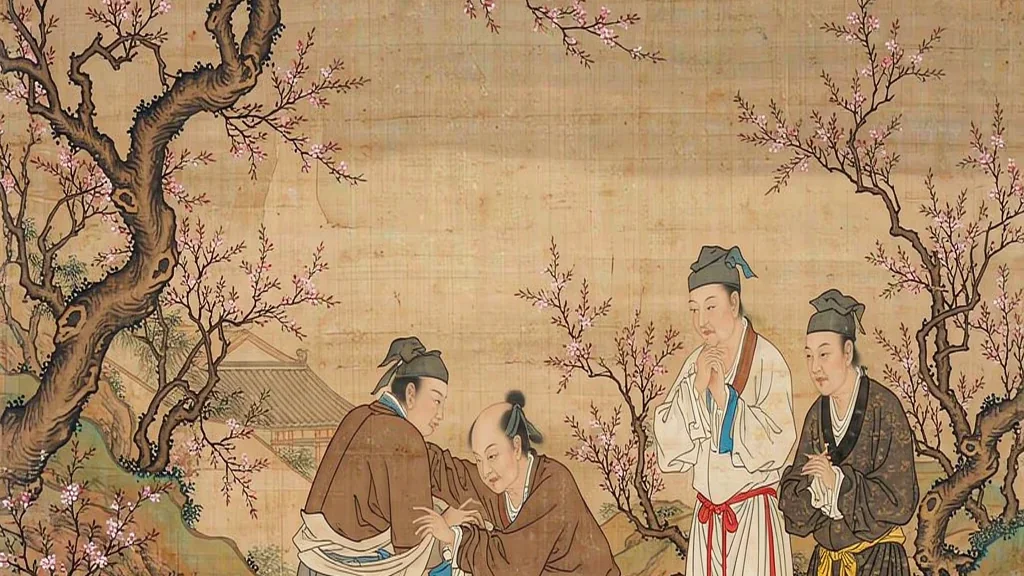
Shuai Jiao (摔跤, "throw and trip") is the indigenous Chinese art of jacket wrestling, a grappling system in which opponents wearing a short-sleeved jacket seek to off-balance and throw one another using holds, trips, and body leverage. With roots reaching back to the wrestling of ancient Zhou-era soldiers and the "jiao li" trials of imperial courts, shuai jiao is one of the oldest continuously practiced martial traditions in China. Unlike striking arts, it concentrates on closeness, balance, and the decisive moment when an opponent's weight can be redirected to the ground. This article covers its history, technique, training, and its relationship to modern sport wrestling.
Ancient Origins
The earliest Chinese term for wrestling, jiao li, appears in Zhou dynasty sources describing contests used to select strong soldiers and to entertain at court. Later, during the Han and Tang, wrestling spectacles were staged for festivals and imperial audiences, and the practice was woven into military training because unarmed control of an enemy was a battlefield necessity.
Through the Ming and Qing dynasties, wrestling evolved in both the palace and the northern provinces, absorbing Manchu and Mongol influences into what became recognizable as shuai jiao. The Qing imperial wrestling corps ("jiao bu") professionalized the art in Beijing and elsewhere, leaving a lasting technical and cultural mark.
Jacket and Rules
Traditional shuai jiao is practiced in a jacket (yi) with short sleeves and a belt, which gives the hands grips absent in bare-chested wrestling. A match is won by throwing the opponent so that a designated scoring area—usually the back, hip, or a combination—touches the ground, or by causing them to step out of the ring. Different regional and modern rule sets vary the exact scoring.
Because the jacket provides handles, shuai jiao technique centers on controlling the cloth: sleeve grips, collar ties, and belt holds let the wrestler steer the opponent's posture. This makes it distinct from freestyle wrestling, where the lack of a jacket shifts the emphasis to underhooks and body locks.
Core Throwing Methods
Shuai jiao catalogues its techniques by body part and principle: hand throws (using grips to unbalance), leg trips (hooking or reaping the opponent's legs), and hip and shoulder throws (using the wrestler's body as a fulcrum). A single exchange may combine a grip break, a foot sweep, and a hip turn in fluid succession.
Famous named techniques include the "double overturn" and various "flying trips," but the heart of the art is timing: feeling the opponent's weight shift and acting in that instant. Practitioners speak of "listening" to balance through the jacket, a sensitivity that echoes the "ting jin" of internal boxing.
Stance and Footwork
Shuai jiao uses a low, springy stance with knees bent and weight forward, ready to drive or yield. Footwork is quick and circular, always seeking the angle that removes the opponent's base. Unlike striking arts, the hands are rarely free; they are occupied managing the jacket and the opponent's limbs.
Mobility is prized because a static wrestler is easy to tip. Drills emphasize shuffling without crossing the feet, dropping the center when pulling, and rising when pushing, so that force flows from the legs through a stable but adaptable base.
Training and Conditioning
Training pairs repetitive throw drills with live practice (san shou) against resisting partners. Students first learn falls (pu) so they can be thrown safely, then cycle through techniques on both sides to build ambidextrous skill. Strength, especially in the legs and back, and grip endurance are trained alongside technique.
Many shuai jiao schools also borrow stance and bridge exercises from other Chinese arts to toughen the body. The culture is pragmatic and communal; senior students coach juniors through countless repetitions, and progress is measured by reliable, repeatable throws under pressure.
Military and Civilian Roles
Historically shuai jiao was a soldier's skill for disarming and controlling without a weapon, and it remained in police and guard training well into the modern period. Civilian teachers ran public yards where townspeople, regardless of class, could learn to wrestle, giving the art a broad social base unusual among martial arts.
In the Qing, the imperial wrestling battalion turned the art into a career path, and retired wrestlers spread technical knowledge across north China. This institutional support is a major reason shuai jiao survived where more esoteric arts faded.
Shuai Jiao in the Modern Era
Today shuai jiao is both a traditional art and a competitive sport, with organizations in China and abroad holding tournaments under standardized rules. It is distinct from Olympic freestyle and Greco-Roman wrestling but shares the universal grammar of throws and trips, and cross-training between them is common.
Outside China it attracts judo and wrestling practitioners curious about its jacket-based grips and distinct throws. Its emphasis on upright, jacket-controlled throwing offers a recognizable yet fresh challenge, and cultural exchanges have helped preserve older regional forms.
Philosophy of Balance
Shuai jiao teaches that victory comes not from raw strength but from using the opponent's force and lost balance against them—a principle it shares with taiji and aikido-like arts. The wrestler who panics and resists is more easily thrown than one who yields at the right moment.
This makes the art a lesson in composure: staying centered while destabilizing another. Many teachers frame it as character training, where losing one's temper or footing reveals the same flaw, and steady breath under pressure is the real technique.
❓ Frequently Asked Questions
What is shuai jiao?
It is traditional Chinese jacket wrestling focused on throws, trips, and off-balancing an opponent using grips on a short-sleeved jacket.
How old is the art?
Its ancestor, jiao li, is documented from the Zhou dynasty, making it one of China's oldest continuous martial practices, refined through Han, Tang, and Qing eras.
How does it differ from judo?
Both use jackets and throws, but shuai jiao has distinct native techniques, regional forms, and historically emphasized upright trips with less ground grappling.
Is it safe to learn?
Yes, provided students first learn break-falls and train progressively with cooperative then resisting partners under supervision.
Does it need strength or skill?
Skill and timing matter most; the art uses the opponent's lost balance, so technique outperforms brute force when properly trained.
Is shuai jiao still practiced?
Yes, both as a traditional art and a competitive sport in China and abroad, with active tournaments and cross-training with judo and wrestling.