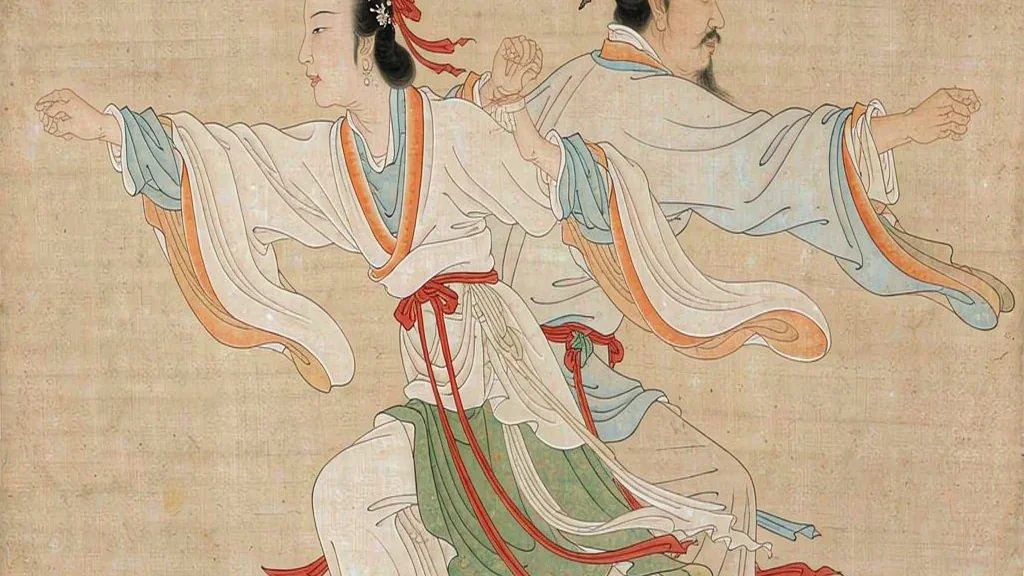
Fanziquan, commonly called "Tumbling Boxing" or "Rotating Fist," is a northern Chinese martial art noted for its rapid, whirling movements, leaping spins, and continuous aerial kicks. Classified among the "Changquan" (long-fist) family of northern styles, it emphasizes agility, flexibility, and acrobatic flair, making it one of the most visually spectacular of the traditional Chinese boxing arts. Though demanding in athleticism, Fanziquan also carries a coherent combat logic: its spins and jumps are used to change angle, evade, and deliver strikes from unexpected positions.
Place in the Northern Long-Fist Family
Fanziquan belongs to the broad Changquan tradition of north China, which values extended postures, high kicks, and flowing sequences. Within that family it is grouped with other "acrobatatic" styles such as Ditangquan (ground tumbling) and some Shaolin jumping sets, sharing an emphasis on momentum and body control in the air.
Historically, northern arts developed in regions where open terrain and looser clothing favored expansive movement, in contrast to the compact, low stances of southern styles. Fanziquan is an extreme expression of that northern preference for reach and elevation.
The style was preserved and refined within the broader wushu ecosystem, appearing in both village practice and the later standardized sport curricula that emerged in the twentieth century.
Name and Meaning
The character "翻" (fan) means to turn over, flip, or rotate, capturing the style's signature somersaults and spinning kicks. "子拳" (ziquan) simply means "son fist" or "boxing," a conventional suffix. Together the name paints a picture of boxing that turns and tumbles.
Some scholars note that "fan" can also imply "returning" or "countering," suggesting the art's principle of using rotation to redirect an opponent's force. The playful name thus hides a serious mechanical idea: circular motion as a defensive and offensive tool.
In performance contexts the name is apt, as practitioners literally appear to tumble through the air, yet traditional teaching insists each rotation has a martial purpose rather than being mere display.
Core Movement Principles
The defining principle is continuous rotation of the body's axis. Practitioners chain spins so that one turn flows into the next, keeping the center of mass moving and the opponent unable to predict where the next strike will land.
Another key idea is "rising and falling": the body alternately launches upward for aerial kicks and drops low to sweep or roll, creating vertical variety that frustrates a grounded defender. This up-and-down rhythm is drilled until it becomes instinctive.
Flexibility is foundational. Without a high degree of hip, spine, and shoulder mobility, the whirling kicks cannot be performed safely or powerfully, so stretching is a daily, non-negotiable part of training.
Acrobatic and Aerial Techniques
Fanziquan's repertoire includes front and side aerial kicks, spinning heel kicks delivered mid-rotation, and leaps where both feet leave the ground before a strike. The "teng kong" (soaring) feeling is cultivated so the body seems to float between techniques.
Tumbling entries such as forward rolls and shoulder spins are used to evade low attacks and immediately counter from an unusual angle. These are borrowed conceptually from Ditangquan, the "ground boxing" art, though Fanziquan keeps more of its action airborne.
Because the movements are dynamic, timing and spatial awareness are critical. A misjudged spin can leave the practitioner exposed, so partners and mats are used in training to build safe, repeatable mechanics before full-speed practice.
Stances and Transitions
Though known for aerial work, Fanziquan still trains the standard northern stances—horse, bow, and empty—as landing positions. A clean landing in a rooted stance is as important as the jump itself, because it lets the fighter immediately continue or defend.
Transitions between ground and air are smooth: a low sweep can become a spring upward, and a spinning kick can resolve into a crouch. This fluidity is what separates the art from pure gymnastics; every position is a potential fighting posture.
Teachers emphasize that the stances, even when brief, must carry intention. A landing is not a rest but a moment to strike, check, or reposition, maintaining the art's relentless continuity.
Training and Conditioning
Conditioning focuses on the three pillars of tumbling ability: flexibility, core strength, and spatial orientation. Practitioners spend long sessions on splits, back bends, and rotational drills to protect the spine during spins.
Core training is intense because the abdominal and lower-back muscles govern rotation and landing control. Many exercises mimic the art's movements—twisting jumps, weighted spins—so strength transfers directly to technique.
As with other wushu forms, repetition of the set builds the "muscle memory" needed to perform complex sequences without conscious thought. Students typically learn a basic short routine before attempting the full acrobatic form.
Relationship to Modern Wushu
In the standardized sport of wushu, Fanziquan is one of the traditional "taolu" (forms) categories, showcasing the athlete's difficulty, execution, and overall presentation. Competitions reward clean rotations, height, and control.
This sporting life has kept the style visible to new generations, even as some traditionalists worry that competition scoring favors spectacle over combat realism. The debate mirrors broader tensions in Chinese martial arts between performance and self-defense.
Still, the athletic base built through sport training—balance, courage in the air, body awareness—provides a strong foundation should a student later pursue the art's fighting applications with a qualified teacher.
Cultural Image and Legacy
Fanziquan occupies a special place in the popular imagination because it looks like martial arts "as imagined"—flying kicks and spinning flips. Films and demonstrations have amplified this image, drawing curious students worldwide.
The style also embodies a Chinese aesthetic value: the union of power and grace. A good Fanziquan performer is both athlete and artist, expressing rhythm and control through the body in motion.
For practitioners today, the art offers a demanding but joyful path: a workout that builds real athleticism while connecting them to a centuries-old northern boxing tradition that literally keeps them on their toes.
❓ Frequently Asked Questions
What is Fanziquan?
It is a northern Chinese "Tumbling Boxing" style known for rapid spins, leaping kicks, and continuous aerial movement within the Changquan long-fist family.
Is Fanziquan practical for self-defense?
Traditional teaching holds that its rotations change angle and evade attacks with martial purpose, though modern practice often emphasizes athletic and performance aspects.
How is it different from Ditangquan?
Both use tumbling, but Fanziquan keeps more action airborne with spinning jumps, while Ditangquan emphasizes ground rolls and low sweeps.
What fitness does it build?
It develops flexibility, core strength, balance, and spatial awareness through demanding rotational and aerial drills.
Is it used in wushu competition?
Yes, Fanziquan is a traditional taolu category in modern wushu, scored on difficulty, execution, and presentation of aerial techniques.
Do you need to be flexible to start?
Flexibility helps greatly, but beginners typically build it gradually through daily stretching alongside basic stance and form training.