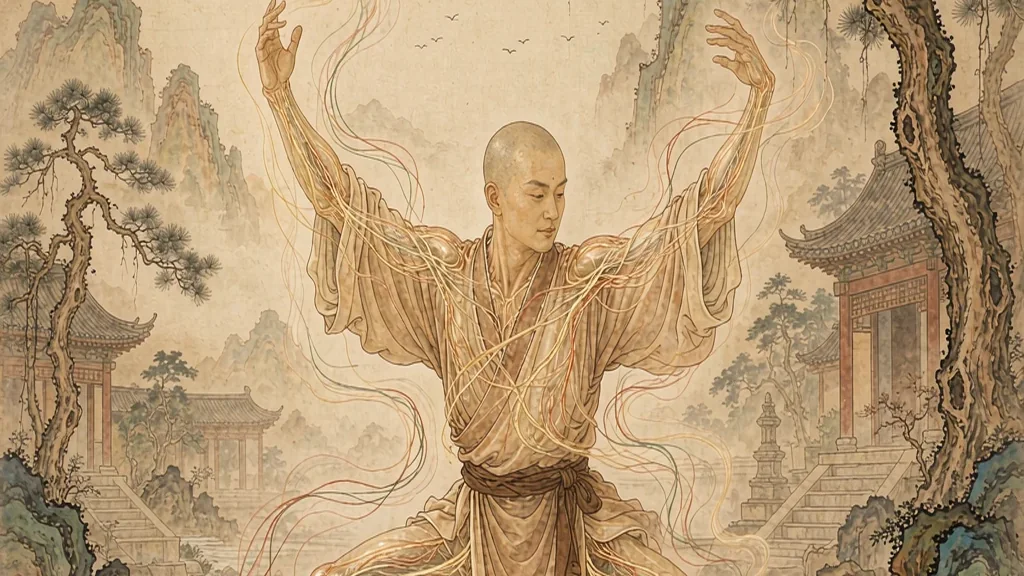
The Yijin Jing (易筋经, "Classic of Tendon and Muscle Change") is a celebrated system of Chinese calisthenics and qigong attributed in legend to Bodhidharma and preserved in Shaolin tradition, designed to strengthen the tendons, muscles, and bones while cultivating breath and concentration. Composed of a series of held postures and coordinated movements, it is practiced today for health, flexibility, and as a foundation for martial conditioning. Though its mythic origin is not historical fact, the routine's value as a gentle, systematic body-mind exercise is widely recognized. This article reviews its lore, structure, principles, and modern practice.
Legend and Attribution
Folklore links the Yijin Jing to Bodhidharma, the Indian monk credited with bringing Chan (Zen) Buddhism to China, who is said to have taught muscle-changing exercises to shaolin monks too weak for meditation. This story is pious tradition rather than verified history; scholars date the surviving text to later centuries and note its Taoist and medical influences.
Regardless of origin, the Yijin Jing became a cornerstone of Shaolin health and martial preparation, symbolizing transformation—"changing the tendons" meant reshaping a weak body into a resilient one. The narrative of a foreign monk's gift gave the routine prestige that helped it survive.
Purpose and Philosophy
The title captures the aim: "yi" (change), "jin" (tendons/muscles), "jing" (classic or method). The practice seeks to make the body's connective tissue supple and strong, so that movement is powerful yet relaxed. It blends physical stretching with breath and intention, reflecting the Chinese view that sinew, breath, and mind are one system.
Unlike vigorous sport, the Yijin Jing works through sustained, mindful tension and release. Held postures lengthen fascia and build isometric strength, while the breathing calms the nervous system—an approach that suits both the elderly and the athlete as a balancing practice.
Structure of the Routine
Traditional versions present a sequence of about a dozen postures, each with a name and imagery—such as "pulling nine oxen by the tail" or "two hands hold the sky." Each posture is held and repeated with synchronized breath, then flowed into the next, forming a continuous, meditative series rather than a cardio workout.
Variants exist: some emphasize martial hardness, others pure health. Modern standardized editions, promoted by Chinese health authorities, simplify and codify the set so it can be taught widely, ensuring consistent, safe practice across clinics, parks, and gyms.
Key Principles
Three principles guide the work: relaxation within effort (tense the target area while keeping the rest soft), breath-led movement (inhale to gather, exhale to extend or press), and intent directing force (yi nian). The mind leads, the body follows, and the breath ties them together—a quintessential qigong pattern.
Another principle is gradualness: postures are deepened over time, never forced. The "change" of tendons is slow, earned through daily repetition, mirroring the broader Chinese training ideal that lasting transformation comes from patience, not intensity.
Tendons, Fascia, and Modern Science
Modern understanding supports the routine's logic: regular loaded stretching strengthens tendons and fascia, improves joint range, and enhances proprioception. The isometric holds build stabilizer strength without heavy load, and the slow breathing engages the parasympathetic nervous system, reducing stress.
While the traditional "tendon changing" language is metaphorical, the physical benefits are concrete. Practitioners commonly report better posture, looser shoulders and hips, and steadier balance—outcomes consistent with mobility and calm-focus training.
Role in Shaolin and Martial Arts
Within Shaolin, the Yijin Jing was a preparatory art: strong, flexible tendons underlie powerful, injury-resistant movement, and the breath control aids the "hard qigong" conditioning of striking arts. Monks treated it as both medicine and foundation, practiced alongside forms and meditation.
Martial schools outside Shaolin also adopted similar tendon-changing sets, recognizing that a resilient frame supports every technique. Today many kung fu classes open or close with Yijin Jing–style exercises to mobilize the body and settle the mind before training.
Health Practice Today
The Yijin Jing is now a mainstream component of Chinese fitness-for-health, taught in parks, community centers, and hospitals as a low-risk exercise for all ages. Its gentle, standing nature makes it especially popular with older adults seeking mobility and calm without strain.
Public-health editions pair it with Baduanjin and other qigong sets, and research—mostly observational—suggests benefits for balance and well-being. It is presented as complementary wellness, not a cure, fitting contemporary, evidence-aware practice.
Getting Started
Beginners should learn the postures from a qualified instructor or a trusted standardized video, focusing on alignment and relaxed breathing rather than depth. Move within a pain-free range, hold each posture steadily, and let the breath set the pace; forcing flexibility invites injury.
A few minutes daily outperforms occasional long sessions. Treated as a quiet daily reset, the Yijin Jing offers a tangible taste of the Chinese ideal it names: small, consistent change that gradually reshapes the body and steadies the mind.
How It Compares with Other Qigong
The Yijin Jing is one of several classic health sets, often taught alongside Baduanjin, Wuqinxi, and Zhan Zhuang standing practice. Where Baduanjin uses eight tidy brocade-like movements and Wuqinxi mimics five animals, the Yijin Jing concentrates on sustained, tendon-loaded postures held with coordinated breath.
Each set targets the body a little differently: some emphasize flowing motion, others stillness or vivid imagination. Practitioners often combine them, using the Yijin Jing for deep, supple strength and a gentler set for warm-up or cool-down, adjusting the routine to the day's condition and energy.
This modular approach reflects a Chinese wellness habit of mixing exercises like recipes, choosing the right routine for the moment's need rather than committing to a single fixed program. It also lets a beginner sample several methods before settling on a personal daily practice that fits their body.
Transmission and Standardization Today
Once guarded within temples and family lines, the Yijin Jing is now taught openly through public classes, books, and video, with standardized versions issued by health authorities to ensure safe, consistent instruction. This openness has widened access enormously across age and ability groups.
Instructors range from qigong specialists and taiji teachers to hospital wellness staff, and many adapt the postures for people with limited mobility, chair versions included. Such adaptation keeps the art relevant to aging populations who most need gentle, low-risk movement to preserve independence.
At the same time, traditionalist teachers preserve older, more martially oriented variants, so students can choose between a health routine and a deeper conditioning method within the same named practice. That continuity—from temple to park to clinic—is part of the set's quiet success.
❓ Frequently Asked Questions
What is the Yijin Jing?
A traditional Chinese qigong set of held postures and breath-led movements aimed at strengthening tendons and muscles, attributed in legend to Bodhidharma.
Did Bodhidharma really create it?
That is pious tradition, not verified history; scholars date the text later and note mixed Taoist and medical influences, but the legend aided its preservation.
What does it do for the body?
Regular practice strengthens fascia and tendons, improves flexibility and balance, and calms the mind through slow, breath-coordinated holding.
Is it a martial art?
It is a foundation and health art used by martial schools to build resilient, flexible bodies, not a fighting system with its own combat techniques.
Can beginners do it safely?
Yes; it is gentle and standing, best learned with correct alignment and relaxed breathing within a pain-free range, a few minutes daily.
How is it practiced today?
As a mainstream health qigong taught in parks and clinics, often alongside Baduanjin, valued for mobility and stress reduction across all ages.