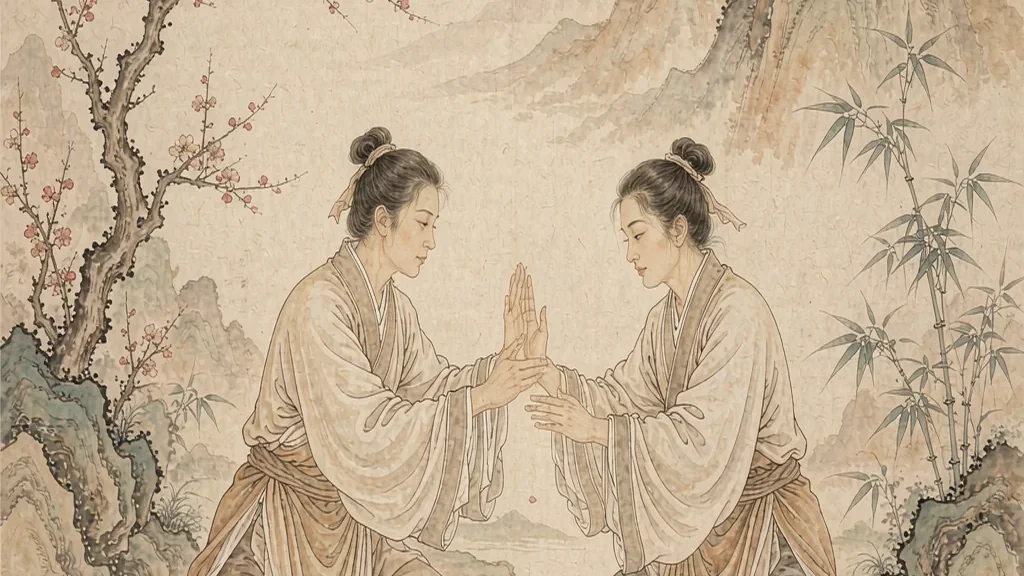
Taiji push hands, known as Tuishou, is the bridge practice of taiji quán that turns solo form work into living skill. Two partners place their forearms in contact and, through a set of fixed or moving patterns, learn to sense, yield, and redirect each other's force without resisting or collapsing. Rather than a contest of strength, push hands trains the practitioner to "stick, connect, follow, and neutralize," using softness to overcome hardness. Rooted in the same philosophy as taiji itself, it is at once a partner drill, a sensitivity exercise, and a gentle martial art. This article explains its principles, methods, levels, and benefits.
What Push Hands Is and Is Not
Push hands is a two-person drill in which partners maintain forearm contact and try to unbalance each other while keeping their own root. It is often misunderstood as a shoving match, but its aim is sensitivity, not force.
The practice grows directly out of the solo taiji form: the slow, rounded movements learned alone are now tested against a live partner who supplies real weight and intent.
Done well, it is cooperative before it is competitive — partners help each other feel correct timing and structure, only later turning the same skills toward playful pushing contests.
The Core Principle of Yielding
The central idea is "yield to overcome" — when pushed, do not meet the force head-on; instead follow it, absorb it, and redirect it so the opponent's own momentum unbalances them.
This is the practical face of the taiji maxim that softness defeats hardness. A relaxed arm can "listen" to pressure and move with it, while a stiff arm simply collides and loses the sensitive link.
Yielding is not weakness; it is active, intelligent movement that keeps contact and control while giving the partner nothing solid to push against.
Sticking, Connecting, and Following
Practitioners train the "four words": stick, connect, follow, and neutralize. The hands stick to the partner, the body connects the contact to the root, the movement follows the partner's force, and the result neutralizes the attack.
"Listening energy" is the tactile awareness developed through this contact — the ability to feel where and how the partner is about to move an instant before it happens.
With experience, the arms seem to know the partner's intention on their own, a skill that comes only from many hours of patient, light-touch practice.
Basic Fixed-Step Patterns
Beginners start with fixed-step single-hand or double-hand patterns, where the feet stay planted and the arms cycle through ward-off, roll-back, press, and push — the "ward-off, roll, press, push" square of energies.
These patterns drill the fundamental responses: how to receive a push, how to roll the arm to deflect, how to press, and how to issue a centered push of one's own.
Because the steps are fixed, the learner focuses entirely on the arms, the waist, and the feeling of root, building the grammar of push hands before adding movement.
Moving-Step and Free Push Hands
Once the fixed patterns are smooth, students add stepping, circling the partner while keeping contact, which introduces the problem of moving root and changing angles.
Free push hands removes the set pattern entirely: partners move as they wish within the rules of contact, applying the four energies and the "da lu" larger rolling pattern in open play.
This stage feels closest to a light martial exchange, yet good practice keeps it safe and exploratory rather than a test of who is strongest.
The Role of the Root and the Waist
All push hands power comes from the root in the feet, passes through the relaxed legs and waist, and arrives at the hands. The waist is the axle that turns incoming force aside.
A stable but not stiff stance lets the practitioner absorb a push into the ground, then return it as a centered issuance. Losing the root means being easily toppled.
Training the waist to turn smoothly is therefore as important as the arm work, since the body, not the limbs, does the real neutralizing and pushing.
From Sensitivity to Issuing Power
Early practice is almost all receiving and following; later the student learns "issuing," the moment of centered push that sends the partner back without telegraphing it.
Issuing relies on the whole-body connection built in the form: a small waist turn and sinking can launch a surprising amount of force because the whole structure moves as one.
The art is in the timing — to issue exactly when the partner's root is empty, so the push meets no resistance and simply carries them off balance.
Push Hands as a Health Practice
Because it is done slowly and with relaxed, circular motion, push hands is excellent low-impact exercise, improving balance, coordination, and leg strength for all ages.
The constant tactile feedback trains proprioception and calm focus, and many practitioners value the practice as much for stress relief and mindfulness as for martial skill.
Working with a partner also builds social connection, which is why push hands groups are common in parks where taiji is practiced communally.
Competition and Modern Spread
Push hands is contested in some taiji and wushu events, where rules vary from no-fall to full throwing, testing skill under mild pressure. These contests reveal the art's effectiveness.
Around the world, taiji schools include push hands as a standard part of curriculum, and workshops let students from different styles exchange the feeling of "listening."
Even in sport form, teachers stress that the heart of push hands remains sensitivity and yielding, not brute pushing strength.
Learning Push Hands as a Beginner
A newcomer should already know basic taiji stance and a little form, then find a partner and a teacher to learn the fixed patterns slowly, keeping touch light and even.
Safety matters: partners agree to stay relaxed, to step out rather than resist violently, and to avoid jerks that could strain a wrist or back. Control beats power.
With regular practice the student discovers the quiet thrill of the art — that by giving way, one gains the position from which the other cannot help but fall.
❓ Frequently Asked Questions
What is taiji push hands?
Tuishou is a two-person drill where partners keep forearm contact and learn to sense, yield, and redirect each other's force.
Is push hands a contest of strength?
No; it trains sensitivity and yielding. Meeting force with force defeats the purpose, which is to use softness against hardness.
What are the four energies?
They are ward-off, roll-back, press, and push — the basic responses drilled in fixed-step patterns.
Do I need to know the taiji form first?
It helps, because push hands applies the stance, relaxation, and structure learned in the solo form.
What is "listening energy"?
It is the tactile awareness, developed through contact, of where and how the partner is about to move.
Is push hands good exercise?
Yes; done slowly and relaxed, it improves balance, coordination, leg strength, and calm focus for all ages.