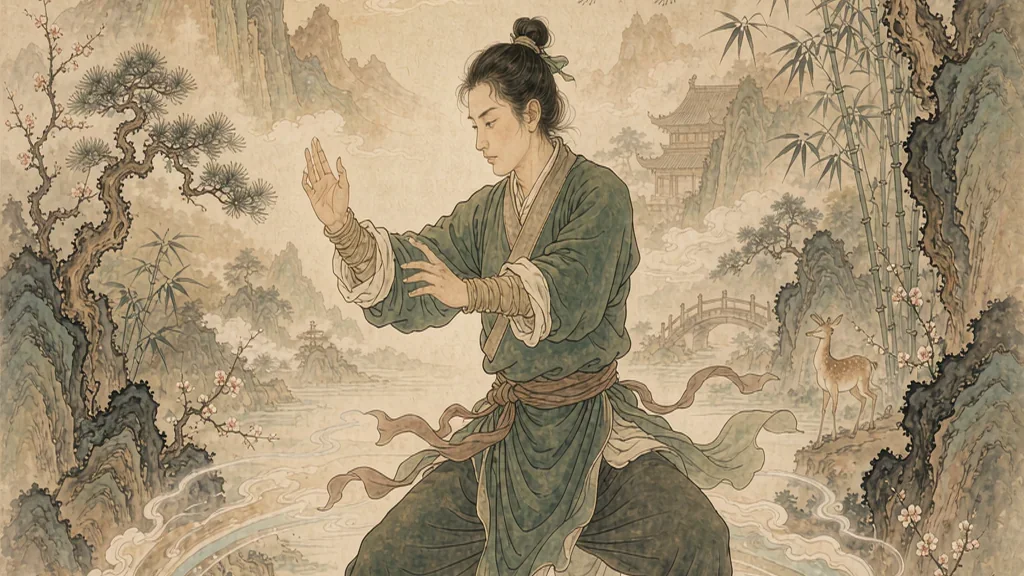
Bagua Zhang (八卦掌, "eight-trigram palm"), commonly called bagua, is one of the three principal internal (neijia) Chinese martial arts alongside taiji and xingyi. Famous for its practice of walking in continuous circles while the palms change shape to deflect, strike, and redirect, bagua develops whole-body coordination, evasive footwork, and spiraling power. Traditionally attributed to the nineteenth-century master Dong Haichuan, it blends Daoist circle-walking meditation with practical fighting. This article explores bagua's principles, history, training, and its role among the internal arts.
The Eight Trigrams and the Name
The name draws on the Yijing (Book of Changes), whose eight trigrams (bagua) symbolize natural forces and transformations. Bagua's circular walking and shifting palm positions are said to embody these changing relationships, though the philosophical framing is interpretive. The art's essence is motion and change, never a fixed posture.
For practitioners the trigrams are less a cosmology lesson than a reminder to stay adaptable: each step and palm change expresses a different "guarding" or "striking" intent, and the body should flow between them like the lines of a hexagram shifting. Change itself is the method.
Origins and Dong Haichuan
Bagua is traditionally credited to Dong Haichuan, a nineteenth-century figure who taught in Beijing and is said to have synthesized circle-walking with martial technique. As with many founders, the history mixes documented teaching with legend, and several regional branches claim slightly different sources. What is clear is bagua's rise in the late Qing court and martial circles.
Dong's students spread distinct lineages—some emphasizing large circular walking, others tighter steps or more striking—so "bagua" today is a family of related methods. Despite variation, all share the circle walk and the palm-centered movement that define the art.
The Circle Walk
Bagua's signature is walking a circle with the body low and the arms held in a guard, continuously changing direction by switching the lead foot ("mud-step" walking). The circle is both a conditioning drill and a tactical device: moving at an angle around an opponent keeps you off their line while you close or escape.
The walk trains the legs, hips, and balance while the upper body stays relaxed and ready. Practitioners often describe a calm center with moving periphery—the feet trace the circle while the palms respond to imagined or real contact, building the art's characteristic fluidity.
Palm Changes
Instead of fists, bagua uses open palms in a vocabulary of "palm changes" (zhang shi)—single palm, double palm, penetrating palm, and many more—each a transition that can deflect, strike, or control. The palms spiral from the waist, so power winds through the torso rather than the arm alone, giving strikes a twisting, penetrating quality.
Palm changes are linked into continuous sequences performed while walking, so the form never stops. This constant variation trains the ability to adapt instantly: a deflect becomes a strike becomes a lock within a few steps, reflecting bagua's "change is the only constant" logic.
Spiraling Power
Like other internal arts, bagua generates force through whole-body coordination: the stance roots, the waist rotates, and the spiral travels out through the arm to the palm. Relaxation stores the energy; a focused intent releases it. The result is "chan si jin," a coiling-silk power that winds and unwinds.
This spiraling makes bagua strikes feel different from straight punches—they seem to arrive from an unexpected angle and with a twisting shock. Training emphasizes feeling the connection from foot to palm so the power is embodied, not forced.
Two-Person and Combat Training
Beyond solo circle-walking, bagua uses partner drills: "rou shou" (soft hands) exchanges where practitioners stick and redirect, and applications where a palm change becomes a throw or lock. The evasive angle of the circle is rehearsed against a moving partner, building the timing to slip off-line.
Combat bagua values not meeting force head-on but sliding to the side and using the opponent's momentum. Its footwork lets a smaller person stay mobile around a larger attacker, a practical advantage the art is known for.
Health and Internal Cultivation
Bagua is valued for health: the circular walk aids balance and leg strength, the spiraling loosens the spine and joints, and the breath-led movement calms the mind. Many practice it primarily as gentle exercise, enjoying the meditative rhythm of the circle without sparring.
As an internal art, bagua links physical training to self-cultivation, teaching patience, awareness, and adaptability. The slow mastery of the circle mirrors a broader lesson about moving with change rather than resisting it.
Bagua Among the Internal Arts
Bagua pairs naturally with taiji (stillness in motion) and xingyi (direct intent), the three often called the internal family. Some practitioners study all three, finding bagua's mobility complements taiji's yielding and xingyi's explosiveness. Together they form a complete internal curriculum.
Modern practice includes standardized wushu forms of bagua alongside traditional lineages, so students can choose performance sport or deeper traditional study. Either way, the circle walk remains the heartbeat of the art.
Animal Imitation and Weapon Sets
Many bagua lineages include forms that imitate animals—the dragon, bear, eagle, and others drawn from the trigram symbolism—each emphasizing a quality such as coiling, rooting, or soaring. These animal sets broaden the vocabulary beyond the basic palm changes and keep training varied and engaging across a long practice life.
Weapon practice is also central: the bagua saber, the straight sword, and especially the long spear or the deer-horn knives let the circle-walking logic extend to an implement. The same evasive angle and spiral power apply, so the weapon feels like an extension of the palm rather than a separate art learned from scratch.
Some schools teach "walking the circle with a weapon" as advanced work, since managing the length while turning demands precise weight shifts and a calm center. Mastery of these sets is often treated as a marker of a mature bagua practitioner, signaling that the circle has become second nature.
Walking Practice Beyond the Gym
The circle walk is portable: practitioners often train it in parks, tracing a path on the ground, because it needs no partner and very little space. This makes bagua unusually easy to keep up as a daily habit compared with sparring-heavy arts that require a school, equipment, and a training partner.
Older adepts in particular favor the walk for its gentle, joint-friendly conditioning and its calming rhythm, sometimes combining it with breath work as much for health as for combat. The meditative quality is a feature of the method, not merely a byproduct of repetition, and many value it for that alone.
Done consistently, the walk becomes a moving form of attention training, teaching the body to stay relaxed and responsive while the mind stays quiet. Practitioners often report that this composure carries over into ordinary poise and balance, making the circle useful far beyond the martial context.
❓ Frequently Asked Questions
What is bagua zhang?
An internal Chinese martial art known for walking in circles while changing palm shapes to deflect, strike, and redirect, emphasizing mobility and spiraling power.
Why walk in circles?
The circle builds leg strength and balance and is a tactical angle: moving around an opponent keeps you off their line while closing or escaping.
Is bagua an internal art?
Yes, alongside taiji and xingyi; it generates power through whole-body relaxation and spiral coordination rather than muscular tension.
Who founded it?
Tradition credits Dong Haichuan in the nineteenth century, though lineages vary; the art rose in late-Qing Beijing martial circles.
Is it good for health?
Yes; the walk aids balance and legs, the spiraling loosens joints, and the breath-led motion calms the mind, making it popular as gentle exercise.
How is it different from taiji?
Bagua is constantly moving and angular with palm changes, while taiji emphasizes slow, rooted yielding; both are internal but feel quite distinct.