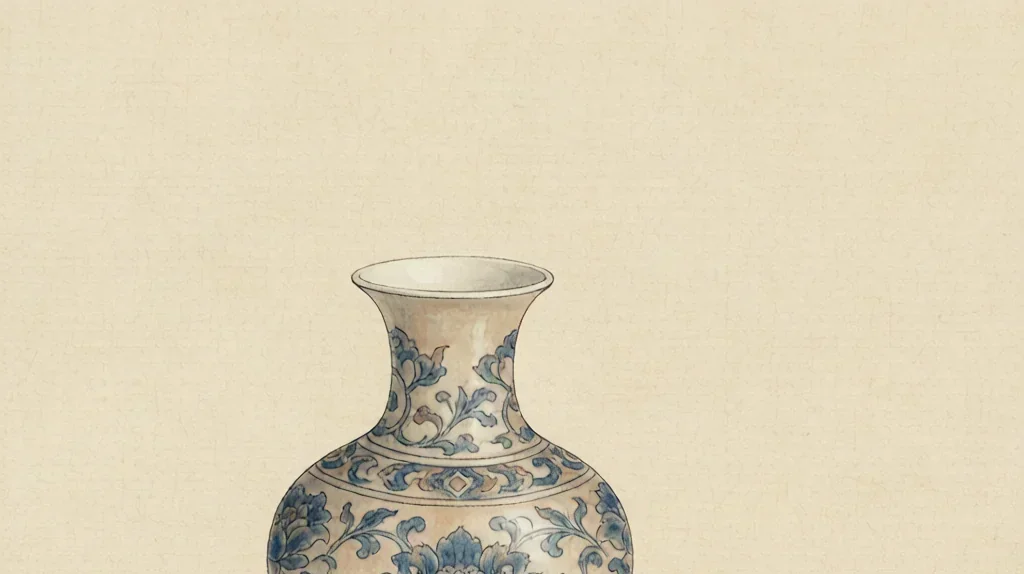
Few human inventions are as universal and yet as culturally distinctive as ceramics. Every civilization has made pottery, but only one culture gave its name to the finest ceramic product the world has ever known. When Europeans first encountered the translucent, ringingly resonant white ware from China, they called it simply "china" — and the name stuck. This is the story of how Chinese potters transformed humble clay into objects that emperors treasured, merchants sailed across oceans to obtain, and museums now guard as priceless artifacts.
The Chinese ceramic tradition stretches back an astonishing 20,000 years. Pottery sherds discovered at Xianrendong Cave in Jiangxi province are among the oldest known examples of fired clay vessels anywhere on Earth. But the true genius of Chinese ceramics lies not in mere antiquity but in a continuous chain of innovation — each dynasty adding new techniques, glazes, and firing methods that pushed the boundaries of what clay and fire could create.
Neolithic Beginnings: The First Masterpieces
Long before the first Chinese dynasty, Neolithic cultures were already producing pottery of remarkable sophistication. The Yangshao culture (c. 5000–3000 BCE), centered in the Yellow River valley, created elegant painted pottery decorated with spirals, net patterns, and stylized faces. Their vessels, shaped by coiling clay ropes and smoothed by hand, were fired in open pits at relatively low temperatures. The famous Majiayao culture in the upper Yellow River region produced even more elaborate painted wares, with bold black geometric designs swirling across buff-colored surfaces in rhythms that still feel strikingly modern.
Meanwhile, the Longshan culture (c. 3000–1900 BCE) in eastern China achieved a technological breakthrough: the potter's wheel. Longshan potters produced thin-walled, jet-black vessels with a metallic sheen, achieved through carbon-rich firing in reducing kilns. These "eggshell black" wares, some with walls as thin as 0.5 millimeters, demonstrate a level of technical mastery that would not be surpassed for centuries.
The Invention of Glaze and Proto-Porcelain
The Shang dynasty (c. 1600–1046 BCE) is famous for bronzes, but its potters made a quieter revolution: the invention of glaze. By applying a mixture of wood ash and clay to the surface of vessels and firing at high temperatures, they created a glossy, glassy coating that made pottery impermeable and beautiful. Early glazes were predominantly green, colored by iron oxide in the ash — the distant ancestor of celadon.
By the late Shang and Zhou periods, potters in southern China were producing proto-porcelain (yuanshi ci, 原始瓷). Using kaolin-rich clay and firing at temperatures approaching 1200°C, they created hard, resonant vessels with a thin greenish glaze. These were not yet true porcelain — the body was not fully vitrified — but they were recognizably on the path. The kilns of Zhejiang province, particularly around the area that would later be famous for celadon, led this development.
The Celadon Golden Age
If Chinese ceramics has a signature color, it is celadon — the misty, jade-like green glaze that captivated the Tang (618–907) and Song (960–1279) dynasties. The word "celadon" is European in origin (possibly from the name of a shepherd in a 17th-century French play who wore green ribbons), but the Chinese term is qingci (青瓷), "greenware." The aesthetic ideal was to imitate jade, the most precious material in Chinese culture, through the alchemy of glaze chemistry.
The Yue kilns of Zhejiang produced the finest early celadons, praised by Tang dynasty poets for being "like jade, like ice." But the Song dynasty represents the absolute zenith of celadon art. The imperial court patronized five "Great Kilns" — Ru, Guan, Ge, Jun, and Ding — each with its own distinctive character. Ru ware (汝窑) is the rarest and most coveted: fewer than 100 complete pieces survive today, their subtle blue-green glaze likened to "the sky after rain." Guan ware (官窑), produced under direct imperial supervision, is known for its deliberate crackle patterns, which the potters learned to control and aestheticize rather than avoid.
Jingdezhen: The Porcelain Capital
No discussion of Chinese ceramics is complete without Jingdezhen (景德镇). Located in Jiangxi province with abundant deposits of kaolin clay and petuntse (china stone), surrounded by forested hills that provided fuel for kilns, and connected by river to major trade routes, Jingdezhen was perfectly positioned to become the world's greatest ceramics center.
During the Song dynasty, Jingdezhen produced fine qingbai (青白) ware — a pale bluish-white porcelain so thin it was nearly translucent. But its golden age began under the Yuan dynasty (1271–1368), when the Mongol rulers, who controlled an empire stretching from Korea to Persia, brought cobalt pigment from the Middle East. This Persian cobalt, painted under a clear glaze, produced a brilliant blue that was far more vivid than anything Chinese potters had previously achieved. Thus was born blue-and-white porcelain (qinghua, 青花) — arguably the most iconic product in the history of Chinese art.
The Ming dynasty (1368–1644) elevated Jingdezhen to imperial status. Emperor Hongwu established the imperial kilns there in 1369, and for the next five centuries, Jingdezhen supplied the court with porcelain of breathtaking quality. The Yongle and Xuande reigns (early 15th century) are particularly celebrated for their deep, intense cobalt blues, often described as "heaped and piled" (duiji) — a slightly uneven effect caused by the cobalt pigment that connoisseurs came to treasure.
The Global Porcelain Trade
Chinese porcelain was not just an art form; it was a global commodity that reshaped world trade. From the Tang dynasty onward, ceramics traveled along the Maritime Silk Road, with shipwrecks like the Belitung wreck (c. 826 CE) revealing cargoes of tens of thousands of Chinese ceramics destined for the Abbasid Caliphate. Arab traders carried Chinese porcelain to the Middle East, where it was prized above all other tableware. The Persian word for porcelain, chini, simply means "Chinese."
When Portuguese ships reached China in the early 16th century, they inaugurated a direct sea trade that would flood Europe with Chinese porcelain. By the 17th century, the Dutch East India Company alone had imported over 40 million pieces of Chinese porcelain. European royalty competed to build porcelain rooms — entire chambers lined with Chinese ceramics. Augustus the Strong, Elector of Saxony, was so obsessed that he once traded 600 dragoons to the King of Prussia for 151 Chinese vases.
The mania for Chinese porcelain drove Europeans to desperate attempts to discover its secret. It was not until 1708 that Ehrenfried Walther von Tschirnhaus and Johann Friedrich Böttger succeeded in producing true hard-paste porcelain at Meissen, Germany — ending China's global monopoly after nearly a thousand years.
Beyond Blue and White: The Color Revolution
While blue-and-white dominates the popular imagination, Chinese potters mastered an extraordinary range of colors. The Ming dynasty developed overglaze enamels — colors painted onto already-fired glaze and fixed in a second, lower-temperature firing. The doucai (斗彩, "contending colors") technique combined underglaze blue outlines with overglaze enamels for a jewel-like effect. The Chenghua reign (1465–1487) produced doucai chicken cups so exquisite that a single example sold at auction in 2014 for over $36 million.
The Qing dynasty (1644–1912) brought even more chromatic brilliance. The famille verte (green family) and famille rose (pink family) palettes, so named by 19th-century French collectors, used imported enamel pigments to achieve unprecedented subtlety. The Kangxi, Yongzheng, and Qianlong emperors personally supervised the imperial kilns, demanding perfection and driving innovation. A single Qianlong vase might combine a dozen techniques — underglaze blue, overglaze enamels, carved decoration, and gilding — into a symphonic display of technical virtuosity.
📝 Chinese Vocabulary
- 陶瓷 (táocí) — Ceramics; pottery and porcelain collectively
- 青花 (qīnghuā) — Blue-and-white porcelain, literally "blue flower"
- 青瓷 (qīngcí) — Celadon, literally "green porcelain"
- 景德镇 (Jǐngdézhèn) — Jingdezhen, the Porcelain Capital
- 窑 (yáo) — Kiln; also refers to the wares produced at a particular kiln site
Sancai and the Tang Cosmopolitan Palette
The Tang dynasty gave China a looser, more worldly ceramic voice in sancai, or three-color ware. Using lead as a flux, potters melted mineral colors into flowing glazes of green (from copper), amber (from iron), and cream, often bleeding into one another on the surface. Sancai was applied chiefly to tomb figures, horses, camels, and elegant ewers rather than to daily tableware, and its exuberant, uneven drips suited the confident internationalism of Tang taste. Many pieces were shaped to please foreign markets along the Silk Road, showing Buddhist lions, Central Asian faces, and caravan animals. Although sancai is earthenware rather than true porcelain, its bold palette widened the Chinese ceramic imagination and fed directly into later colored glazes and the overglaze enamels of the Ming and Qing.
The Secret of the Imperial Kilns
From the Ming onward, the finest Chinese ceramics came not from free workshops but from imperial kilns run for the throne. Emperor Hongwu founded the imperial factory at Jingdezhen in 1369, and for five centuries it answered directly to the court, receiving designs, clay, and cobalt from the capital and returning only the best pieces. Failure was costly: the Ming 'sacrificial red' copper glaze succeeded only rarely, and potters who missed the imperial standard could be punished. Yet this pressure drove astonishing innovation, from the heaped-and-piled blues of Xuande to the famille rose enamels supervised by the Qianlong emperor himself. The imperial kilns kept their recipes as state secrets, so certain effects, like the exact Ru blue or a perfect copper red, vanished when a dynasty fell and were never fully recovered.
❓ Frequently Asked Questions
🎉 Fun Facts
- The Chinese word for "porcelain" is ci (瓷), and it was so admired that the English word "china" became synonymous with fine ceramic ware — one of the few cases where a country's name became a common noun for its most famous product.
- Jingdezhen's kilns once burned so brightly that a 17th-century French missionary wrote that at night the city looked like "a great city on fire" — hundreds of kilns glowing red against the dark Jiangxi hills.
- The Ming dynasty developed a secret "sacrificial red" glaze colored with copper oxide. The recipe was so difficult that even the imperial kilns only succeeded a fraction of the time. Potters who failed risked punishment — creating a powerful incentive for technical perfection.
- The Chenghua doucai chicken cup is among the most valuable small ceramics ever made, with one selling for over 36 million dollars.
- Ru ware, the rarest Song imperial porcelain, shows a subtle blue-green glaze and fine crackle, with fewer than a hundred pieces surviving.
- Tang sancai, or three-color ware, used lead fluxes to create green, amber, and cream glazes on horses and court figures.