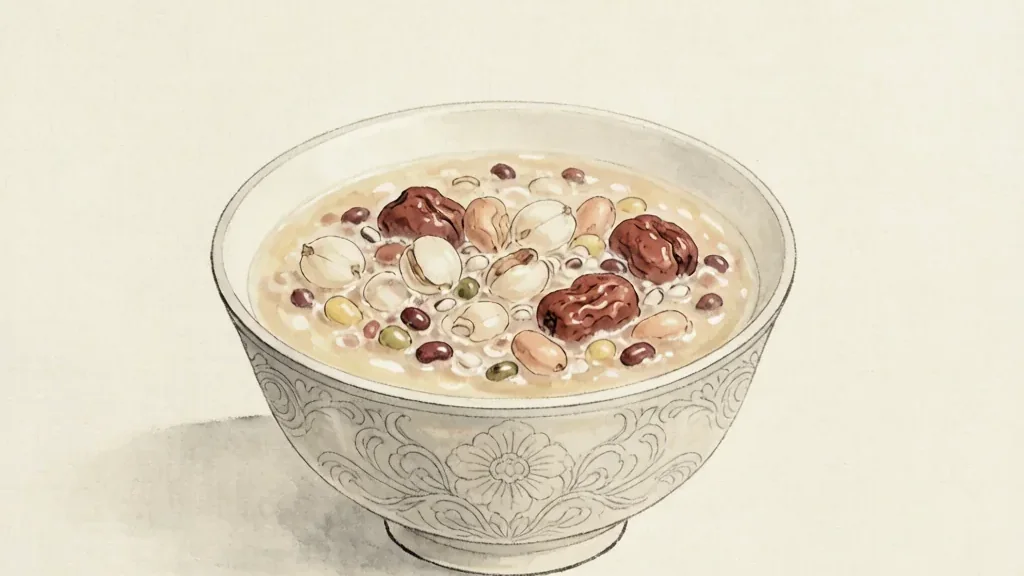
The observance of th twelfth lunar month — known as the Laba Festival (腊八节, Làbā Jié) — the aroma of simmering grains, beans, nuts, and dried fruits wafts from kitchens across China. This is the day when millions of families prepare laba porridge (腊八粥, làbā zhōu), a hearty, nutritious congee whose origins weave together Buddhist piety, ancient harvest rituals, and the practical wisdom of winter nutrition. The festival marks the beginning of the Chinese New Year season — a transitional moment when the old year's harvest is honored and preparations for the coming spring begin. Laba porridge, with its rich mixture of at least eight ingredients symbolizing abundance and harmony, serves as both a sacrificial offering to ancestors and deities and a nourishing meal that sustains families through the coldest days of winter. The name "laba" itself combines "la" (腊), the twelfth lunar month traditionally associated with sacrifice, and "ba" (八), the number eight, linking the dish directly to its calendar position and its requirement of eight symbolic ingredients.
Buddhist Origins and the Enlightenment of Shakyamuni Buddha
The most widely accepted origin story of laba porridge connects the dish to the enlightenment of Shakyamuni Buddha. According to Buddhist tradition, the historical Buddha, Siddhartha Gautama, spent six years practicing extreme asceticism in his quest for liberation from suffering. He reduced his food intake to a single grain of rice per day until his body became skeletal and he collapsed from weakness near the Nairanjana River. A village woman named Sujata found him and, recognizing his noble purpose, offered him a bowl of milk porridge made with rice, milk, and honey. Restored by this nourishment, Siddhartha realized that neither extreme indulgence nor extreme deprivation led to enlightenment. He sat beneath the Bodhi tree in Bodh Gaya, India, and on the eighth day of the twelfth lunar month — according to Chinese Buddhist reckoning — he attained complete enlightenment, becoming the Buddha. This story, preserved in Buddhist scriptures such as the "Lalitavistara Sutra" and transmitted to China through the works of early translators like Kumarajiva, provided Chinese Buddhism with a powerful justification for the middle path between asceticism and indulgence. The story of Sujata's offering resonated particularly deeply in a culture where the offering of food to monks and deities was already a well-established religious practice. Chinese Buddhists commemorate this event by preparing and sharing porridge on the Laba Festival, and the porridge itself is understood as both a reenactment of Sujata's offering and an expression of the Buddhist virtue of generosity (dana). Major temples prepare large quantities of laba porridge in iron cauldrons beginning before dawn, and the distribution of the porridge to the public is considered a meritorious act that accumulates good karma for the temple and its patrons.
Ingredients and Regional Variations Across China
The name "eight-treasure porridge" (八宝粥, babao zhou) — a common alternative name for laba porridge — refers to the minimum of eight ingredients traditionally included, though many recipes call for significantly more and can include up to twenty or even thirty different components. The number eight (八, bā) is auspicious in Chinese culture, homophonous with prosperity (发, fā) and associated with the Eight Immortals, the Eight Trigrams of the Yijing, and the Buddha's Eightfold Path. A classic northern Chinese laba porridge recipe includes: glutinous rice for stickiness and cohesion; millet for its golden color representing wealth; red beans for their red color symbolizing joy and warding off evil; mung beans for their cooling medicinal properties; lotus seeds symbolizing fertility and the hope for many children; red dates (jujubes) for their sweetness and association with prosperity; longan for reunion and wholeness; and peanuts, whose Chinese name "huasheng" (花生) literally means "birth of flowers" and symbolizes longevity. Additional common ingredients include barley, black rice, walnuts, chestnuts, goji berries, dried apricots, and rock sugar. Regional variations are extensive and reflect local agricultural traditions. In Beijing, the porridge tends to be sweeter and thicker, with an emphasis on dried fruits like raisins and preserved plums. In Shaanxi Province, the porridge incorporates local specialties like millet and includes a savory element with the addition of minced mutton and noodles. In Jiangsu and Zhejiang provinces, the porridge is often made with sweet osmanthus flowers, giving it a distinctive floral aroma. In Gansu Province, laba porridge is traditionally prepared with mutton broth rather than water, creating a savory version entirely different from the sweet porridges of eastern China. In Tibet, the tradition merges with local customs to create a version made with barley, yak butter, and dried cheese. Each region thus stamps the basic concept of "eight-treasure porridge" with its own character, demonstrating the remarkable adaptability of Chinese culinary traditions.
Laba Garlic and Other Festival Traditions
While laba porridge is the most famous food of the Laba Festival, it is not the only one. Another important tradition, particularly in northern China, is the preparation of laba garlic (腊八蒜, làbā suàn). On the same day that the porridge is cooked, families peel cloves of garlic and submerge them in rice vinegar in sealed jars. The jars are stored in a cool place, and over the following weeks, the garlic undergoes a remarkable transformation: the whitish cloves gradually turn a vivid, emerald green. This color change is a chemical reaction caused by the interaction of the vinegar's acetic acid with amino acids and enzymes in the garlic, and it is considered a sign that the preparation has been successful. By New Year's Eve, approximately three weeks later, the laba garlic is ready to be served alongside the traditional New Year's Eve dumplings (jiaozi). The green-tinted garlic has a milder, sweeter flavor than fresh garlic, having been mellowed by the vinegar, and the vinegar itself — now infused with garlic flavor — is used as a dipping sauce for the dumplings. The tradition of laba garlic is said to have originated in northern China during the Qing dynasty, possibly as a way to preserve garlic through the winter months when fresh vegetables were scarce. Beyond garlic, the Laba Festival is also traditionally associated with the beginning of the Chinese New Year preparation period. The folk proverb says: "After Laba, the year follows close behind" (过了腊八就是年). From this day forward, families begin the process of spring cleaning, purchasing New Year goods, and preparing decorations. In some regions, the Laba Festival also involves the practice of smearing laba porridge on fruit trees — a folk ritual believed to ensure a bountiful harvest in the coming year. In Hebei Province, this practice is called "feeding the trees" and is performed by the head of the household, who smears a spoonful of porridge on each tree trunk while chanting a blessing for abundant fruit.
Modern Adaptations and Cultural Preservation
The Laba Festival and its signature porridge have adapted successfully to modern Chinese life. Commercial food companies now produce canned and instant versions of laba porridge, making it accessible year-round. Wahaha, one of China's largest beverage companies, produces a popular canned babao zhou that has become a staple convenience food found in convenience stores and supermarkets throughout China. E-commerce platforms report a surge in pre-packaged laba porridge ingredient sets during the festival season, with Alibaba's Freshhema reporting a 200% year-over-year increase in laba porridge kit sales. The Chinese diaspora has carried the tradition worldwide: in San Francisco's Chinatown, the Buddha's Universal Church distributes laba porridge to thousands of visitors each year, and similar distributions occur at Chinese Buddhist temples in New York, London, Sydney, and Vancouver. The Laba Festival has also attracted interest from non-Chinese audiences through food tourism and cultural exchange programs. In 2021, the Laba Festival customs, including the preparation of porridge and laba garlic, were formally inscribed on China's National Intangible Cultural Heritage list, ensuring official support for their preservation and transmission to future generations. This recognition acknowledges the festival's unique role in embodying the harmonious coexistence of Buddhist, folk, and culinary traditions that characterizes Chinese religious culture — a single bowl of porridge that contains within it the story of the Buddha's enlightenment, the agricultural rhythms of the traditional Chinese calendar, and the warmth of family gathered against the winter cold.