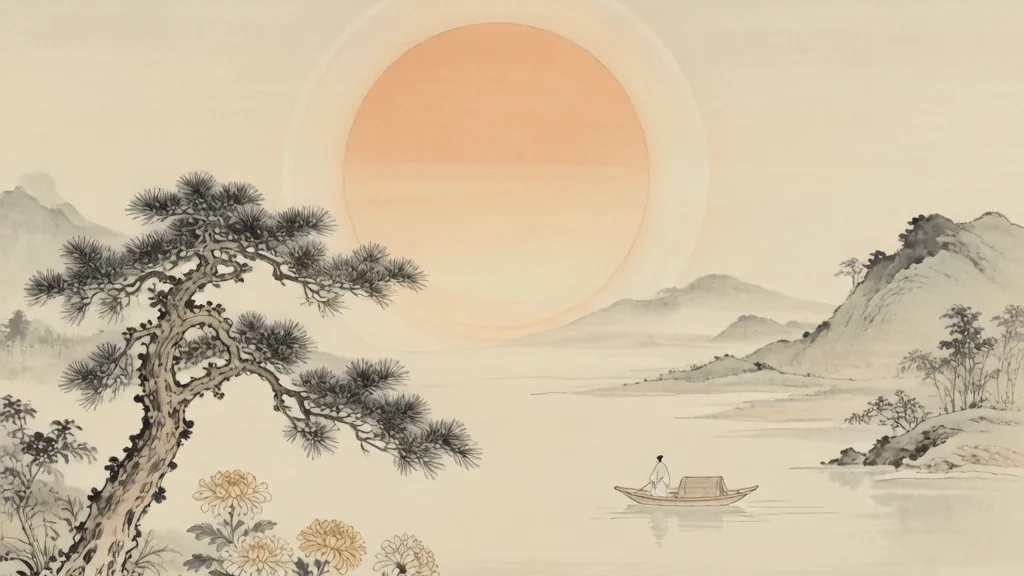
Qiufen, the "Autumn Equinox," is the sixteenth of the twenty-four traditional Chinese solar terms and usually falls on September 22 or 23. Like its spring counterpart Chunfen, Qiufen marks a day when day and night are nearly equal in length, after which the nights grow longer than the days. It sits between Bailu (White Dew) and Hanlu (Cold Dew) in the mid-autumn calendar. Qiufen is a moment of balance and, in the traditional view, of transition: the harvest is in full swing, the heat is gone, and the year tips toward its closing half. It is also a time woven into family and lunar festival observances, carrying both agricultural and cultural weight.
Balance of Day and Night
Qiufen occurs when the sun crosses the celestial equator moving southward, reaching a longitude of 180 degrees. On this day the lengths of daylight and darkness are closest to equal. After Qiufen, as the sun moves farther south, the northern hemisphere loses daylight steadily.
This astronomical balance made Qiufen a natural symbol of equilibrium in Chinese thought, which values the harmony of opposites. The term was sometimes a point for adjusting clocks and for ceremonies that honored the balance of yin and yang as the cooler, darker yin half of the year began.
The Three Pentads of Qiufen
Qiufen's pentads describe the autumn landscape. The first is "thunder begins to cease" (lei shi shou), as thunderstorms of summer give way to calm. The second is "insects burrow and close their doors" (zhong chong pei hu), hiding from the coming cold. The third is "water and rivers diminish" (shui shi ke), as rains lessen and streams run low.
Together these images sketch a world slowing down and drawing in. The dramatic weather of summer is past; the creatures and waters prepare for the restraint of winter. For farmers, the signs confirmed that the season of growth had ended and storage had begun.
The Harvest in Full Swing
Qiufen is one of the busiest harvest terms. In the north, the autumn grain — corn, sorghum, millet, and soybeans — is gathered; in central China, the middle rice crop is cut and dried. The work is urgent, because fair autumn weather can turn quickly to rain that spoils the grain.
The term's near-equal days gave a useful window of light for long working hours. Communities organized collectively, sharing labor and tools, and the successful Qiufen harvest secured food for the household through the winter. It was, in every sense, the climax of the agricultural year.
The Moon and Mid-Autumn Ties
Qiufen often falls near the Mid-Autumn Festival (Zhongqiu Jie), the lunar holiday of family reunion marked by mooncakes and moon viewing. Although the festival follows the lunar calendar and does not always coincide exactly with the solar term, the two are culturally linked as celebrations of autumn abundance.
In some traditions, Qiufen itself was a day to worship the moon, since the full autumn moon was considered especially bright. The connection between the equinox and moon reverence shows how the solar and lunar calendars intertwined in Chinese seasonal life.
Sacrifices to the Moon and Earth
Historically, Qiufen was associated with feminine and lunar rites. While the spring equinox (Chunfen) was linked to sun worship by the emperor, the autumn equinox was the time for moon and earth offerings. Households might set out plates of fruit and mooncakes toward the moon, praying for peace and a good year.
These rites expressed gratitude for the harvest and hope for its safe keeping. The act of offering the season's own produce back to heaven and earth closed a circle of reciprocity that defined the agricultural worldview.
Seasonal Foods
Autumn foods come to the fore at Qiufen. Freshly harvested rice, chestnuts, persimmons, pomegranates, and grapes appear in markets. In the south, the term is also a time for eating crabs, which are fat and ready in the autumn waters.
Many of these foods are not only tasty but, in traditional dietary thought, suited to the season's dryness — moistening fruits and warming grains that help the body adjust as the air turns cool and parched. Eating seasonally at Qiufen was both pleasure and medicine.
Weather Lore and Planting
Qiufen carried proverbs about the weather to come. One warned that a clear, fine Qiufen foretold a dry, windy late autumn, while another tied the term's temperature to the severity of the following winter. Such lore helped farmers time the sowing of winter wheat.
In the north, Qiufen is a key deadline for planting winter wheat, which must establish roots before the ground freezes. The term thus combined harvesting the old with sowing the new, a dual labor that defines the autumn equinox across the farming world.
Qiufen in Modern Life
Today Qiufen is observed less by farming than by food, family, and the appreciation of the season's beauty. City parks fill with visitors admiring chrysanthemums and the clear autumn sky. The term appears in calendars and apps as a prompt to notice the changing light.
Its deeper meaning — balance, gratitude, and the turning toward rest — remains resonant. In a hurried modern life, Qiufen offers a scheduled pause to recognize that the year is half-spent and the harvest, literal or figurative, deserves thanks.
Qiufen Customs in North and South
Local practice gave Qiufen different accents. In the north the term centered on the grain harvest and the urgent sowing of winter wheat, with communities pooling labor before the weather turned. In the south the rice harvest and the fattening of autumn crabs took focus.
Some regions marked the day with a small family meal built around the season's new foods, a modest echo of the Mid-Autumn feast to come. The act linked the solar term to the table even for households far from farming.
In towns, Qiufen was a time to air and store clothes and books against the damp that followed, a domestic rhythm keyed to the cooling air. Such chores, repeated yearly, made the term felt in the body before it was read in any almanac.
The Equinox in Classical Poetry
Poets used Qiufen's balance as a metaphor for life's turning point, the moment when light and dark stand even before the dark gains. The equal day became an image for maturity, loss, or the calm before decline.
The clear autumn sky and the bright full moon of the season supplied ready scenery for verse about reunion and absence, themes that overlap with Mid-Autumn poetry. The term thus sits at a rich intersection of nature and feeling in the literary record.
Farmers' proverbs about Qiufen's weather also entered casual speech, so that the term carried not only astronomical meaning but folk wisdom about the winter to come. In poem and saying alike, Qiufen named a pause the culture agreed to notice.
❓ Frequently Asked Questions
When does Qiufen occur?
Qiufen usually falls on September 22 or 23, when the sun reaches a celestial longitude of 180 degrees.
Why is it called the Autumn Equinox?
Because day and night are nearly equal in length on this day, before nights grow longer than days.
What are Qiufen's three pentads?
They are thunder ceasing, insects burrowing closed, and waters beginning to diminish.
How is Qiufen linked to the moon?
It is culturally tied to the Mid-Autumn Festival and historically a time for moon worship and offerings.
What foods are associated with Qiufen?
Fresh rice, chestnuts, persimmons, pomegranates, grapes, and autumn crabs are seasonal highlights.
What farming happens at Qiufen?
The main grain harvest continues, and in the north winter wheat must be sown before the ground freezes.