More About This Solar Term
This solar term has been observed in Chinese culture for thousands of years. Ancient Chinese farmers relied on these seasonal markers to plan their agricultural activities with remarkable precision. The 24 solar terms, originating in the Yellow River basin during the Zhou Dynasty (1046–256 BCE), represent one of humanity's earliest systematic approaches to understanding seasonal change.
In 2016, UNESCO recognized the Twenty-Four Solar Terms as an Intangible Cultural Heritage of Humanity, acknowledging their enduring importance in Chinese cultural identity and agricultural wisdom. Each solar term reflects a specific astronomical event or natural phenomenon — the sun's position at 15° intervals along the ecliptic — dividing the year into 24 equal segments of approximately 15 days each.
Traditional Chinese medicine closely aligns health practices with the solar terms. During each term, specific foods, exercises, and lifestyle adjustments are recommended to maintain harmony with nature. This philosophy, known as "yang sheng" (养生), or the art of nurturing life, remains widely practiced across China today. Seasonal ingredients are chosen not just for flavor but for their perceived medicinal properties — warming foods in winter, cooling foods in summer.
In literature and art, the solar terms have inspired countless poems, paintings, and musical compositions throughout Chinese history. Tang Dynasty poets like Du Fu and Li Bai frequently wove seasonal imagery into their verses, using the specific characteristics of each solar term to evoke mood and meaning. The famous Song Dynasty scroll painting "Along the River During the Qingming Festival" (清明上河图) takes its very name from one of the 24 solar terms — Qingming — capturing the vibrant life of a Chinese city during this spring moment.
Today, the solar terms continue to guide daily life in China. Farmers still consult the traditional calendar for planting and harvesting. Families observe customs passed down through generations — eating spring pancakes at Lichun (Start of Spring), honoring ancestors at Qingming (Clear and Bright), and gathering for family feasts at Dongzhi (Winter Solstice). Schools teach children about the solar terms, ensuring this ancient knowledge system remains alive for future generations. Weather forecasts on Chinese television often reference the current solar term, connecting modern meteorology with traditional wisdom.
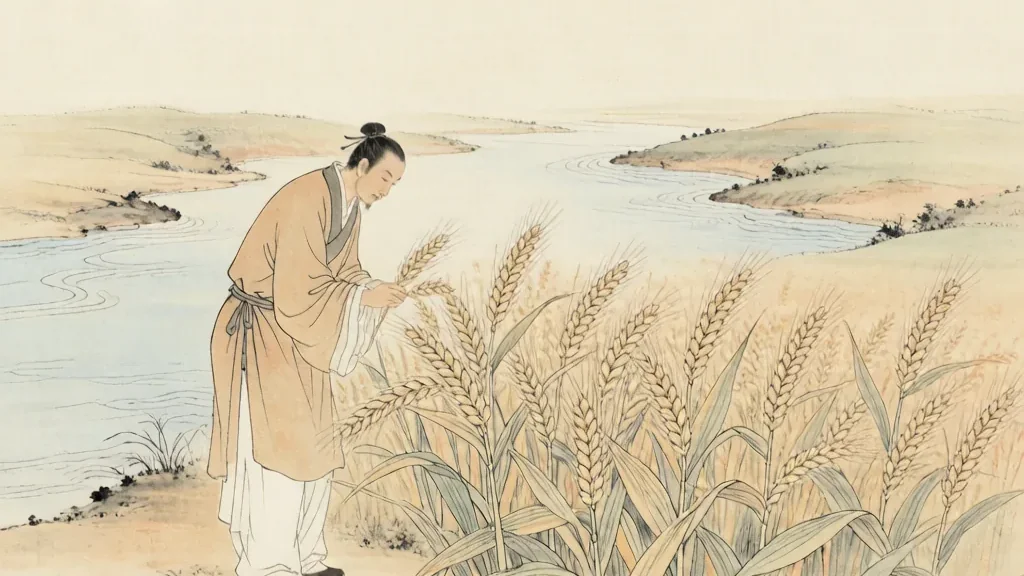
Grain Full (小满, Xiǎomǎn) occupies a unique place among the twenty-four solar terms — it is the only one whose name contains the character 小 (xiǎo), meaning "small" or "lesser." Falling between May 20th and 22nd, Xiaoman describes a state of incompleteness that Chinese philosophy regards as the most auspicious condition of all. The grains of wheat, barley, and other cereal crops have begun to fill with milky starch, swelling visibly beneath their husks, but they are not yet fully ripe. This state of "almost but not quite" — of potential on the verge of fulfillment — embodies a profound cultural value: the beauty and wisdom of knowing when enough is enough.
The name Xiaoman contains a philosophical depth that rewards careful reflection. The character 满 (mǎn) means "full," and in the context of the agricultural cycle, it refers to the grain kernels that are plump with developing endosperm. But 满 also carries the connotation of "fullness" in a broader sense — of having reached one's limit, of being complete. The prefix 小 (xiǎo) tempers this fullness, suggesting a state of sufficiency rather than excess. This distinction is crucial in Chinese thought: the proverb "满招损,谦受益" (mǎn zhāo sǔn, qiān shòu yì) warns that "fullness invites loss, while humility attracts benefit." Xiaoman thus teaches that the ideal state is not maximum fullness but balanced contentment — a lesson as relevant to modern life as it was to ancient agriculture.
The Grain-Filling Stage: Agricultural Science and Tradition
When the sun reaches 60 degrees of celestial longitude, Xiaoman begins, and the wheat fields of northern China enter their most critical developmental phase. The grain-filling period that gives Xiaoman its name is a biological miracle: carbohydrates produced through photosynthesis in the leaves and stems are rapidly transported to the developing kernels, where they accumulate as starch, swelling each grain with the energy that will sustain human life through the coming year. Farmers during this period become keen observers of their fields, walking the rows daily to monitor the progress of grain development and to watch for the first signs of the golden color that signals approaching ripeness.
The traditional method for testing grain ripeness during Xiaoman was elegantly simple: a farmer would pluck a wheat head from the field, rub it between his palms to separate the grains, and bite into a kernel. If the grain released a milky white liquid — the developing starch suspended in water — the crop was at the Xiaoman stage, still perhaps two weeks from harvest. If the kernel was firm and floury, harvest was imminent. This direct, sensory engagement with the crop reflects the intimate knowledge that traditional farmers developed over generations of working the same land, reading the same seasonal signals, and passing their observations from father to son.
The agricultural activities of Xiaoman extend well beyond wheat fields. In the rice-growing regions of southern China, farmers prepare the paddies for the approaching rice-planting season, repairing terrace walls, clearing irrigation channels, and flooding fields to soften the soil. The proverb "小满前后,种瓜种豆" (xiǎomǎn qián hòu, zhòng guā zhòng dòu) — "around Xiaoman, plant melons and sow beans" — guided the planting of summer vegetables and legumes across the country. Cotton, peanuts, and sweet potatoes all found their way into the warming soil during this period, each crop contributing to the diversified agricultural system that sustained Chinese civilization through centuries of climate variability.
Honoring the Silkworm Goddess
In the silk-producing regions of the Yangtze River Delta — particularly Zhejiang, Jiangsu, and Sichuan provinces — Xiaoman coincides with the peak of the spring silkworm season. The mulberry leaves that feed the silkworms are at their most tender and nutritious during this period, and the silkworms themselves, having passed through their voracious final larval stage, begin the miraculous process of spinning their cocoons. The sight of thousands of silkworms, their translucent bodies glowing with liquid silk protein, methodically constructing their protective shells, has inspired wonder and reverence in Chinese culture for over five thousand years.
The central ritual of Xiaoman in sericulture communities is the worship of the Silkworm Goddess (蚕神, Cánshén), a deity whose origins stretch back to the very beginnings of Chinese silk production. According to legend, the Silkworm Goddess was originally a young woman who promised to marry a horse that had saved her father's life. When her father killed the horse in horror at the proposed union, the horse's hide wrapped itself around the girl and transformed her into a silkworm — a myth that speaks to the mysterious, almost magical nature of silk production in the ancient world. During Xiaoman, silk-producing families would offer sacrifices of fruit, incense, and specially prepared rice cakes at small shrines dedicated to the goddess, praying for healthy silkworms and abundant cocoons.
The 祈蚕节 (Qícán Jié), or Silkworm Prayer Festival, observed during Xiaoman in regions like Huzhou and Suzhou, involved elaborate community ceremonies. Women, who traditionally managed silkworm rearing, would dress in their finest clothes and gather at local temples to burn incense and present offerings. The ceremonies were followed by festive meals featuring dishes made from the previous year's preserved cocoon byproducts — a reminder of the complete cycle of silk production. In some villages, opera performances told the story of the Silkworm Goddess, educating younger generations about the divine origins of their livelihood. These rituals strengthened community bonds and transmitted the specialized knowledge of sericulture — from mulberry cultivation to cocoon harvesting to silk reeling — that had made Chinese silk the envy of the world since the days of the Silk Road.
Eating Bitter Herbs: The Wisdom of Seasonal Cleansing
One of the most distinctive Xiaoman dietary traditions is the consumption of bitter vegetables and wild herbs — a practice known as 吃苦菜 (chī kǔ cài). Dandelion greens, sow thistle, shepherd's purse, and various wild mustards are gathered from fields and hillsides during this period, their slightly bitter flavor prized not despite but because of its intensity. In traditional Chinese medicine, bitter foods are associated with the fire element and are believed to clear heat from the body, stimulate the digestive system, and prepare the body for the full intensity of summer that lies ahead.
The practice of eating bitter herbs during Xiaoman reflects a sophisticated understanding of seasonal nutrition that developed over millennia of empirical observation. As temperatures rise and humidity increases during late spring and early summer, the body's digestive fire — associated with the spleen and stomach in Chinese medicine — can become sluggish. Bitter compounds stimulate the production of digestive enzymes and bile, counteracting the tendency toward summer-related digestive weakness. Modern nutritional science has confirmed what traditional wisdom long practiced: bitter greens are rich in vitamins, minerals, and phytochemicals that support liver function and provide antioxidant protection.
Bitter herbs are prepared in a variety of ways during Xiaoman. The simplest preparation — blanching the greens briefly in boiling water, then dressing them with sesame oil, vinegar, and a pinch of salt — allows their natural flavor to shine. More elaborate dishes incorporate bitter herbs into dumpling fillings, stir-fries with garlic, or soups with tofu and dried shrimp. The culinary philosophy is not to mask the bitterness but to balance it with complementary flavors — the nuttiness of sesame, the acidity of vinegar, the umami of dried seafood. This approach to bitter foods, embracing rather than avoiding their challenging flavor, reflects the broader Chinese cultural attitude that what is difficult or uncomfortable often carries the greatest benefit.
The Water Cart Festival: Honoring Agricultural Technology
In some regions of China, particularly along the Yellow River basin and in areas dependent on irrigation, Xiaoman was traditionally marked by the 祭车神 (Jì Chēshén) ritual — the sacrifice to the Water Cart God. The water cart (水车, shuǐchē), an ingenious chain-pump device powered by human feet, animal traction, or water current, was one of the most important agricultural technologies in traditional Chinese farming. During Xiaoman, as the need for irrigation intensified with rising temperatures, communities would honor the spirit of this essential machine with offerings and ceremonies.
The ritual typically involved bringing a water cart to a central location in the village, where it would be cleaned, inspected, and blessed. Farmers would offer sacrifices of fish, pork, and incense, placing bowls of water before the cart as a symbolic offering to the spirit that dwelled within the mechanism. In some regions, a live fish was released into the irrigation canal as a gesture of reciprocity — taking water from the river for irrigation while returning a creature to its waters. After the ceremony, the water carts would be put into active service, their rhythmic creaking becoming the soundtrack of the summer farming season.
The Water Cart God ritual represents the sophisticated way that traditional Chinese culture integrated technology, spirituality, and community organization. The water cart was not merely a machine; it was a partner in the agricultural enterprise, deserving of respect and ritual acknowledgment. The ceremony also served practical purposes: it ensured that irrigation equipment was inspected and maintained before the critical summer period, and it coordinated community water management at a time when efficient irrigation could mean the difference between harvest and hunger. Today, while motorized pumps have largely replaced traditional water carts, the underlying principle — that water management requires both technical competence and community cooperation — remains as relevant as ever.
Xiaoman in Poetry and Philosophy
Xiaoman has inspired Chinese poets and philosophers for centuries with its theme of beautiful incompleteness. Song Dynasty poet Ouyang Xiu captured the season's essence in verses describing the gentle swaying of wheat in the wind, the songs of orioles among mulberry branches, and the particular quality of late-spring light. The poet's observation that the wheat is "full but not yet golden" became a metaphor for the most desirable state of human affairs — sufficient, promising, but not yet at the point of inevitable decline. This poetic sensibility draws on the ancient Daoist insight that what is full must soon empty, what is complete must soon break, and therefore the wise person stops before reaching the point of fullness.
The philosophical dimension of Xiaoman finds expression in the traditional Chinese concept of 中庸 (zhōngyōng) — the Doctrine of the Mean, or the cultivation of balanced moderation. Just as the grain at Xiaoman has achieved sufficiency without excess, the cultivated person seeks a state of balanced contentment rather than relentless accumulation. This is not a counsel of mediocrity but of wisdom: knowing when one has enough, recognizing that the pursuit of maximum gain often leads to loss, and finding satisfaction in the process of growth rather than only in its completion. In a modern world of constant pressure toward more — more productivity, more consumption, more achievement — Xiaoman offers a gentle countercultural message: sometimes, "small fullness" is the truest form of abundance.
Regional Variations of Xiaoman Customs
Although Xiaoman is observed nationwide, its customs shift with local agriculture. In the Yangtze Delta and Sichuan, the Silkworm Goddess rituals dominate, with whole communities pausing sericulture work for prayer and feast. Across the North China Plain, attention centers on wheat and the Water Cart God, as irrigation becomes urgent. Southern rice regions mark Xiaoman by flooding and repairing paddies rather than by silk. Even the bitter-herb tradition varies: northern families favor sow thistle and dandelion greens, while southern cooks may add wild watercress. These regional emphases show how one solar term adapts to the crops, climate, and crafts of each place, yet all share the underlying idea of living in step with the season's turning point.
Xiaoman and the Modern Farm Calendar
Today Xiaoman still guides Chinese agriculture even amid mechanized farming and weather satellites. Agronomists issue advisories timed to the term: monitor wheat moisture, guard against late frost, and begin rice transplantation in the south. The philosophical side also survives in modern life, where 'small fullness' has become a gentle popular motto against overwork and endless accumulation. Schools and museums use Xiaoman to teach children the twenty-four terms, and social media fills with photos of ripening fields and plates of bitter greens. Far from being a relic, the term remains a living checkpoint that connects scientific scheduling, cultural memory, and a distinctly Chinese attitude toward sufficiency and restraint.
❓ Frequently Asked Questions
📝 Chinese Vocabulary
- 小满 (xiǎo mǎn) — Grain Full; the eighth solar term, meaning "lesser fullness"
- 吃苦菜 (chī kǔ cài) — Eating bitter vegetables; the seasonal dietary practice of consuming wild bitter greens
- 蚕神 (Cánshén) — The Silkworm Goddess; the deity honored during Xiaoman in sericulture regions
- 祭车神 (jì chē shén) — Sacrifice to the Water Cart God; the ritual honoring irrigation technology
- 中庸 (zhōng yōng) — The Doctrine of the Mean; the Confucian ideal of balanced moderation
🎉 Fun Facts
- Xiaoman is the only one of the 24 solar terms whose name begins with 小 (xiǎo), reflecting the Chinese cultural preference for modesty and the wisdom of avoiding excess.
- The silkworms raised during Xiaoman produce the highest quality silk of the year, as the mulberry leaves they consume are at peak nutritional value during this season.
- Farmers traditionally test wheat ripeness by biting a grain kernel — if it releases a milky white liquid, the crop is at the Xiaoman stage and still needs about two more weeks to mature.
- In Chinese philosophy, "small fullness" is considered a more desirable state than "great fullness," reflecting the belief that reaching one's absolute limit invites reversal and loss.
- The ancient phenological calendar records three signs of Xiaoman: bitter herbs flourish, weaker plants wither in the heat, and the wheat harvest draws near — a precise biological timetable farmers relied on for centuries.
- In parts of southern China, Xiaoman was considered an auspicious moment to repair and bless the year's irrigation water wheels, blending practical farming with ritual respect for the water that would carry crops through summer.