More About This Solar Term
This solar term has been observed in Chinese culture for thousands of years. Ancient Chinese farmers relied on these seasonal markers to plan their agricultural activities with remarkable precision. The 24 solar terms, originating in the Yellow River basin during the Zhou Dynasty (1046–256 BCE), represent one of humanity's earliest systematic approaches to understanding seasonal change.
In 2016, UNESCO recognized the Twenty-Four Solar Terms as an Intangible Cultural Heritage of Humanity, acknowledging their enduring importance in Chinese cultural identity and agricultural wisdom. Each solar term reflects a specific astronomical event or natural phenomenon — the sun's position at 15° intervals along the ecliptic — dividing the year into 24 equal segments of approximately 15 days each.
Traditional Chinese medicine closely aligns health practices with the solar terms. During each term, specific foods, exercises, and lifestyle adjustments are recommended to maintain harmony with nature. This philosophy, known as "yang sheng" (养生), or the art of nurturing life, remains widely practiced across China today. Seasonal ingredients are chosen not just for flavor but for their perceived medicinal properties — warming foods in winter, cooling foods in summer.
In literature and art, the solar terms have inspired countless poems, paintings, and musical compositions throughout Chinese history. Tang Dynasty poets like Du Fu and Li Bai frequently wove seasonal imagery into their verses, using the specific characteristics of each solar term to evoke mood and meaning. The famous Song Dynasty scroll painting "Along the River During the Qingming Festival" (清明上河图) takes its very name from one of the 24 solar terms — Qingming — capturing the vibrant life of a Chinese city during this spring moment.
Today, the solar terms continue to guide daily life in China. Farmers still consult the traditional calendar for planting and harvesting. Families observe customs passed down through generations — eating spring pancakes at Lichun (Start of Spring), honoring ancestors at Qingming (Clear and Bright), and gathering for family feasts at Dongzhi (Winter Solstice). Schools teach children about the solar terms, ensuring this ancient knowledge system remains alive for future generations. Weather forecasts on Chinese television often reference the current solar term, connecting modern meteorology with traditional wisdom.
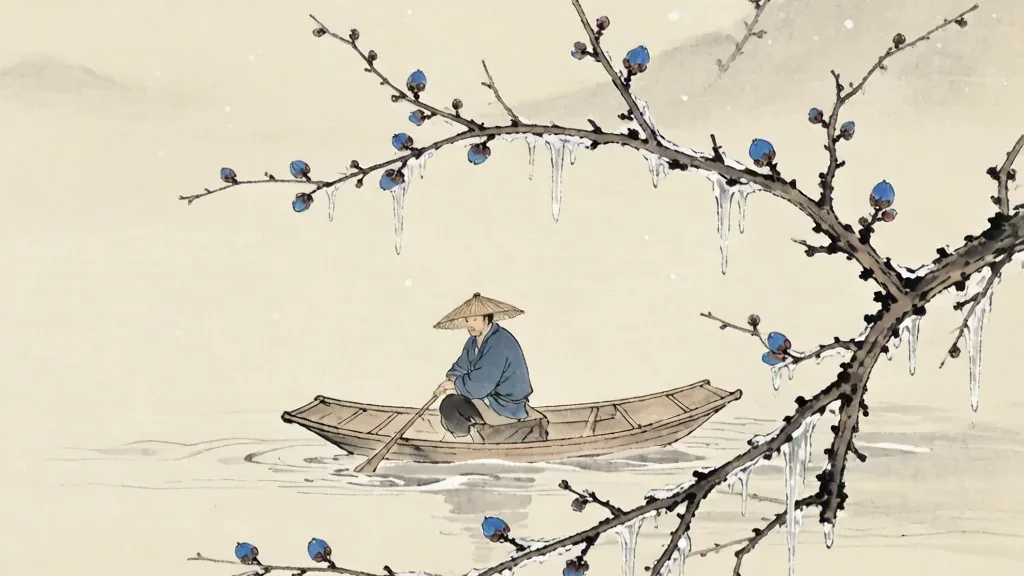
Minor Cold (小寒, Xiǎohán) arrives as the twenty-third solar term, and despite its diminutive name, it often brings the most bitter cold of the entire year. Falling annually between January 5th and 7th, Xiaohan marks the period when winter reaches its deepest intensity — when the wind cuts like a knife, when breath crystallizes in the air, and when the frozen earth seems to hold its breath, waiting for the distant promise of spring. The paradox of Xiaohan's name — "minor" cold for what is often the coldest period — reflects a characteristically Chinese subtlety: the cold is called "minor" because the "major" cold (大寒, Dàhán) follows, even though in many regions Xiaohan is actually the colder of the two.
The name Xiaohan speaks with elegant precision: 小 (xiǎo) means "minor" or "small," and 寒 (hán) means cold. Together they describe the penetrating, bone-deep cold that characterizes this season. When the sun reaches 285 degrees of celestial longitude, Minor Cold officially begins. In the philosophy of yin and yang, this moment represents yin energy at its absolute peak — the maximum expression of cold, darkness, and contraction. Yet the ancient sages understood that this extreme point also contains its opposite: within the deepest cold, the first stirrings of returning yang energy can be detected, like a pulse barely felt beneath the frozen surface. The winter solstice has passed; the days are already lengthening, imperceptibly but inexorably; and the entire cosmos, having reached its nadir, has begun its long climb back toward the light and warmth of spring.
The Depths of Winter: Climate and Phenology
The climatic character of Xiaohan is defined by extremes. In the northeastern provinces, temperatures routinely plunge to thirty or forty degrees below zero Celsius, and the landscape transforms into a frozen tableau of white and grey. The Songhua River in Harbin freezes solid, its ice thick enough to support cars and trucks, and the city's famous ice festival reaches its peak, with elaborate sculptures illuminated from within by colored lights. In Beijing, the northwest wind — known as the "Xiaohan wind" — howls through the city's ancient hutongs, and the lakes of the imperial gardens freeze into sheets of grey ice dotted with skaters. Even in the relatively mild south, the cold penetrates in a way that summer's heat never does — a damp, pervasive chill that seeps through walls and clothing alike.
Ancient Chinese observers identified three phenological signs marking the arrival of Xiaohan. In the first pentad, wild geese were said to begin their northern journey — a seemingly counterintuitive observation, as one would expect birds to flee the cold rather than move toward it. Yet the ancient Chinese understood that the geese, sensitive to the subtle lengthening of days that follows the winter solstice, were already responding to the returning yang energy that would eventually bring spring. In the second pentad, magpies were observed to begin building their nests, preparing for the breeding season ahead. By the third pentad, pheasants were heard to call — their cries, described in classical texts as "the voice of the pheasant," were interpreted as the birds' response to the stirring yang energy in the earth. These observations, transmitted through generations, represent a civilization's patient attention to the earliest signs of seasonal change, finding hope in the smallest signals of returning life.
For agricultural communities, Xiaohan marked a period of intense preparation rather than idleness. The Chinese New Year, the most important festival of the year, was approaching, and the weeks of Xiaohan were devoted to the myriad tasks required for its celebration. Houses were swept from top to bottom, driving out the accumulated dust and bad luck of the old year. New clothes were sewn, festival foods were prepared and stored, and red paper couplets bearing auspicious phrases were written and set aside for the New Year's decorations. The rhythm of rural life, which had slowed during the earlier winter months, now quickened with anticipation, as the entire community turned its attention toward the great festival that would mark the year's renewal.
Laba Festival and Laba Porridge
Xiaohan frequently coincides with the Laba Festival (腊八节, Làbā Jié), celebrated on the eighth day of the twelfth lunar month. This ancient festival, with roots stretching back over two thousand years, centers on the preparation and sharing of Laba porridge (腊八粥, làbā zhōu) — a rich, sweet congee made from a medley of grains, beans, nuts, and dried fruits. The tradition of Laba porridge blends Buddhist and folk elements into one of Chinese culture's most beloved winter customs, and its arrival during the depths of Xiaohan provides both physical warmth and spiritual comfort.
The origins of Laba porridge are traditionally traced to the story of Sakyamuni, the historical Buddha. According to Buddhist tradition, the prince who would become the Buddha spent years practicing extreme asceticism in his quest for enlightenment, reducing himself to a living skeleton. Realizing that self-mortification was not the path to understanding, he accepted a bowl of milk porridge offered by a village girl named Sujata. Nourished by this simple meal, he sat beneath the bodhi tree and attained enlightenment on the eighth day of the twelfth lunar month. The Laba Festival commemorates this event, and the tradition of preparing and sharing porridge on this day spread from Buddhist temples throughout Chinese society. For centuries, temples across China have prepared enormous vats of Laba porridge on this day, distributing it freely to the public as an act of compassion and blessing.
The preparation of Laba porridge is an art in itself, with recipes varying by region and family tradition. The basic formula includes glutinous rice as a base, to which are added red beans, mung beans, peanuts, lotus seeds, red dates, longan, goji berries, and various other ingredients depending on availability and preference. The porridge is simmered slowly for hours, the grains and beans gradually breaking down into a thick, creamy consistency while the dried fruits release their sweetness into the broth. The finished porridge is a mosaic of colors and textures — the red of jujubes, the gold of millet, the brown of chestnuts, the translucent white of lotus seeds — each spoonful a different combination of flavors. The porridge is traditionally sweetened with rock sugar and sometimes garnished with dried osmanthus flowers or rose petals. The sharing of Laba porridge among family members, neighbors, and even strangers represents the Confucian virtue of communal care and the Buddhist ideal of universal compassion, woven together in a single, steaming bowl.
Plum Blossom Appreciation: Seeking Beauty in the Cold
Among the most elegant customs associated with Xiaohan is the appreciation of plum blossoms (探梅, tàn méi) — literally "seeking out the plum." The plum tree (梅, méi) is unique among flowering plants in that it blooms during the coldest part of winter, its delicate pink and white blossoms opening on bare branches while snow still covers the ground. This remarkable quality has made the plum blossom one of the most revered symbols in Chinese culture, representing the noble person who maintains virtue and integrity through adversity. The custom of venturing out into the winter cold specifically to view plum blossoms speaks to a deeply held Chinese value: that beauty is most precious when it appears in unlikely places, and that the human spirit, like the plum, can bloom even in the harshest conditions.
The tradition of plum blossom appreciation during Xiaohan has inspired Chinese artists and poets for over a thousand years. The Song Dynasty poet Lin Bu famously lived as a recluse on Solitary Hill by West Lake in Hangzhou, devoting his life to the cultivation and appreciation of plum blossoms. His poem declaring the plum his wife and the crane his son has become one of the most quoted verses in Chinese literature. Painters of the Song and Yuan dynasties developed a distinctive style of plum blossom painting — ink on silk, the branches rendered in bold, calligraphic strokes, the blossoms in delicate washes of pale color — that captured the flower's paradoxical combination of fragility and strength. The "Three Friends of Winter" (岁寒三友, suì hán sān yǒu) — pine, bamboo, and plum — became a standard motif in Chinese art, representing the virtues of endurance, flexibility, and purity that sustain the noble person through difficult times.
In modern China, the tradition of seeking plum blossoms during Xiaohan remains vibrantly alive. Parks and gardens known for their plum collections — West Lake in Hangzhou, the Plum Garden in Nanjing, the Fragrant Hills in Beijing — draw crowds of visitors during this season, who brave the cold to witness the blossoms' brief, brilliant display. Photographers capture the contrast of pink petals against white snow, painters set up easels in the winter gardens, and poets continue to find inspiration in the plum's stubborn beauty. The custom serves as a cultural reminder that winter, for all its harshness, contains its own form of beauty — a beauty that requires effort to seek out, that rewards those who venture into the cold, and that speaks to the resilience of life in even the most unforgiving seasons.
Winter Foods and the Nourishment of Deep Cold
The cuisine of Xiaohan is defined by intense warmth and deep nourishment. In a season when the body's energy is concentrated inward and the cold demands constant fuel, the foods of Xiaohan are designed to generate internal heat and strengthen the body's core reserves. Mutton, the most warming of all meats according to traditional Chinese medicine, dominates the winter kitchen. Mutton soup, simmered for hours with ginger, star anise, cassia bark, and angelica root, fills homes with its rich, aromatic steam. Mutton hotpot brings families together around bubbling cauldrons of spicy broth, the shared meal generating warmth that is both physical and social.
Glutinous rice (糯米, nuòmǐ) features prominently in Xiaohan cuisine, its sticky, warming nature making it the ideal grain for deep winter. In the Jiangnan region, families prepare "eight-treasure rice" (八宝饭, bābǎo fàn) — glutinous rice steamed with red bean paste, dried fruits, nuts, and seeds, then inverted onto a plate to reveal a mosaic of colors and textures. The dish is simultaneously a dessert, a health tonic, and a work of art, its eight treasures symbolizing abundance and completeness. Black sesame paste (黑芝麻糊, hēi zhīma hú), ground from toasted black sesame seeds and simmered with rice flour and sugar, is consumed as a warming breakfast or evening snack, its rich, nutty flavor and dark color connecting it to the kidneys — the organs most associated with winter and the color black in Chinese medical philosophy.
The general principle of Xiaohan eating extends beyond specific ingredients to encompass methods of preparation and consumption. All foods should be served hot — the warmth of the food itself is considered as important as its inherent thermal nature. Soups, stews, and porridges are preferred over dry or cold preparations. Meals are taken in a calm, unhurried manner, allowing the body to fully absorb the nourishment offered. The traditional advice to avoid raw, cold foods during Xiaohan is not merely about comfort but about protecting the spleen and stomach — the organs of digestion — from the damaging effects of cold. In this way, every meal during Xiaohan becomes an act of preventive medicine, a daily practice of aligning the body's internal environment with the demands of the external season.
Health and the Preservation of Yang in Deep Winter
Traditional Chinese medicine identifies Xiaohan as a period of maximum vulnerability and maximum opportunity. The vulnerability lies in the extreme cold, which can invade the body through any point of exposure and damage the yang energy that sustains life. The opportunity lies in the body's heightened receptivity to nourishment during this season of inward-turning energy — the same principle that makes winter the ideal season for taking tonic herbs and building deep reserves. The health practices of Xiaohan thus focus on a dual strategy: protect against cold invasion while simultaneously strengthening the body's core.
Protection against cold focuses on three key areas of the body. The lower back, where the kidneys are located, must be kept warm at all times — kidney yang is the root of all yang energy in the body, and damage to the kidneys during winter can have consequences that persist throughout the year. The feet, through which cold most easily enters the body, require particular attention: warm socks, insulated shoes, and nightly foot baths in hot water infused with ginger, mugwort, or Sichuan peppercorn are standard practices. The neck and upper back, where the "wind gate" acupuncture points are located, should be protected with scarves and high-collared clothing. The traditional image of the warmly wrapped elder, moving slowly through the winter landscape, represents not fragility but wisdom — the accumulated knowledge of how to preserve health through the most challenging season.
Exercise during Xiaohan follows the principle of "not disturbing the yang." Vigorous, sweat-producing activity is discouraged, as sweating opens the pores and allows cold to invade while simultaneously depleting the body's precious yang reserves. Instead, gentle indoor movement — tai chi practiced in a warm room, qigong exercises that emphasize internal energy circulation, or simple stretching — maintains flexibility and circulation without exhausting the body. The timing of exercise is also important: outdoor activity should be limited to the warmest part of the day, when the sun is at its highest, and should cease as darkness falls. These practices, developed over centuries of careful observation, represent a sophisticated understanding of the relationship between human physiology and seasonal rhythms — a wisdom that continues to guide health practices in China today, and that offers valuable perspective for anyone seeking to live in harmony with the natural world.
Counting the Nines: The Winter Countdown
A beloved way to survive the cold of Xiaohan is the custom of 'counting the nines,' which splits the deepest winter into nine periods of nine days each, from the winter solstice toward spring. Families tracked the passage on a 'nine-nine cold-dispelling picture,' a chart or poem whose strokes were filled in one by one as each nine-day cycle passed, so that the act of marking time became a small daily ritual of hope. The practice turned an otherwise featureless stretch of cold into a countable journey, and the final nine was said to bring the thaw. It is a charming example of how the solar-term calendar gave people a psychological handle on winter's length.
Xiaohan Proverbs and the Cold Peak
Xiaohan inspired proverbs that treated cold as something to be read and respected. Sayings warned that the coldest days come not at the solstice but in the 'third nine' after it, a window that often falls during Minor Cold, and they advised sealing windows, wrapping the body, and eating warming broths. Other rhymes linked the term's severity to the year's wheat, since a thorough freeze could kill pests and lock in moisture for spring. These proverbs show rural wisdom meeting the season head-on: rather than wishing the cold away, people measured it, named its stages, and built their routines around its predictable, if harsh, progression toward the return of warmth.
❓ Frequently Asked Questions
📝 Chinese Vocabulary
- 小寒 (xiǎo hán) — Minor Cold; the twenty-third solar term, often the coldest period of the year
- 腊八粥 (là bā zhōu) — Laba porridge; a rich grain and fruit porridge eaten during the Laba Festival
- 探梅 (tàn méi) — Seeking plum blossoms; the winter custom of appreciating plum blossoms
- 岁寒三友 (suì hán sān yǒu) — The Three Friends of Winter: pine, bamboo, and plum blossom
- 八宝饭 (bā bǎo fàn) — Eight-treasure rice; a festive glutinous rice dish with dried fruits and nuts
🎉 Fun Facts
- Despite its name "Minor Cold," Xiaohan is often colder than Dahan (Major Cold) in many regions of China — a linguistic quirk that has puzzled observers for centuries.
- The Laba Festival, which often falls during Xiaohan, is considered the unofficial start of the Chinese New Year preparations, with a saying that "after Laba, it's the New Year" (过了腊八就是年).
- Plum blossoms can survive temperatures as low as -25°C, and their ability to bloom in snow has made them a symbol of perseverance in Chinese culture for over a thousand years.
- In some northern regions, people practice the custom of "ice play" during Xiaohan, skating and sledding on frozen rivers in activities that have been enjoyed since the Song Dynasty.
- The 'counting the nines' custom divides the deepest part of winter into nine periods of nine days, and families once marked each with a stroke on a picture or a poem to count down to spring.
- The Laba Festival porridge traditionally contains eight or more grains and dried fruits, and sharing it was a way to honor ancestors and strengthen community bonds in the coldest days.