More About This Solar Term
This solar term has been observed in Chinese culture for thousands of years. Ancient Chinese farmers relied on these seasonal markers to plan their agricultural activities with remarkable precision. The 24 solar terms, originating in the Yellow River basin during the Zhou Dynasty (1046–256 BCE), represent one of humanity's earliest systematic approaches to understanding seasonal change.
In 2016, UNESCO recognized the Twenty-Four Solar Terms as an Intangible Cultural Heritage of Humanity, acknowledging their enduring importance in Chinese cultural identity and agricultural wisdom. Each solar term reflects a specific astronomical event or natural phenomenon — the sun's position at 15° intervals along the ecliptic — dividing the year into 24 equal segments of approximately 15 days each.
Traditional Chinese medicine closely aligns health practices with the solar terms. During each term, specific foods, exercises, and lifestyle adjustments are recommended to maintain harmony with nature. This philosophy, known as "yang sheng" (养生), or the art of nurturing life, remains widely practiced across China today. Seasonal ingredients are chosen not just for flavor but for their perceived medicinal properties — warming foods in winter, cooling foods in summer.
In literature and art, the solar terms have inspired countless poems, paintings, and musical compositions throughout Chinese history. Tang Dynasty poets like Du Fu and Li Bai frequently wove seasonal imagery into their verses, using the specific characteristics of each solar term to evoke mood and meaning. The famous Song Dynasty scroll painting "Along the River During the Qingming Festival" (清明上河图) takes its very name from one of the 24 solar terms — Qingming — capturing the vibrant life of a Chinese city during this spring moment.
Today, the solar terms continue to guide daily life in China. Farmers still consult the traditional calendar for planting and harvesting. Families observe customs passed down through generations — eating spring pancakes at Lichun (Start of Spring), honoring ancestors at Qingming (Clear and Bright), and gathering for family feasts at Dongzhi (Winter Solstice). Schools teach children about the solar terms, ensuring this ancient knowledge system remains alive for future generations. Weather forecasts on Chinese television often reference the current solar term, connecting modern meteorology with traditional wisdom.
The Beginning of Winter (立冬, Lìdōng) arrives as the nineteenth solar term, the official threshold between autumn's golden decline and winter's stark dominion. Falling annually around November 7th or 8th, Lidong carries profound weight in the Chinese calendar — it is the moment when the year's energy, having spent itself in the exuberant growth of spring and summer and the gathering harvest of autumn, turns definitively inward. For the agricultural civilization of ancient China, this was not merely a date on the calendar but a cosmic signal that demanded a comprehensive response: store the harvest, fortify the body, and prepare the spirit for the long, cold months ahead.
The name Lidong follows the pattern established by the other "beginning" solar terms: 立 (lì) means "to establish" or "to begin," and 冬 (dōng) means winter. Together they declare: winter is established. When the sun reaches 225 degrees of celestial longitude, Lidong officially begins. In the philosophy of the Five Elements, winter is associated with the Water element, the direction north, the color black, and the kidneys in the human body. This is the season of storage and conservation, when nature withdraws its visible vitality into hidden depths — seeds sleeping beneath frozen soil, sap retreating into roots, animals entering hibernation. Human life, the ancient sages taught, must follow the same pattern: reducing external activity, conserving internal energy, and allowing the body and spirit to rest and regenerate in preparation for the renewal of spring.
The Astronomical and Climatic Threshold
Astronomically, Lidong marks the point when the northern hemisphere's tilt away from the sun becomes unmistakable. The days have been shortening since the summer solstice, but by Lidong, the change is dramatic and undeniable. In Beijing, the sun sets before five in the afternoon, and the weak winter light barely warms the frozen ground. In Harbin, in China's far northeast, temperatures routinely plunge below freezing, and the first heavy snowfalls blanket the landscape. Even in the relatively mild Yangtze River valley, the persistent chill penetrates clothing and settles into bones, and families begin the annual ritual of bringing out winter quilts and lighting charcoal braziers.
Ancient Chinese observers identified three phenological signs marking the arrival of Lidong. In the first pentad, water was said to begin freezing — ponds and slow streams developed their first thin skins of ice, fragile and transparent, that would thicken into winter's solid armor over the coming weeks. In the second pentad, the ground began to freeze, the soil hardening into an impenetrable crust that would not soften until spring. By the third pentad, pheasants were observed to disappear into the waters, transforming into large clams — another instance of the ancient Chinese belief in seasonal metamorphosis, based on the observation that pheasant markings and clam shell patterns shared a similar appearance. These careful observations, however fanciful some may seem to modern eyes, represent a civilization's sustained attention to the natural world's seasonal transformations.
The agricultural significance of Lidong centers on storage and preparation. The autumn harvest is complete, and the year's produce — grains, beans, vegetables, and preserved meats — must be properly stored to sustain the family through winter. In northern China, the tradition of storing winter vegetables reaches its peak during Lidong. Families purchase cabbages, radishes, and potatoes by the dozens of kilograms, stacking them in cool cellars or burying them in pits lined with straw. The cabbage, in particular, becomes the winter staple of northern Chinese cuisine — pickled as suancai (酸菜) in the northeast, stir-fried with vinegar in Beijing, or simmered in soups and hotpots throughout the region. The sight of cabbage piled on every balcony and in every courtyard is as much a sign of Lidong as the falling leaves and the first frost.
Eating Dumplings: The Quintessential Lidong Tradition
No custom is more universally associated with Lidong than the eating of dumplings (饺子, jiǎozi). Across northern China, families gather to prepare and consume these crescent-shaped parcels of dough and filling, following a tradition that stretches back nearly two thousand years. The custom is often traced to Zhang Zhongjing, the revered physician of the Eastern Han Dynasty, who is said to have invented dumplings as a medicinal food. According to legend, Zhang noticed that the poor suffered from frostbitten ears during the harsh winters, so he devised a remedy: dough wrappers filled with warming mutton, medicinal herbs, and chili peppers, shaped like ears, and served in hot broth. The dish was called "祛寒娇耳汤" (qū hán jiāo ěr tāng) — "cold-dispelling tender ear soup" — and its effectiveness in warming the body and preventing frostbite established the dumpling as the definitive winter food.
The ear-shaped dumpling tradition has evolved into one of China's most beloved culinary practices. On Lidong, families across the north gather to make dumplings together — a communal activity that transforms food preparation into a social ritual. The dough is kneaded and rolled into thin circles, each one a small canvas for the filling within. The fillings vary by region and family tradition: pork and cabbage, the most classic combination, represents the marriage of the season's staple vegetable with warming meat; mutton and carrot fillings are prized for their intense warming properties; and in coastal areas, shrimp and chive dumplings bring a taste of the sea to winter tables. The act of wrapping dumplings is itself a form of meditation — the repetitive motion of folding and crimping, the satisfaction of creating perfect, identical crescents, the anticipation of the meal to come.
The symbolism of Lidong dumplings extends beyond their shape and filling. The Chinese word for dumpling, 饺子 (jiǎozi), is homophonous with 交子 (jiāo zǐ), meaning "the transition between the old and the new" — a reference to the midnight hour that divides one day from the next. Eating dumplings on Lidong thus symbolizes crossing the threshold from autumn into winter, marking the transition with a food that is itself a symbol of change and renewal. Some families place a coin inside one dumpling, and the person who finds it is said to enjoy special good fortune in the coming year. The dumpling, in its humble way, embodies the Chinese cultural genius for investing ordinary acts — eating, cooking, gathering — with layers of meaning that connect the individual to family, community, history, and the cosmos.
Winter Tonic: The Custom of Supplementing Winter
Beyond dumplings, Lidong inaugurates the broader tradition of "supplementing winter" (补冬, bǔ dōng) — the practice of consuming rich, nourishing foods to build the body's reserves for the cold months ahead. This custom is rooted in traditional Chinese medicine's understanding that winter is the season of storage: the body's energy retreats inward, metabolism slows, and nutrients consumed during this period are retained more efficiently than at any other time of year. Lidong thus becomes the optimal moment to begin a winter-long program of nutritional reinforcement, and families prepare elaborate tonic meals designed to strengthen the body's deepest reserves.
The specific foods consumed during Lidong vary dramatically by region, but certain principles unite them all. Warming meats — particularly lamb, beef, and chicken — feature prominently, often prepared in rich, slow-cooked soups and stews that extract every nutrient from bones and marrow. In the north, mutton hotpot (涮羊肉, shuàn yángròu) becomes a centerpiece of winter dining, the bubbling broth filling the room with fragrant steam while diners cook thin slices of meat and seasonal vegetables at the table. In the south, particularly in Fujian and Guangdong, Lidong tonics often incorporate medicinal herbs — ginseng, astragalus, goji berries, and Chinese angelica — simmered with chicken or pork to create soups that are simultaneously food and medicine. The Cantonese tradition of herbal soup (药膳汤, yàoshàn tāng) reaches its fullest expression during this season, with recipes passed down through families and carefully calibrated to each individual's constitutional needs.
The tradition of supplementing winter extends beyond food to encompass a comprehensive approach to seasonal health. In some regions, particularly in the Yangtze River delta, Lidong is the traditional time to begin taking prepared Chinese medicines — herbal formulas compounded into pills, powders, or liquid extracts that are consumed throughout the winter months. These formulas, prescribed by traditional practitioners after careful diagnosis, are designed to address each person's specific weaknesses and imbalances. The winter season, with its inward-turning energy and slower pace, is considered the ideal time for this kind of deep, constitutional treatment. The investment in health made during Lidong, traditional wisdom holds, pays dividends throughout the entire year to come.
Nourishing Life Through the Winter Months
Traditional Chinese medicine offers comprehensive guidance for living in harmony with winter's energy. The foundational text, "The Yellow Emperor's Classic of Internal Medicine," devotes careful attention to the winter season, advising: "In the three months of winter, all things are in a state of closing and storage. Water freezes, and the earth cracks. Do not disturb the yang energy. Go to bed early and rise late — wait for the sun's warmth. Keep the mind calm and withdrawn, as if guarding a private possession, as if harboring a secret intention." This passage, memorized by generations of Chinese physicians, establishes the principle that winter is a time for conservation, not expenditure.
Sleep patterns shift dramatically during Lidong and the winter months that follow. The ancient advice to "go to bed early and rise late" represents a complete reversal of summer's rhythms. In summer, yang energy is abundant and rising early allows the body to absorb its benefits; in winter, yang energy is scarce and must be carefully protected. Staying up late during winter is considered particularly harmful, as it depletes the kidneys — the organ system most closely associated with winter and the storage of essential life force. The ideal winter day begins after the sun has risen and ends well before midnight, allowing the body's natural rhythms to align with the season's slower, deeper cadence.
Exercise during Lidong and the winter months follows the same principle of conservation. Vigorous, sweat-inducing exercise is discouraged, as sweating is believed to deplete yang energy and open the body's pores to invasion by pathogenic cold. Instead, gentler forms of movement are recommended: tai chi practiced slowly and deliberately in a sheltered courtyard, qigong exercises that emphasize internal energy circulation over external movement, and walking at a moderate pace that warms the body without exhausting it. The goal is to keep the channels open and the qi flowing without depleting the reserves that must sustain life through the cold months. This measured, mindful approach to winter activity represents a profound understanding of the body's seasonal needs — wisdom accumulated over millennia of careful observation and practice, and still relevant in an age of climate-controlled environments that often obscure the natural rhythms that shaped human physiology.
The emotional dimension of winter health is equally significant. Winter's inward-turning energy naturally inclines the mind toward reflection, introspection, and the processing of the year's experiences. Chinese medical philosophy associates winter with the emotion of fear, and the season's darkness and cold can stir anxiety about survival and the unknown. The antidote lies in the cultivation of inner stillness and the acceptance of winter's necessary role in the cycle of life. Meditation, reading, quiet conversation, and the simple warmth of family gathered around a shared meal — these are the winter activities that nourish the spirit as surely as soup nourishes the body. In the wisdom of Lidong, the season of withdrawal is not a season of deprivation but of deepening, a time when the visible world contracts so that the invisible world — the world of dreams, memories, and quiet understanding — may expand. To live well in winter is to learn the art of turning inward, trusting that the seeds of spring's renewal are already sleeping in the darkness, waiting for their season to bloom.
The Imperial Welcome of Winter
In imperial China, Lidong was marked by a formal state rite in which the emperor traveled to the northern suburbs to welcome winter and report to heaven on the year's governance. Dressed in ceremonial black and riding a decorated carriage, he performed sacrifices oriented toward the north, the direction associated with winter and the water element. The ritual affirmed the ruler's role as mediator between heaven and the seasonal cycle, and it set the tone for how officials and commoners alike should meet the cold: with respect, restraint, and preparation. The ceremony's northern orientation and somber color reflected the cosmology of winter as a time of storage, stillness, and conservation rather than growth.
Lidong Across the Regions
Lidong means very different things north and south of the Yangtze. In the northeast and north China plain, the ground may already be hard, the last crops gathered, and the day dominated by dumplings, hotpot, and the start of indoor life. In the warmer south, Lidong can still feel mild, with late vegetables in the field and the 'winter tonic' expressed through slow-cooked soups and herbal broths rather than heavy meats. Coastal and river communities time their final fishing and the curing of fish to the term. These regional contrasts show that the solar term is less a single weather event than a shared signal interpreted through local climate, crops, and cuisine.
Storing the Harvest: Winter Preparations
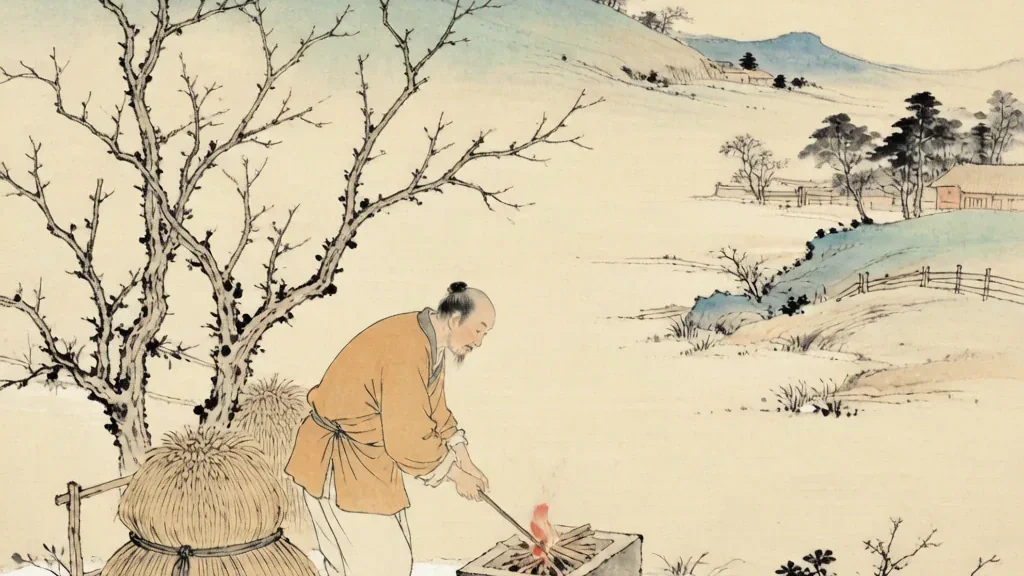
For farming households, Lidong was the deadline for autumn's remaining work and the start of winter storage. Grain was threshed and sealed in jars, root vegetables banked in cellars or buried in sand, and the year's tools oiled and put away. Livestock were moved to sheltered pens and fed the last of the dried fodder. In the home, quilts were aired, wind doors hung, and pickles and cured foods begun. This flurry of storing reflected the term's deeper philosophy of 'hiding': just as seeds rest in the cold earth, people were expected to conserve energy, eat well, and keep warm, laying the physical foundation that would carry families and fields through the long, quiet months ahead.
❓ Frequently Asked Questions
📝 Chinese Vocabulary
- 立冬 (lì dōng) — Beginning of Winter; the nineteenth solar term and the first of winter
- 饺子 (jiǎo zi) — Dumplings; the quintessential Lidong food, traditionally shaped like ears
- 补冬 (bǔ dōng) — Supplementing winter; the custom of eating nourishing foods to build winter reserves
- 涮羊肉 (shuàn yáng ròu) — Mutton hotpot; a classic winter dish popular in northern China
- 酸菜 (suān cài) — Pickled cabbage; a winter staple in northeastern Chinese cuisine
🎉 Fun Facts
- The tradition of eating dumplings on Lidong is traced to Zhang Zhongjing, a famous Han Dynasty physician who created ear-shaped dumplings to prevent frostbite.
- In ancient China, the emperor would lead a ceremony on Lidong to welcome winter, traveling to the northern suburbs to perform rituals honoring the season.
- Some regions practice the custom of "winter swimming" on Lidong, with hardy swimmers plunging into icy rivers as a test of endurance and vitality.
- The Chinese character 冬 (dōng) originally depicted a knotted rope, representing the "end" of the year's cycle — a meaning preserved in the character's use as "winter."
- In traditional Chinese medicine, Lidong is the day when the body's yang energy begins to retreat inward, so the season's task is to 'store' rather than expend vitality.
- Many northern families use Lidong to start making preserved foods such as cured meats and pickled vegetables, laying in supplies that will carry them through the cold months.