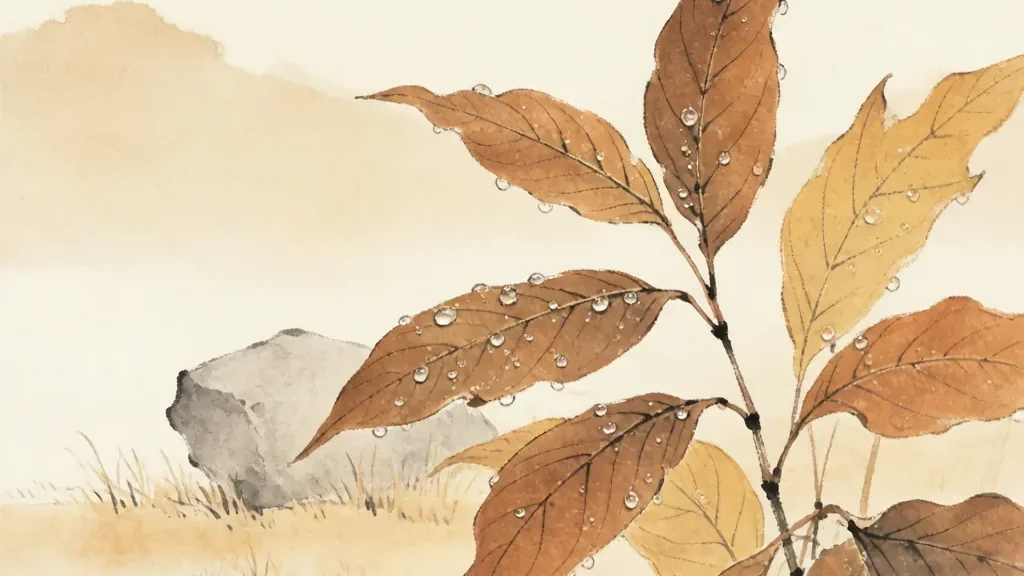
Bailu, "White Dew," is the fifteenth of the twenty-four traditional Chinese solar terms and usually begins around September 7 or 8. It follows Liqiu (Beginning of Autumn) and Chushu (End of Heat) and precedes Hanlu (Cold Dew). The name describes the dew that forms on grass and leaves during the cool nights of early autumn, visible as a white film in the early morning light. Bailu marks the point where summer's warmth has clearly gone and the air turns crisp and dry. It is a term of transition and of gathering: the rice is cut in the south, the fruits ripen, and the clear autumn sky invites both harvest work and quiet appreciation of the season's beauty.
Early Autumn on the Calendar
Bailu is the third solar term of autumn, following Chushu and preceding Hanlu. The sun reaches a celestial longitude of 165 degrees at its start. After the heat's end at Chushu, Bailu confirms the cool has arrived and settled in.
The term belongs to the comfortable heart of autumn — not the lingering heat of early fall, nor the approaching frost of late fall. Its dew, its clear days, and its ripe fields make it one of the pleasanter terms in the calendar.
The Three Pentads of Bailu
Bailu's pentads describe the cooling, drying world. The first is "wild geese come" (hong yan lai), as migratory geese head south. The second is "black birds return" (xuan niao gui), swallows and similar birds departing northward homes. The third is "birds hide and store" (qun niao yang xiu), as birds fatten and prepare for winter.
These images center on birds in motion, mirroring the human movement of harvest and storage. The term reads the sky as a register of the season, where the comings and goings of birds mark the turning of the year.
The White Dew Itself
The dew of Bailu forms because autumn nights are cool while the ground still holds some warmth and moisture. As the air near the surface cools below its dew point, water condenses on leaves and grass, and in the clear morning light it looks white — hence "white dew."
This dew is a gentle phenomenon, unlike the cold dew of Hanlu that follows. It signals a specific microclimate: cool nights, mild days, and enough moisture for condensation but not for frost. The term thus names a precise, fleeting weather condition of early autumn.
The Harvest of Rice
In the south, Bailu is a major harvest term for the single-crop (or early) rice. The grain ripens in the cooling air and is cut, threshed, and dried under the clear autumn sun. Good drying weather at Bailu is essential to prevent mold in the stored grain.
The term's clear, dry days are ideal for this work, and communities organize the harvest with care. A successful Bailu rice harvest secured a large part of the year's food, making the term one of the most economically important of autumn.
Fruits and the Orchard
Bailu is also orchard season. Grapes, pears, apples, and pomelos ripen and are picked. In many regions, the term is associated with the arrival of fresh grapes and the last of the summer stone fruits, bridging the seasons at the market.
The abundance of fruit gave Bailu a festive, generous quality. Eating the season's fruit was both nourishment and pleasure, and the term's produce was often the first fresh taste of autumn after a summer of vegetables and early crops.
The "White Dew Tea" and Drinks
Like Guyu, Bailu has its own tea tradition: "White Dew tea" (bailu cha) is picked during the term and valued for a mellow flavor distinct from the earlier spring teas. Farmers and tea drinkers prize it as a seasonal refreshment suited to the cooler air.
In some areas, the term is also a time for making drinks from the season's herbs and for the first warming teas of the year. The act of drinking the new tea links the calendar to daily comfort, as the body adjusts from summer coolness to autumn warmth.
Seasonal Health and Diet
Traditional health advice for Bailu emphasizes protecting against the growing dryness and the temperature swing between day and night. Light clothing in the warm afternoon and a wrap for the cool morning are recommended, along with moistening foods.
Pears, lilies, and white fungus are favored to soothe the lungs, which in Chinese medicine correspond to autumn. The dietary logic is preventive: keep the body balanced as the climate shifts, so that the colder terms ahead find it prepared.
Folk Sayings and Omens
Bailu carries proverbs about the weather to come. One says that if Bailu arrives with much dew, the autumn will be fine; another links the term's temperature to the severity of the next winter. Such lore helped households plan storage and fuel.
The term also appears in love and parting poetry, where the white dew on grass became an image of transience and the chill of separation. Its clear, cool beauty made it a natural metaphor for the melancholy edge of autumn.
Bailu in Modern Life
Today Bailu is noted through weather, tea, and food. People remark on the cool mornings, buy the season's fruit and new tea, and share images of dew on grass. The term persists as a gentle cue to notice autumn's arrival.
Its enduring message is one of balance and gratitude: the heat is gone, the harvest is in, and the clear air invites a mindful pause. Bailu asks us to appreciate the season's mildness before the colder terms demand more of us.
❓ Frequently Asked Questions
When does Bailu occur?
Bailu usually begins around September 7 or 8, when the sun reaches a longitude of 165 degrees.
Why is it called White Dew?
Cool autumn nights condense moisture on grass, which looks white in the morning light.
What are Bailu's three pentads?
They are wild geese arriving, swallows returning south, and birds storing food for winter.
What farming happens at Bailu?
The south harvests and dries rice, and orchards pick grapes, pears, and apples in the clear weather.
What is White Dew tea?
It is tea picked during Bailu, valued for a mellow flavor suited to the cooler autumn air.
How is Bailu observed today?
Through noting cool mornings, drinking new tea, eating seasonal fruit, and enjoying the clear air.