More About This Solar Term
This solar term has been observed in Chinese culture for thousands of years. Ancient Chinese farmers relied on these seasonal markers to plan their agricultural activities with remarkable precision. The 24 solar terms, originating in the Yellow River basin during the Zhou Dynasty (1046–256 BCE), represent one of humanity's earliest systematic approaches to understanding seasonal change.
In 2016, UNESCO recognized the Twenty-Four Solar Terms as an Intangible Cultural Heritage of Humanity, acknowledging their enduring importance in Chinese cultural identity and agricultural wisdom. Each solar term reflects a specific astronomical event or natural phenomenon — the sun's position at 15° intervals along the ecliptic — dividing the year into 24 equal segments of approximately 15 days each.
Traditional Chinese medicine closely aligns health practices with the solar terms. During each term, specific foods, exercises, and lifestyle adjustments are recommended to maintain harmony with nature. This philosophy, known as "yang sheng" (养生), or the art of nurturing life, remains widely practiced across China today. Seasonal ingredients are chosen not just for flavor but for their perceived medicinal properties — warming foods in winter, cooling foods in summer.
In literature and art, the solar terms have inspired countless poems, paintings, and musical compositions throughout Chinese history. Tang Dynasty poets like Du Fu and Li Bai frequently wove seasonal imagery into their verses, using the specific characteristics of each solar term to evoke mood and meaning. The famous Song Dynasty scroll painting "Along the River During the Qingming Festival" (清明上河图) takes its very name from one of the 24 solar terms — Qingming — capturing the vibrant life of a Chinese city during this spring moment.
Today, the solar terms continue to guide daily life in China. Farmers still consult the traditional calendar for planting and harvesting. Families observe customs passed down through generations — eating spring pancakes at Lichun (Start of Spring), honoring ancestors at Qingming (Clear and Bright), and gathering for family feasts at Dongzhi (Winter Solstice). Schools teach children about the solar terms, ensuring this ancient knowledge system remains alive for future generations. Weather forecasts on Chinese television often reference the current solar term, connecting modern meteorology with traditional wisdom.
The Winter Solstice (冬至, Dōngzhì) stands as one of the most significant moments in the entire Chinese calendar — the twenty-second solar term, when the northern hemisphere experiences its shortest day and longest night. Falling annually between December 21st and 23rd, Dongzhi represents the extreme of yin energy, the moment when darkness reaches its maximum dominion and the sun appears at its lowest point in the sky. Yet within this profound darkness, the ancient Chinese recognized the seed of transformation: from this moment forward, yang energy begins its return, the days begin their slow lengthening, and the entire cosmos pivots from contraction toward expansion. This understanding transformed the winter solstice from a moment of darkness into a celebration of returning light, making Dongzhi one of the most important festivals in traditional Chinese culture.
The name Dongzhi carries cosmic significance: 冬 (dōng) means winter, and 至 (zhì) means "extreme" or "arrival." Together they mark the extreme of winter and the arrival of the turning point. The ancient saying "冬至一阳生" (dōngzhì yī yáng shēng) — "at the winter solstice, yang energy is born" — captures the philosophical heart of this solar term. In the hexagrams of the I Ching (Book of Changes), the winter solstice corresponds to the Fu hexagram (复卦), which depicts a single yang line at the bottom of five yin lines — the first stirring of returning light and warmth in the depths of winter's darkness. This hexagram has inspired Chinese philosophers for millennia as a symbol of hope and renewal, teaching that even in the darkest moments, the forces of life and light are already gathering strength for their return.
The Astronomy and Philosophy of the Solstice
Astronomically, Dongzhi occurs when the sun reaches 270 degrees of celestial longitude, positioning itself directly over the Tropic of Capricorn. At this moment, the northern hemisphere receives the least direct sunlight of the entire year, and the arc of the sun across the sky is at its lowest and shortest. Ancient Chinese astronomers, using the gnomon — a vertical pole whose shadow was measured at noon each day — observed that the shadow cast on the winter solstice was the longest of the year, a precise physical measurement that allowed them to calibrate their calendars and predict the seasons. The observation platforms built by royal astronomers during the Zhou and Han dynasties, some of which still stand today, were aligned to capture the exact moment of the solstice with remarkable precision.
In Chinese philosophy, Dongzhi embodies the principle that extremes contain their opposites. The maximum of yin — the coldest, darkest moment of the year — is precisely the moment when yang begins its return. This understanding shaped not only cosmology but also practical approaches to health, governance, and daily life. The emperor, as the Son of Heaven, would perform elaborate solstice rituals at the Temple of Heaven in Beijing, offering sacrifices to ensure the smooth transition of cosmic forces and the continued harmony of heaven and earth. These state ceremonies, conducted with the utmost solemnity, affirmed the emperor's role as the intermediary who maintained the balance of yin and yang upon which the wellbeing of the entire realm depended.
Ancient Chinese observers identified three phenological signs marking the arrival of Dongzhi. In the first pentad, earthworms were said to coil themselves into tight knots underground, their bodies responding to the return of yang energy even as the surface world remained frozen. In the second pentad, elk were believed to shed their antlers — the antlers, being the most yang part of the animal's body, were naturally shed as yang energy began its return, a seeming paradox that the ancient Chinese understood as the old yang making way for the new. By the third pentad, underground springs were said to stir, their waters warmed by the nascent yang energy rising from the earth's depths. These careful observations, recorded in classical texts and passed down through generations, represent a civilization's profound attunement to the subtle signals of cosmic change.
The Northern Tradition: Dumplings and the Story of Zhang Zhongjing
In northern China, Dongzhi is inseparable from dumplings (饺子, jiǎozi). The tradition of eating dumplings on the winter solstice is traced to Zhang Zhongjing, the great physician of the Eastern Han Dynasty whose compassion and medical genius have made him a beloved figure in Chinese cultural memory. According to the well-known legend, Zhang noticed that during the harsh winters, many poor people suffered from frostbitten ears, their exposed flesh turning purple and painful in the bitter cold. Moved by their suffering, he devised a remedy that combined medicine with nourishment: he filled dough wrappers with warming mutton, medicinal herbs, and chili peppers, shaped them like ears, and served them in hot broth.
The dish, which Zhang called "祛寒娇耳汤" (qū hán jiāo ěr tāng) — "cold-dispelling tender ear soup" — proved remarkably effective. The warming ingredients drove the cold from the body, the hot broth provided immediate comfort, and the ear-shaped dumplings served as a mnemonic device that reminded people to protect their ears from the cold. Zhang distributed his medicinal dumplings freely to the poor on the day of the winter solstice, and the custom of eating dumplings on Dongzhi was born. Over the centuries, the tradition spread throughout northern China, and the specific medicinal herbs gave way to more conventional fillings — pork and cabbage, mutton and carrot, chive and egg — but the essential meaning remained: eating dumplings on Dongzhi protects against the cold and honors the memory of a physician whose compassion embraced the most vulnerable.
The communal preparation of dumplings on Dongzhi is as important as the eating. Families gather in kitchens warm from boiling water and steaming baskets, the windows fogged with condensation against the winter cold outside. Dough is kneaded and rolled into thin circles, fillings are mixed and seasoned, and each family member contributes to the assembly line of wrapping — the experienced hands of grandparents shaping perfect, uniform crescents alongside the clumsy but enthusiastic efforts of children learning the art for the first time. The dumplings are boiled in great pots of water, their pale wrappers becoming translucent as they cook, and then served with vinegar, soy sauce, and chili oil. The shared labor and shared meal embody the Dongzhi spirit of family reunion, warmth, and mutual care — values that sustain Chinese families through the darkest, coldest days of the year.
The Southern Tradition: Tangyuan and the Sweetness of Reunion
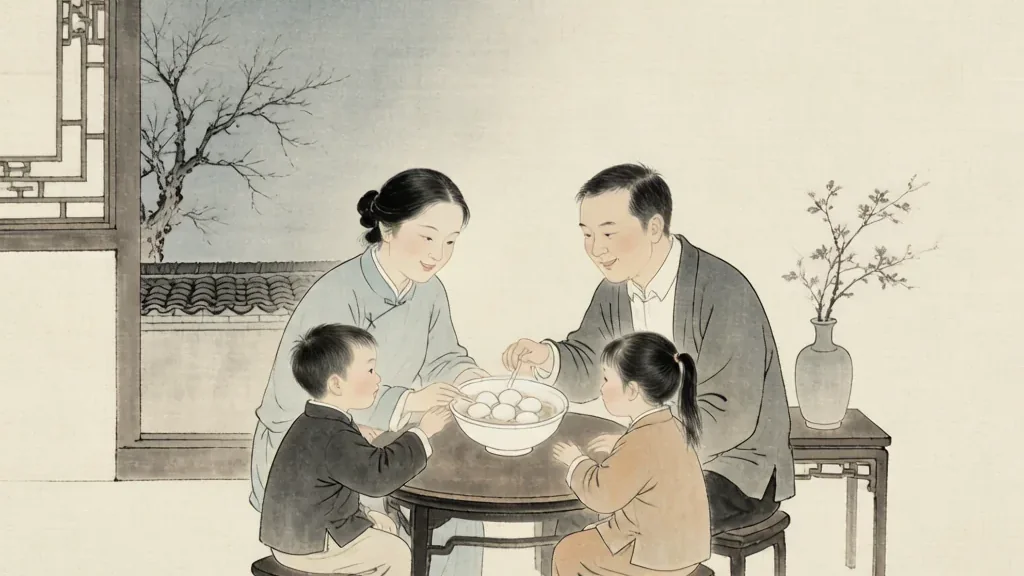
In southern China, the winter solstice table is dominated by tangyuan (汤圆, tāngyuán) — round, glutinous rice balls served in sweet soup. Where northerners eat savory dumplings, southerners eat sweet tangyuan, and the contrast reflects the deep regional diversity of Chinese cuisine. Yet both traditions serve the same essential purpose: bringing the family together around a shared meal that symbolizes unity, completeness, and the warmth that sustains life through the winter's cold. The roundness of tangyuan — their perfect spherical shape — represents the unity of the family and the wholeness of the cosmic cycle, making them the ideal food for a festival that celebrates the turning of the year.
The preparation of tangyuan is a labor of love that often begins days before the solstice. Glutinous rice flour is mixed with water to form a smooth, pliable dough, then divided into small pieces and rolled into balls. Some tangyuan are left plain, their pure white color symbolizing the clarity and simplicity of the season. Others are filled with sweet pastes — black sesame ground with sugar and lard, red bean paste simmered until silky smooth, or crushed peanuts mixed with sugar — the filling hidden within the white wrapper like the returning yang energy hidden within winter's darkness. The tangyuan are boiled until they float to the surface, then served in a sweet soup flavored with ginger, rock sugar, and sometimes osmanthus flowers or fermented rice (酒酿, jiǔniàng), the ginger's warmth balancing the tangyuan's cooling nature according to traditional medicine.
The symbolism of tangyuan extends beyond their shape to encompass their name. The word 汤圆 (tāngyuán) is homophonous with 团圆 (tuányuán), meaning "reunion" or "togetherness." Eating tangyuan on Dongzhi thus becomes an act of symbolic reunion — the family members who have been separated by work, study, or distance come together to share this food, and even those who cannot be physically present are remembered and included in the family's thoughts. In some regions, the custom of eating tangyuan marks a person's age: it was traditionally said that eating tangyuan on Dongzhi adds one year to one's age, as the solstice was considered the beginning of the solar year's new cycle. This custom, though less common today, reflects the deep association between Dongzhi, the passage of time, and the accumulation of life experience that the winter solstice represents.
Counting the Nine: The Calendar of Winter's Passage
One of the most distinctive traditions associated with Dongzhi is the custom of "counting the nine" (数九, shǔ jiǔ) — a folk method of tracking the progress of winter from the solstice to the return of spring. According to this system, the winter season is divided into nine periods of nine days each, totaling eighty-one days from the winter solstice to the full arrival of spring. The "nine nines" (九九) chart the gradual warming of the weather and the slow return of life to the frozen landscape, providing a framework of hope and anticipation that helped Chinese farmers and families endure the long winter months.
The most famous expression of the counting tradition is the "Nine Nines Song" (九九歌), a folk poem that describes the changing weather and natural phenomena of each nine-day period. The song begins: "一九二九不出手" (yī jiǔ èr jiǔ bù chū shǒu) — "In the first and second nines, you dare not put your hands out" — describing the bitter cold of the solstice period when exposed skin freezes in moments. It continues through the deepening cold of the third and fourth nines, when rivers freeze solid and even the hardiest animals seek shelter, before reaching the turning point: "五九六九沿河看柳" (wǔ jiǔ liù jiǔ yán hé kàn liǔ) — "In the fifth and sixth nines, look for willows along the river" — when the first signs of returning warmth appear in the greening of willow branches. The song concludes with the arrival of spring in the eighth and ninth nines, when farmers begin plowing and the world awakens from its winter sleep.
A more refined version of the counting tradition is the "Nine Nines Cold-Dispelling Chart" (九九消寒图), a custom popular among the literate classes during the Ming and Qing dynasties. The chart typically featured a design of eighty-one elements — often a painting of a plum branch with eighty-one blossoms, or a calligraphic composition of nine characters each containing nine strokes. Each day, the artist would color in one element or fill in one stroke, and by the time the entire chart was completed, winter would have passed and spring would have arrived. The most elegant version used the phrase "庭前垂柳珍重待春风" (tíng qián chuí liǔ zhēnzhòng dài chūn fēng) — "Before the courtyard, the drooping willows carefully await the spring wind" — nine characters, each with nine strokes, requiring eighty-one days to complete. This practice transformed the endurance of winter into a daily ritual of artistic creation and patient anticipation, the gradual completion of the chart mirroring the gradual return of warmth and light.
Dongzhi: A Festival as Important as the New Year
Throughout Chinese history, Dongzhi has been celebrated with a significance rivaling that of the Chinese New Year itself. The saying "冬至大如年" (dōngzhì dà rú nián) — "the winter solstice is as important as the New Year" — reflects the festival's traditional status. During the Han Dynasty, Dongzhi was an official holiday, and government offices, schools, and businesses closed so that families could gather for celebration. The emperor performed grand rituals at the Temple of Heaven, while common people visited temples, prepared special foods, and exchanged gifts of shoes and socks — practical items that expressed care for family members during the cold season.
The family reunion dimension of Dongzhi is central to its enduring appeal. In a culture where family bonds are considered the foundation of social order and personal identity, the solstice provides an annual occasion for families to gather, share a meal, and reaffirm their connections. For centuries, sons and daughters who had left their hometowns for work or study would make the journey home for Dongzhi, braving winter roads to sit at the family table. The reunion was not merely social but spiritual — the shared meal at the solstice table symbolically united the living members of the family with the ancestors who were honored in ritual and remembered in stories. In this way, Dongzhi served as a mechanism for maintaining the continuity of the family across both space and time.
In modern China, Dongzhi continues to be widely observed, though its forms have adapted to contemporary life. Urban families may not have the time or space for elaborate traditional preparations, but the essential customs endure: dumplings in the north, tangyuan in the south, and family gatherings wherever possible. Restaurants fill with families celebrating the solstice, social media fills with photos of steaming bowls of dumplings and tangyuan, and the day serves as a reminder, in the midst of the holiday season's commercial bustle, of the deeper rhythms that have shaped Chinese culture for millennia. As the world grapples with the disconnection from natural cycles that characterizes modern life, Dongzhi offers a moment to pause, to gather with loved ones, and to remember that even in the deepest darkness, the light is already beginning its return.
The I Ching and the Return of Yang
The philosophical heart of Dongzhi lies in the I Ching's Fu hexagram, a single yang line rising beneath five yin lines. It depicts the first stirring of light and warmth in the depth of winter's darkness, the moment when yang begins its slow return after the longest night. Philosophers prized this image for teaching that even at the extreme of cold and dark, the forces of renewal are already gathering. The solstice is therefore not a day of loss but of quiet birth, a lesson in patience that has shaped Chinese thought about endings and beginnings for more than two thousand years.
Dongzhi Customs of Gift and Care
Beyond the festive table, Dongzhi carried duties of care. In Han times government offices closed and people exchanged practical gifts of shoes and socks, small comforts for the cold season offered to elders and kin. Families visited temples to report the year and seek blessing, and the reunion meal reaffirmed bonds across distance and generations. Today the form is lighter, yet the substance remains: a shared bowl of dumplings or tangyuan, a call home, a moment to remember ancestors. The solstice keeps its old role as a pause in the year when care for family and respect for the turning cosmos are openly honored.
❓ Frequently Asked Questions
📝 Chinese Vocabulary
- 冬至 (dōng zhì) — Winter Solstice; the twenty-second solar term marking the shortest day
- 饺子 (jiǎo zi) — Dumplings; the traditional Dongzhi food in northern China
- 汤圆 (tāng yuán) — Tangyuan; glutinous rice balls eaten in southern China during Dongzhi
- 数九 (shǔ jiǔ) — Counting the nine; the tradition of tracking the eighty-one days of winter
- 九九消寒图 (jiǔ jiǔ xiāo hán tú) — Nine Nines Cold-Dispelling Chart; a traditional winter calendar artwork
🎉 Fun Facts
- Dongzhi was considered so important in ancient China that it was celebrated as the "Little New Year," and the saying "冬至大如年" declared it as significant as the Spring Festival.
- The tradition of eating dumplings on Dongzhi traces back nearly 1,800 years to the Han Dynasty physician Zhang Zhongjing, whose compassion for frostbite sufferers created a culinary tradition.
- The "Nine Nines Song" has countless regional variations across China, each reflecting the specific weather patterns and natural phenomena of that area.
- In the I Ching, the winter solstice corresponds to the Fu hexagram (复), which depicts a single yang line beneath five yin lines — one of the most philosophically significant hexagrams in the entire text.
- In the south, eating tangyuan on Dongzhi was once believed to add a year to a person's age, because the solstice began the solar new year's cycle.
- The emperor's Dongzhi sacrifice at the Temple of Heaven was among the grandest rites of the imperial calendar, performed to keep heaven and earth in balance.