More About This Solar Term
This solar term has been observed in Chinese culture for thousands of years. Ancient Chinese farmers relied on these seasonal markers to plan their agricultural activities with remarkable precision. The 24 solar terms, originating in the Yellow River basin during the Zhou Dynasty (1046–256 BCE), represent one of humanity's earliest systematic approaches to understanding seasonal change.
In 2016, UNESCO recognized the Twenty-Four Solar Terms as an Intangible Cultural Heritage of Humanity, acknowledging their enduring importance in Chinese cultural identity and agricultural wisdom. Each solar term reflects a specific astronomical event or natural phenomenon — the sun's position at 15° intervals along the ecliptic — dividing the year into 24 equal segments of approximately 15 days each.
Traditional Chinese medicine closely aligns health practices with the solar terms. During each term, specific foods, exercises, and lifestyle adjustments are recommended to maintain harmony with nature. This philosophy, known as "yang sheng" (养生), or the art of nurturing life, remains widely practiced across China today. Seasonal ingredients are chosen not just for flavor but for their perceived medicinal properties — warming foods in winter, cooling foods in summer.
In literature and art, the solar terms have inspired countless poems, paintings, and musical compositions throughout Chinese history. Tang Dynasty poets like Du Fu and Li Bai frequently wove seasonal imagery into their verses, using the specific characteristics of each solar term to evoke mood and meaning. The famous Song Dynasty scroll painting "Along the River During the Qingming Festival" (清明上河图) takes its very name from one of the 24 solar terms — Qingming — capturing the vibrant life of a Chinese city during this spring moment.
Today, the solar terms continue to guide daily life in China. Farmers still consult the traditional calendar for planting and harvesting. Families observe customs passed down through generations — eating spring pancakes at Lichun (Start of Spring), honoring ancestors at Qingming (Clear and Bright), and gathering for family feasts at Dongzhi (Winter Solstice). Schools teach children about the solar terms, ensuring this ancient knowledge system remains alive for future generations. Weather forecasts on Chinese television often reference the current solar term, connecting modern meteorology with traditional wisdom.
The Autumn Equinox (秋分, Qiūfēn) arrives as one of the most perfectly balanced moments in the entire annual cycle — the sixteenth solar term, when day and night once again stand as equals, as they did six months earlier at the Spring Equinox. Falling between September 22nd and 24th, Qiufen marks the exact midpoint of autumn, the pivot upon which the season turns from early golden warmth toward the crisp chill of late autumn. For the agricultural civilization of ancient China, this was not merely an astronomical curiosity but a profound moment of cosmic equilibrium, offering lessons about balance, gratitude, and the eternal rhythm of giving and receiving that governs both nature and human society.
The name Qiufen embodies its essence: 秋 (qiū) means autumn, and 分 (fēn) means "to divide equally." The character 分 depicts a knife dividing something into two equal halves — a perfect visual metaphor for the sun's position directly above the equator, splitting the day into equal portions of light and darkness. At this moment, the sun reaches 180 degrees of celestial longitude, and for a brief instant, the entire planet experiences roughly twelve hours of daylight and twelve hours of night. After this pivot point, the northern hemisphere tilts increasingly away from the sun, and the nights begin their steady lengthening toward the winter solstice. The balance that characterizes this moment is not a static endpoint but a dynamic turning point — the threshold between the expansive energy of the year's first half and the contracting, inward-turning energy of its second.
Astronomy and the Philosophy of Balance
The astronomical precision of the Autumn Equinox was understood and tracked by Chinese scholars for thousands of years. Using bronze instruments, carefully aligned observation platforms, and the ancient gnomon — a vertical pole whose shadow length was measured at noon each day — royal astronomers could determine the exact moment of the equinox with remarkable accuracy. The equinoxes, together with the solstices, formed the four cardinal points that anchored the entire Chinese lunisolar calendar system. The Autumn Equinox specifically marked the moment when the sun's path crossed the celestial equator heading south, initiating the period of increasing yin that would culminate at the winter solstice.
In Chinese philosophy, the Autumn Equinox embodies the principle of balance between yin and yang in a distinctive way. Unlike the Spring Equinox, where yang energy is rising and the balance represents a moment of expansion and growth, the Autumn Equinox represents a balance achieved through contraction and gathering. The yang energy of summer has spent itself in the ripening of crops and the fullness of growth; now, yin energy begins its gentle but inexorable ascent. The equinox moment, when the two forces meet as equals, offers a natural opportunity for reflection: what has the year's effort produced? What must now be gathered and stored against the coming cold? This philosophical framework extended beyond agriculture into every dimension of life, from health practices to governance to personal conduct.
Ancient Chinese observers identified three phenological signs marking the arrival of Qiufen. In the first pentad, thunder was said to cease — the great summer storms that had rolled across the land finally fell silent, their energy exhausted as the atmosphere cooled and stabilized. In the second pentad, hibernating insects sealed the entrances to their underground chambers with earth, preparing for the long winter sleep ahead. By the third pentad, the waters of rivers and lakes began to shrink, as evaporation slowed and the great rains of summer gave way to autumn's drier skies. These careful observations, recorded in classical texts and passed down through generations, represent a civilization deeply attuned to the subtle signals of seasonal transformation.
The Autumn Moon Sacrifice: Honoring the Celestial
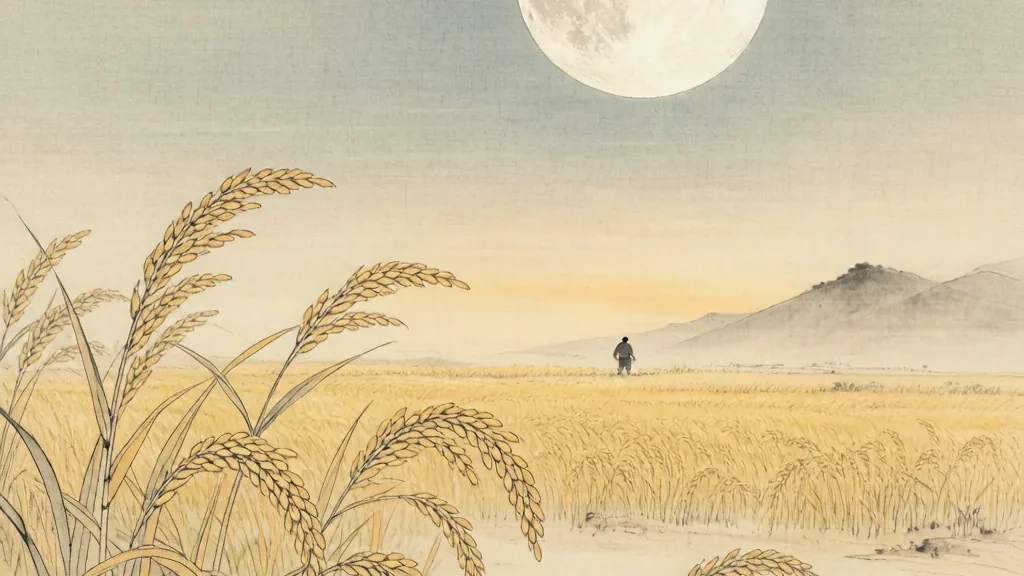
Among the most significant traditions of the Autumn Equinox is the Autumn Moon Sacrifice (秋祭月, qiū jì yuè), an ancient ritual that dates back to the Zhou Dynasty. Originally, the Chinese moon festival was celebrated on the day of the Autumn Equinox itself, when the moon was believed to be at its most perfectly balanced and auspicious. The emperor, as the Son of Heaven, would lead elaborate ceremonies at the Temple of the Moon (月坛, Yuètán), offering sacrifices of the finest autumn produce — newly harvested grains, ripe fruits, and specially prepared cakes — to the moon deity. These state rituals affirmed the cosmic order and the emperor's role as the intermediary between heaven and earth.
At the household level, families set up moon-viewing altars in their courtyards and gardens. The altar would be draped in red cloth and arranged with offerings that symbolized the season's abundance: round mooncakes representing the full moon and family unity, pomelos whose Chinese name (柚子, yòuzi) sounds like "to have sons," pomegranates bursting with seeds that symbolized fertility, and persimmons whose orange color represented joy and prosperity. Incense was burned, and family members would bow to the moon, expressing gratitude for the harvest and praying for continued blessings. The roundness of the offerings — round fruits, round cakes, round plates — echoed the full moon overhead and the ideal of familial completeness that the Chinese have cherished for millennia.
Over time, the moon celebration shifted from the exact equinox date to the fifteenth day of the eighth lunar month, which usually falls close to the Autumn Equinox and guarantees a full moon. This evolution gave rise to the Mid-Autumn Festival (中秋节, Zhōngqiū Jié), one of China's most beloved holidays. Yet the Autumn Equinox's association with moon worship persists, and the themes of gratitude, abundance, and cosmic harmony that characterized the original equinox rituals remain central to Chinese cultural identity. Even today, families gathering to admire the harvest moon and share mooncakes are participating in a tradition whose roots reach back to the astronomical observations and seasonal rituals of the Autumn Equinox.
Eating Autumn Vegetables: The Qiucai Tradition
In the rural regions of southern China, particularly in the Lingnan area encompassing Guangdong and Guangxi, the Autumn Equinox is celebrated with a distinctive culinary custom: eating autumn vegetables (吃秋菜, chī qiū cài). On the morning of Qiufen, villagers go into the fields to gather wild amaranth (野苋菜, yě xiàn cài), a leafy green that grows abundantly in the autumn countryside. Known locally as "autumn green vegetable" (秋碧蒿, qiū bì hāo), this wild amaranth is prized not only for its fresh, slightly earthy flavor but also for its symbolic association with health and cleansing during the seasonal transition.
The gathered amaranth is typically prepared as a simple soup with fish fillets — a dish called "autumn soup" (秋汤, qiū tāng). The combination of fresh wild greens and fish creates a light yet nourishing meal that perfectly suits the body's needs during this transitional period. The greens provide cooling, cleansing properties that help dispel any remaining summer heat, while the fish adds protein and warmth without heaviness. A folk rhyme associated with this custom declares: "秋汤灌脏,洗涤肝肠" (qiū tāng guàn zàng, xǐ dí gān cháng) — "Autumn soup fills the organs, washing the liver and intestines clean." The rhyme continues with a wish for the whole family's safety and health throughout the coming year.
The wild amaranth custom embodies several layers of Chinese cultural wisdom. Gathering wild greens connects people directly to the land and its seasonal offerings, reinforcing the awareness that nature provides what the body needs at each time of year. The simplicity of the preparation — fresh greens, water, a few pieces of fish — reflects the Chinese culinary principle that the finest foods require the least manipulation, allowing their essential nature to shine through. And the sharing of the soup as a family meal strengthens the bonds that, in Chinese thought, are as essential to health as any food or medicine. This humble custom, maintained in rural communities for generations, represents a holistic approach to wellbeing that integrates nutrition, seasonality, community, and the simple joy of eating what the earth provides.
The Season of Crabs and Chrysanthemums
The Autumn Equinox inaugurates one of China's most anticipated culinary seasons: crab season. As the waters cool and the autumn moon rises full, freshwater crabs — particularly the prized hairy crabs (大闸蟹, dàzháxiè) of the Yangtze River region — reach their peak condition. The crabs have spent the summer feeding and growing, and by the Autumn Equinox, their meat is sweet and firm, and the females carry rich, golden roe that connoisseurs consider one of the finest delicacies in all of Chinese cuisine. Restaurants across the Jiangnan region prepare special crab menus, and families gather for elaborate crab feasts that can last for hours.
The ritual of eating crab during the Autumn Equinox is as much about the experience as the food. Crabs are traditionally steamed whole and served with a dipping sauce of ginger and Zhenjiang black vinegar, whose warmth balances the crab's "cooling" nature according to traditional medicine. Eating crab is a slow, deliberate process that encourages conversation and togetherness — each diner works through their crab with specialized tools, extracting every morsel of meat from the legs and body while sharing stories and toasting with warm Shaoxing wine. The warm wine is not merely for pleasure; traditional wisdom holds that wine's warming nature counteracts the crab's coldness, preventing digestive discomfort.
Alongside crab, chrysanthemum takes center stage during the Autumn Equinox. The flower blooms in spectacular profusion during this season, and the custom of appreciating chrysanthemums (赏菊, shǎng jú) has been a refined autumn pastime since the Jin Dynasty. Chrysanthemum exhibitions draw crowds to parks and gardens, where hundreds of varieties display their intricate blooms in shades of gold, white, purple, and red. The flower carries profound cultural significance: as one of the "Four Gentlemen" of Chinese art (along with plum blossom, orchid, and bamboo), the chrysanthemum represents the noble scholar who maintains integrity through adversity, blooming defiantly as other flowers wither in the autumn frost. Chrysanthemum tea and chrysanthemum wine, both believed to have health-giving properties, accompany the autumn feasts, their delicate floral notes complementing the richness of the seasonal foods.
Health and Harmony in the Season of Gathering
Traditional Chinese medicine offers detailed guidance for maintaining health during the Autumn Equinox period. The lungs and large intestine, the organs associated with autumn and the metal element, require particular attention. The season's increasing dryness — the characteristic "autumn dryness" (秋燥) — can damage the lungs' delicate tissues, leading to dry cough, sore throat, and skin problems. Practitioners recommend foods that moisten and protect the lungs: pears, particularly the fragrant snow pears of northern China, white fungus soup simmered with rock sugar, lily bulbs, sesame seeds, and honey. These ingredients, with their gentle, lubricating properties, form a protective barrier against the season's drying influence.
The emotional dimension of autumn health receives equal attention in Chinese medical philosophy. Autumn is associated with the emotion of grief, and the season's natural turn toward contraction and withdrawal can stir feelings of sadness or melancholy. The Autumn Equinox, with its theme of balance, offers a natural moment to assess one's emotional state and take steps to maintain equilibrium. Practitioners advise spending time outdoors in the crisp autumn air, appreciating the beauty of changing leaves and the harvest's abundance, as an antidote to excessive introspection. Gentle exercise — walking, tai chi, or the practice of "autumn qigong" that emphasizes slow, deep breathing — helps circulate qi and blood while calming the mind.
The Autumn Equinox's message of balance and gratitude resonates perhaps more deeply in the modern world than ever before. In an era of constant stimulation and year-round availability of everything, the equinox reminds us that life is meant to be lived in seasons — times of effort and times of rest, times of abundance and times of conservation, times of outward expansion and times of inward reflection. The ancient Chinese recognized that human wellbeing depends on harmonizing with these natural rhythms rather than resisting them. As the Autumn Equinox arrives each year, its equal hours of light and darkness offer a moment to pause, to give thanks for the harvest — whether literal crops or the fruits of a year's work — and to prepare, with gratitude and wisdom, for the turning of the year toward winter's quiet depths.
Osmanthus and the Fragrance of Autumn
As the Autumn Equinox arrives, the air in southern and central China fills with the scent of osmanthus, tiny golden and white blossoms whose fragrance peaks exactly at this point in the season. The flower is more than perfume: it is eaten, steeped into osmanthus wine, and folded into rice cakes and sweet soups, making the equinox a feast for the nose as well as the table. Poets prized osmanthus for its ability to scent an entire courtyard from a single hidden branch, and its timing made it a natural emblem of the harvest season. In this way the term is experienced not only through the balanced light of the day but through a fragrance that signals autumn at its most generous.
The Equinox in the Modern Calendar
The Autumn Equinox sits at a fascinating crossroads of old and new. Astronomically it is the day when day and night are equal, a fact Chinese observers recorded centuries before modern science, and philosophically it stands for balance, the midpoint between the fullness of summer and the decline of winter. Today that ancient meaning is extended by the Farmers' Harvest Festival, which uses the term as a national moment of thanks. The equinox thus carries three layers at once: a precise astronomical event, a traditional ideal of harmony, and a contemporary public holiday, showing how the solar terms still adapt to modern life without losing their original logic.
❓ Frequently Asked Questions
📝 Chinese Vocabulary
- 秋分 (qiū fēn) — Autumn Equinox; literally "autumn division," the sixteenth solar term
- 秋祭月 (qiū jì yuè) — Autumn Moon Sacrifice; the ancient ritual of offering to the moon
- 吃秋菜 (chī qiū cài) — Eating autumn vegetables; the custom of gathering and eating wild amaranth
- 大闸蟹 (dà zhá xiè) — Hairy crab; the prized freshwater crab of the Yangtze region
- 秋燥 (qiū zào) — Autumn dryness; a seasonal condition affecting the lungs and skin
🎉 Fun Facts
- The Autumn Equinox is one of only two days in the year when the sun rises exactly in the east and sets exactly in the west everywhere on Earth — a fact ancient Chinese astronomers documented centuries before Western science.
- Since 2018, China has officially designated the Autumn Equinox as the "Chinese Farmers' Harvest Festival" (中国农民丰收节), making it a national celebration of agricultural achievement.
- The custom of eating wild amaranth soup on the Autumn Equinox is so deeply rooted in Lingnan culture that a folk rhyme has preserved the practice for centuries.
- The Mid-Autumn Festival, one of China's most important holidays, originally took place on the Autumn Equinox itself before shifting to the full moon of the eighth lunar month.
- The Autumn Equinox is famous for the 'egg standing' game, when people try to balance an egg on its end, a pastime linked to the idea of balanced day and night.
- Around the equinox, osmanthus comes into full bloom, and its fragrance is captured in seasonal foods such as osmanthus wine and osmanthus-flavored rice cakes.