More About This Solar Term
This solar term has been observed in Chinese culture for thousands of years. Ancient Chinese farmers relied on these seasonal markers to plan their agricultural activities with remarkable precision. The 24 solar terms, originating in the Yellow River basin during the Zhou Dynasty (1046–256 BCE), represent one of humanity's earliest systematic approaches to understanding seasonal change.
In 2016, UNESCO recognized the Twenty-Four Solar Terms as an Intangible Cultural Heritage of Humanity, acknowledging their enduring importance in Chinese cultural identity and agricultural wisdom. Each solar term reflects a specific astronomical event or natural phenomenon — the sun's position at 15° intervals along the ecliptic — dividing the year into 24 equal segments of approximately 15 days each.
Traditional Chinese medicine closely aligns health practices with the solar terms. During each term, specific foods, exercises, and lifestyle adjustments are recommended to maintain harmony with nature. This philosophy, known as "yang sheng" (养生), or the art of nurturing life, remains widely practiced across China today. Seasonal ingredients are chosen not just for flavor but for their perceived medicinal properties — warming foods in winter, cooling foods in summer.
In literature and art, the solar terms have inspired countless poems, paintings, and musical compositions throughout Chinese history. Tang Dynasty poets like Du Fu and Li Bai frequently wove seasonal imagery into their verses, using the specific characteristics of each solar term to evoke mood and meaning. The famous Song Dynasty scroll painting "Along the River During the Qingming Festival" (清明上河图) takes its very name from one of the 24 solar terms — Qingming — capturing the vibrant life of a Chinese city during this spring moment.
Today, the solar terms continue to guide daily life in China. Farmers still consult the traditional calendar for planting and harvesting. Families observe customs passed down through generations — eating spring pancakes at Lichun (Start of Spring), honoring ancestors at Qingming (Clear and Bright), and gathering for family feasts at Dongzhi (Winter Solstice). Schools teach children about the solar terms, ensuring this ancient knowledge system remains alive for future generations. Weather forecasts on Chinese television often reference the current solar term, connecting modern meteorology with traditional wisdom.
Major Snow (大雪, Dàxuě) arrives as the twenty-first solar term, the moment when winter's grip tightens and the world begins its transformation into a landscape of white. Falling annually between December 6th and 8th, Daxue marks the period when snowfall becomes heavy and sustained, when the ground stays white from one storm to the next, and when the full, silent beauty of deep winter settles over the land. For the ancient Chinese, this was the season of profound quiet — the fields sleeping beneath their snowy blankets, the rivers frozen into silence, and the entire natural world withdrawn into a state of deep, regenerative rest.
The name Daxue speaks with direct simplicity: 大 (dà) means "major" or "great," and 雪 (xuě) means snow. Together they describe the season of heavy snow that distinguishes this period from the earlier, lighter snowfalls of Xiaoxue (Minor Snow). When the sun reaches 255 degrees of celestial longitude, Major Snow officially begins. In the philosophy of yin and yang, this moment represents yin energy at its near-maximum — the cold, dark, contracting force that will soon reach its peak at the winter solstice. Yet within this extreme yin, the ancient sages recognized the seed of yang's return, the hidden warmth that would eventually break winter's hold and bring the spring. This philosophical understanding transformed the experience of deep winter from mere endurance into a meditation on the cyclical nature of all existence.
The Deep Winter Landscape: Climate and Phenology
The climatic character of Daxue varies dramatically across China's vast geography, yet everywhere it signals the definitive arrival of deep winter. In the northeastern provinces of Heilongjiang and Jilin, temperatures plummet to twenty or thirty degrees below zero, and the snowpack builds to depths that will persist until March. The famous ice and snow festivals of Harbin draw their raw material from the Daxue snows, which provide the dense, packable snow ideal for the elaborate ice sculptures that attract millions of visitors. In Beijing and the North China Plain, snowfalls become regular rather than occasional, and the city's ancient architecture — the golden roofs of the Forbidden City, the grey-tiled hutongs, the frozen lakes of the imperial gardens — takes on a hushed, monochromatic beauty under the winter sky.
Ancient Chinese observers identified three phenological signs marking the arrival of Daxue. In the first pentad, the "crying bird" — identified as a type of pheasant — was said to fall silent, its calls stilled by the deepening cold. In the second pentad, tigers were believed to begin mating, their powerful yang energy stirring even in the depths of winter's yin — a reminder that the generative forces of life continue their work beneath the season's frozen surface. By the third pentad, a hardy plant known as "liting" (荔挺) was observed to push its shoots through the snow, its determination to grow despite the cold serving as a natural symbol of life's persistence. These careful observations, recorded in classical texts, reveal a civilization that found meaning and hope in even the subtlest signs of natural vitality.
For agricultural communities, Daxue marked a period of relative rest after the intense labor of the growing season, but the work of rural life never truly ceased. Livestock required daily care — feeding, watering, and protection from the cold — and farm equipment needed maintenance and repair in preparation for spring. In the wheat-growing regions of the north, farmers would spread additional layers of mulch or manure over the winter wheat fields, the organic material slowly decomposing under the snow to enrich the soil for the spring growth. The snow itself was welcomed as "white fertilizer" — its gradual melting in spring would provide the moisture essential for the new season's crops. The saying "瑞雪兆丰年" (ruì xuě zhào fēng nián), "timely snow promises a bountiful year," expresses the deep agricultural appreciation for winter's frozen gift.
The Art of Curing: Preserving Meat for Winter
Among the most distinctive Daxue customs is the tradition of curing meat (腌肉, yān ròu). As temperatures drop low enough to prevent spoilage and the dry winter air creates ideal conditions for preservation, families across China — but particularly in the southern provinces of Sichuan, Hunan, and Guangdong — begin the annual process of transforming fresh pork, poultry, and fish into preserved delicacies that will sustain them through the winter and beyond. The tradition, developed over centuries of practical necessity, has evolved into a culinary art form that produces some of Chinese cuisine's most beloved flavors.
The process of making cured meat during Daxue is both practical and ritualistic. In Sichuan, families prepare lawei (腊味) — a category of preserved meats that includes la rou (cured pork belly), la chang (Chinese sausage), and la yu (cured fish). The fresh meat is rubbed with a mixture of salt, Sichuan peppercorns, and sometimes sugar, then hung to dry in the cold winter air. The unique climate of Daxue — cold enough to preserve, dry enough to cure, but not so harsh as to freeze — creates the perfect conditions for the slow enzymatic transformation that develops the meat's complex, savory flavor. After the initial air-drying, many families smoke their cured meats over smoldering cypress or citrus wood, adding layers of aromatic complexity.
In the Yangtze River delta, the Daxue curing tradition takes a different form. Here, families prepare "wind-dried" meats (风干肉, fēng gān ròu), hanging strips of marinated pork or whole ducks in the cold, dry wind that blows through the region during winter. The famous Jinhua ham, one of China's most prized cured meats, begins its months-long aging process during this season. In Hunan, the curing tradition incorporates the region's famous smoked and spiced flavors, with cured meats rubbed with chili and hung above the kitchen stove, where the smoke from daily cooking slowly infuses them with flavor. The sight of cured meats hanging from eaves, balconies, and kitchen rafters is as characteristic of Daxue in southern China as snow-covered roofs are in the north.
The significance of cured meat extends beyond preservation and flavor. In traditional Chinese culture, meat was a luxury that most families could afford only occasionally. The curing tradition allowed families to stretch their resources, transforming a single pig into months of flavorful protein. The cured meats of Daxue would become the centerpiece of the Chinese New Year feast, their rich, concentrated flavors representing the abundance and prosperity that every family hoped for in the coming year. The hanging meats also served as a visible display of the household's preparedness for winter — a reassuring sign that the family would eat well through the cold months, and a tangible connection to generations of ancestors who had performed the same seasonal ritual.
Warming Foods: Mutton, Porridge, and Winter Tonic
The cuisine of Daxue is defined by warmth — foods that generate internal heat, nourish deep energy reserves, and provide comfort against the season's bitter cold. Mutton (羊肉, yángròu) reigns supreme during this period, its powerful warming properties making it the ideal winter food according to traditional Chinese medicine. Across northern China, mutton hotpot restaurants fill with diners seeking refuge from the cold, the bubbling broth and fragrant steam creating islands of warmth in the winter landscape. Mutton soup, simmered for hours with ginger, star anise, and medicinal herbs, is consumed as both food and medicine, its rich broth believed to strengthen the kidneys and warm the body's core.
Porridges and soups occupy a central place in the Daxue kitchen. Sweet potato porridge (红薯粥, hóngshǔ zhōu), made by simmering diced sweet potatoes with rice until the mixture becomes thick, creamy, and naturally sweet, is a beloved winter breakfast throughout China. The sweet potato, introduced to China from the Americas in the sixteenth century, proved ideally suited to the winter diet — its warming nature, high energy content, and affordability made it a staple that helped sustain populations through the lean winter months. Red bean soup (红豆汤, hóngdòu tāng), simmered with rock sugar and sometimes tangerine peel, provides warmth and sweetness while supporting the body's fluid balance against winter's dryness.
Nuts and seeds feature prominently in Daxue nutrition. Walnuts, whose convoluted surface resembles the human brain, are traditionally believed to nourish the brain and kidneys. Chestnuts, roasted until their shells split to reveal the golden flesh within, are warming and nourishing. Sesame seeds, particularly black sesame, are prized for their ability to nourish the liver and kidneys and are often ground into paste and spread on bread or stirred into hot water as a warming drink. The general principle of Daxue eating is captured in the saying "大雪进补,开春打虎" (dàxuě jìn bǔ, kāi chūn dǎ hǔ) — "take tonics during Major Snow, and you will have the strength to fight tigers when spring arrives." While the tiger-fighting is metaphorical, the message is clear: the investment in nutrition made during deep winter determines the vitality available for the year ahead.
Winter Health and the Cultivation of Inner Warmth
Traditional Chinese medicine identifies Daxue as a period when the body is particularly vulnerable to cold invasion and when the kidneys — the organs associated with winter and the storage of essential life force — require special protection and nourishment. The ancient medical texts emphasize that during deep winter, the body's yang energy retreats to its innermost depths, making the surface vulnerable to cold while the core must be carefully protected. The practice of keeping warm during Daxue is thus not merely about comfort but about preserving the fundamental energy that sustains life.
Specific health recommendations for Daxue address every aspect of daily life. Clothing should be warm but not excessively heavy, allowing the body to maintain its own heat-generating capacity rather than becoming dependent on external warmth. The feet, considered the body's "second heart" in Chinese medicine and the point through which cold most easily invades, should be kept warm at all times — warm socks, insulated shoes, and nightly foot baths in hot water infused with ginger or mugwort are standard practices. The head and neck should also be protected, as these areas are considered the most yang parts of the body and therefore the most vulnerable to cold's yin invasion. The classic winter image of the Chinese elder, wrapped in a padded jacket with a scarf around the neck and a warm hat on the head, represents not merely fashion but centuries of accumulated health wisdom.
Exercise during Daxue follows the principle of moderation. The ancient texts advise against vigorous, sweat-inducing activity that would deplete the body's precious yang reserves. Instead, gentle indoor exercise — tai chi, qigong, or simple stretching — maintains flexibility and circulation without exhausting the body. The practice of "winter swimming" (冬泳, dōng yǒng), in which hardy individuals plunge into icy rivers and lakes, represents a specialized tradition that, while seemingly contrary to the general advice, is believed by its practitioners to strengthen the body's resistance to cold. However, this practice is reserved for those who have trained their bodies gradually and is not recommended for the general population. For most people, the Daxue exercise prescription is simple: stay warm, stay moving gently, and conserve energy for the renewal of spring.
The emotional dimension of Daxue health reflects winter's inward-turning nature. The season's long nights and short days naturally incline the mind toward introspection, and Chinese medical philosophy encourages this turn inward rather than resisting it. Quiet activities — reading, calligraphy, painting, or simply sitting in contemplation — are considered appropriate to the season. Social connection, however, remains important: the warmth of family gathered around a shared meal, the pleasure of conversation with friends over tea, the comfort of knowing one is not alone in the winter darkness. In the wisdom of Daxue, health is not merely the absence of illness but the harmonious alignment of body, mind, and spirit with the season's unique character — an alignment that, when achieved, transforms the cold months from a period of deprivation into a season of deep, regenerative rest, preparing the whole person for the renewal that spring will surely bring.
Snow in Chinese Art and Poetry
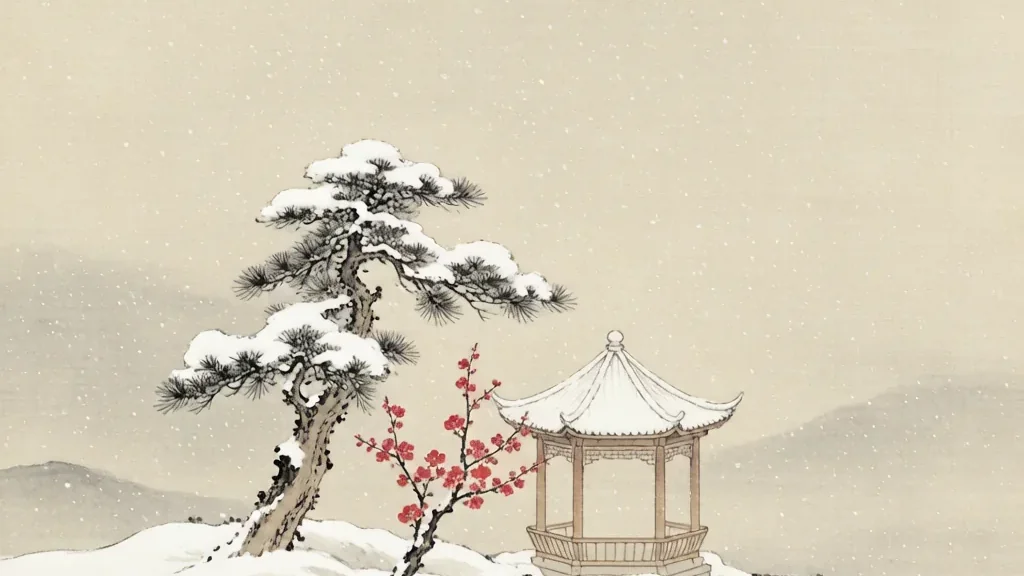
Snow has always been a favorite subject of Chinese painters and poets, and Major Snow is its yearly occasion. The monochrome beauty of a frozen river or a plum sprig against white ground suited the ink-wash aesthetic perfectly, while poets used snow to evoke stillness, purity, and the patience of waiting. Unlike the noisy abundance of harvest festivals, a Daxue scene is quiet and withdrawn, mirroring the season's call to rest. The heavy snow that interrupts travel also frees the mind for calligraphy and contemplation, so the term carries an artistic weight far beyond the weather report.
Major Snow in Northern Cities
In the north, Daxue transforms the great cities into studies in white. Beijing's tiled roofs and the frozen lakes of its imperial gardens take on a hushed stillness, and Harbin builds its ice and snow festival from the season's dense, packable snow. Daily life slows to a winter pace: mornings begin with steamed buns and hot soy milk, commuters bundle against the wind, and evenings center on the hotpot. The same solar term that preserves meat in the countryside also shapes the rhythm of the metropolis, proving that Daxue is as much an urban experience as a rural one.
From Cured Meat to the New Year Feast
The meats hung during Daxue are not eaten at once; they are saved. Cured pork, sausages, and fish become the centerpiece of the Spring Festival table weeks later, their concentrated flavor standing for the abundance a family hopes to carry into the new year. The hanging rows outside southern kitchens thus double as a kind of savings account, wealth preserved against lean months and displayed with quiet pride. In this way Major Snow quietly sets the larder that the greatest Chinese holiday will later draw upon, linking the deepest cold to the warmest gathering.
❓ Frequently Asked Questions
📝 Chinese Vocabulary
- 大雪 (dà xuě) — Major Snow; the twenty-first solar term marking the season of heavy snow
- 腌肉 (yān ròu) — Cured meat; the tradition of preserving meat during the cold winter months
- 腊味 (là wèi) — Winter cured foods; a category of preserved meats including sausages and cured pork
- 瑞雪兆丰年 (ruì xuě zhào fēng nián) — "Timely snow promises a bountiful year"; an agricultural proverb
- 红薯粥 (hóng shǔ zhōu) — Sweet potato porridge; a warming winter breakfast staple
🎉 Fun Facts
- The saying "大雪进补,开春打虎" encourages eating nourishing foods during Daxue so that one will be strong enough to fight tigers in spring — a colorful metaphor for winter nutrition.
- In northeastern China, the snow during Daxue is so reliable and dense that it becomes a building material — entire ice hotels and sculpture parks are constructed from compacted Daxue snow.
- Ancient Chinese believed that snow water collected during Daxue had special medicinal properties and would store it for use in preparing herbal medicines throughout the year.
- The tradition of curing meat during Daxue produces flavors that cannot be replicated at any other time of year — the unique combination of cold, dry air and specific bacteria creates the distinctive taste of winter-cured Chinese meats.
- Farmers call timely Daxue snow 'white fertilizer,' because its gentle melt in spring waters the winter wheat and insulates the soil against frost.
- Major Snow is the season when the famous Jinhua ham of Zhejiang begins its long, slow aging, a process that gives the cured meat its prized sweetness.