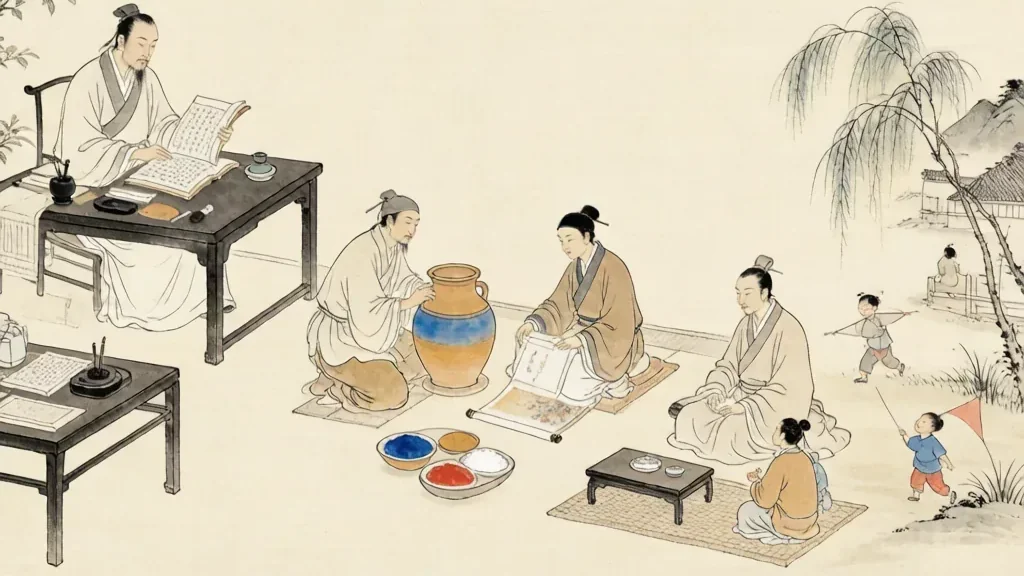
Color in Chinese culture is not merely a matter of aesthetics. It is a language — a symbolic system as rich and structured as the written word. For over three thousand years, the Five Colors (五色) — 青 (blue-green), 赤 (red), 黄 (yellow), 白 (white), and 黑 (black) — have formed the chromatic backbone of Chinese civilization, mapping onto the five elements, the five directions, the five seasons, the five flavors, and even the five internal organs of the body. To understand these five colors is to understand a fundamental layer of how Chinese people have organized and interpreted the world.
The system of the Five Colors is deeply rooted in the philosophy of Wu Xing (五行), the Five Elements or Five Phases, which emerged during the Warring States period (475–221 BCE). According to this cosmology, all phenomena in the universe can be classified into five categories, each associated with a particular element, direction, season, planet, flavor, and — crucially — color. This was not merely a theoretical exercise. For centuries, the Five Colors governed everything from the color of imperial robes to the design of temples, from the preparation of food to the practice of medicine. They were, in a very real sense, the colors of the cosmos.
青 (Qīng) — Blue-Green: The Color of Spring and Growth
The color 青 (qīng) is perhaps the most difficult of the Five Colors to translate, as it spans a range from deep blue through teal to vibrant green. It is the color of the eastern sky at dawn, of young bamboo shoots pushing through the earth, of the deep waters of a mountain lake. In the Wu Xing system, qing is associated with the element of Wood (木), the direction East (东), the season of Spring (春), and the planet Jupiter (木星).
In Chinese art, qing is the dominant color of the blue-green landscape (青绿山水) tradition, which reached its peak during the Tang Dynasty. Painters used mineral pigments — azurite for blue, malachite for green — to create luminous, jewel-like landscapes that captured the vitality of spring. The color also appears in the phrase "青出于蓝而胜于蓝" — "blue-green comes from indigo but surpasses it" — a metaphor for a student who exceeds their teacher. In the famous blue-and-white porcelain (青花瓷) of the Yuan and Ming dynasties, cobalt blue pigment painted onto white clay created some of the most celebrated ceramics in human history.
Qing is also the color of the Azure Dragon (青龙), guardian of the east in the Four Symbols, and it appears prominently in traditional Chinese clothing. Young scholars wore qing-colored robes, and the phrase "青衫 (qīng shān)" — "blue-green robe" — became a literary shorthand for a young man of talent and promise.
赤 (Chì) — Red: The Color of Fire and Celebration
If any single color defines Chinese culture in the global imagination, it is red (赤/红). The color of fire, blood, and the life force itself, red is the most yang of all colors — the embodiment of warmth, energy, joy, and good fortune. In the Wu Xing system, red is associated with the element of Fire (火), the direction South (南), the season of Summer (夏), and the planet Mars (火星).
Red dominates Chinese celebrations. During the Lunar New Year (春节), red lanterns, red couplets (春联), red envelopes (红包), and red clothing are everywhere, the color believed to ward off evil spirits and attract good fortune. The tradition originates from the legend of the Nian beast (年兽), a monster that terrorized villages every New Year's Eve but was discovered to fear the color red. At Chinese weddings (婚礼), the bride traditionally wears a red dress (红裙), the wedding chamber is decorated in red, and the gifts are wrapped in red paper — red symbolizing not just joy but fertility, passion, and the continuation of the family line.
Red also carries political weight. The flag of the People's Republic of China is red, symbolizing the blood of revolutionary martyrs. The phrase "红红火火" — "red red, fire fire" — is a blessing for prosperity and vibrant living, reflecting red's dual associations with celebration and success.
It is important to note that red is not used in all contexts. Red ink, for example, is traditionally used only for official seals and for writing the names of the deceased — writing a living person's name in red is considered a curse. And while red is the color of celebration, it is conspicuously absent from funerals, where its joyful energy would be entirely inappropriate.
黄 (Huáng) — Yellow: The Imperial Color
Of all the Five Colors, yellow (黄) holds the highest status. In the Wu Xing system, yellow is associated with the element of Earth (土), the direction Center (中), and the season of late summer (长夏) — the pivot point around which the other four seasons turn. Yellow is the color of the Yellow Emperor (黄帝), the mythical progenitor of Chinese civilization, and of the Yellow River (黄河), the cradle of Chinese culture. It is, quite literally, the color at the center of the Chinese world.
For over two thousand years, from the Han Dynasty to the fall of the Qing in 1912, yellow was the exclusive color of the emperor. The emperor's robes were yellow, the roofs of the Forbidden City are covered in yellow glazed tiles, and commoners were forbidden from wearing yellow clothing or using yellow in their architecture. The phrase "黄袍加身" — "to be draped in the yellow robe" — means to become emperor. This association between yellow and supreme authority is unique to Chinese culture; in most Western traditions, purple is the color of royalty, but in China, it was yellow that marked the Son of Heaven.
Yellow also carries more mundane but equally important meanings. It is associated with the earth and with harvest, reflecting China's agricultural roots. The phrase "黄道吉日" — "yellow path auspicious day" — refers to a day that is astrologically favorable for important activities like weddings or business openings. In modern times, however, yellow has acquired a less savory connotation: "黄色 (huáng sè)" — "yellow color" — is a euphemism for pornography, a usage that dates to the early 20th century and has nothing to do with the color's traditional symbolic significance.
白 (Bái) — White: The Color of Mourning and Purity
In Western cultures, white is the color of weddings, brides, and celebration. In traditional Chinese culture, white (白) carries precisely the opposite meaning: it is the color of mourning, death, and funerals. In the Wu Xing system, white is associated with the element of Metal (金), the direction West (西), the season of Autumn (秋), and the planet Venus (金星). Autumn is the season when leaves fall and nature withers, and the west is the direction of the setting sun — associations that align white with endings, decline, and the passage from life to death.
At traditional Chinese funerals, mourners wear white clothing and white headbands. White paper money is burned as an offering to the deceased. White flowers, particularly chrysanthemums, are associated with death and are never given as gifts. The phrase "红白喜事" — "red and white happy events" — refers to weddings (red) and funerals (white), treating both as natural and inevitable passages in human life.
Yet white is not exclusively negative. It is also associated with purity, clarity, and truth. The phrase "清白 (qīng bái)" — "clear white" — means innocent or incorruptible. White is the color of the White Tiger (白虎), guardian of the west, and it appears in the white clouds (白云) of Daoist paradise. In Chinese opera, a white-painted face indicates a treacherous or cunning character, but in daily life, white retains its complex duality — the color of both mourning and moral clarity.
黑 (Hēi) — Black: The Color of Water and Mystery
The fifth of the Five Colors is black (黑), associated with the element of Water (水), the direction North (北), the season of Winter (冬), and the planet Mercury (水星). Black is the color of the deep ocean, the winter sky, and the unknown. It is the most yin of colors, embodying the receptive, the hidden, and the mysterious.
In Chinese art, black is the primary color of ink painting (水墨画), where it is not merely a color but a universe of tonal possibilities. The phrase "墨分五色" — "ink is divided into five colors" — refers to the artist's ability to create an entire spectrum of visual effects using only black ink and water: dry, light, white, thick, and thin. In this tradition, black is not the absence of color but the origin of all colors, the primordial darkness from which form emerges.
In Chinese cosmology, black is the color of the Black Tortoise (玄武), guardian of the north. It is associated with the Dao (道), the ineffable source of all existence, which is described as dark, mysterious, and beyond human comprehension. In traditional medicine, black foods — black sesame, black beans, black fungus — are believed to nourish the kidneys and promote longevity. Black also appears in the black hair (黑发) that symbolizes youth and vitality, and the phrase "黑白分明" — "black and white clearly distinguished" — refers to moral clarity and the ability to tell right from wrong.
The Five Colors in Harmony
The power of the Five Colors lies not in any single color but in their relationship to one another. In Chinese thought, the Five Colors are not a palette of independent choices but a dynamic, interactive system governed by the cycles of Wu Xing. Each color generates and is generated by another, and each color controls and is controlled by another, creating a web of relationships that mirrors the interconnectedness of all natural phenomena.
This holistic understanding of color continues to shape Chinese aesthetics today. The five colors appear together in temple decorations, traditional embroidery, and festival costumes. The five-colored rice (五色饭) of the Zhuang and Miao ethnic minorities, the five-colored flags (五色旗) of Tibetan Buddhism, and the five-colored threads (五色线) worn during the Dragon Boat Festival all draw on this ancient chromatic system. Even in modern China, the Five Colors remain a living tradition — not a museum piece, but a language of meaning that continues to evolve while remaining rooted in the deepest layers of Chinese culture.
Colors as a Language of Status
Beyond cosmology, the Five Colors once functioned as a visible language of rank. Under the imperial system, the hue of a robe, a rank badge, or a banner told a viewer exactly where a person stood. Yellow was reserved for the Son of Heaven, while officials of the highest ranks wore robes edged in purple or crimson and lower officers in green or blue. Even the tiles of a roof and the lacquer of a gate followed the code, so that a glance at a building's color announced its owner's place in the world. This was not vanity but governance: color made the social order legible at a distance, long before printed directories existed. The Five Colors thus did double duty, ordering both the cosmos and the court, and a person who wore the wrong color could be accused of challenging the throne itself.
The Five Colors in Modern Design
The Five Colors did not vanish with the empire. In modern Chinese graphic design, branding, and festival staging, the same chromatic set still carries meaning that audiences feel without being taught. Red and gold dominate Lunar New Year campaigns because they still read as luck and prosperity, while white space and black ink recall the restraint of ink painting. Fashion designers revive qing-green and cinnabar in seasonal collections, and five-color thread and rice remain common at folk events. Even digital interfaces use the scheme to signal tradition and trust. The persistence is partly habit and partly the deep logic of Wu Xing, which trained Chinese eyes to read color as relationship rather than mere decoration. What began as a cosmic map now survives as a quiet visual grammar shared by two thousand years of viewers.
❓ Frequently Asked Questions
📝 Chinese Vocabulary
- 五色 (Wǔ Sè) — The Five Colors: 青 (blue-green), 赤 (red), 黄 (yellow), 白 (white), 黑 (black), the foundational chromatic system of Chinese culture.
- 五行 (Wǔ Xíng) — The Five Elements or Five Phases: Wood, Fire, Earth, Metal, Water, the cosmological framework to which the Five Colors are mapped.
- 红白喜事 (Hóng Bái Xǐ Shì) — "Red and white happy events," referring to weddings (red) and funerals (white), treated as natural passages in human life.
- 黄袍加身 (Huáng Páo Jiā Shēn) — "To be draped in the yellow robe," meaning to become emperor, reflecting yellow's status as the exclusive imperial color.
- 墨分五色 (Mò Fēn Wǔ Sè) — "Ink is divided into five colors," the principle in Chinese ink painting that black ink alone can create a full spectrum of visual effects.
🎉 Fun Facts
- During the Ming and Qing dynasties, wearing yellow clothing without imperial permission was punishable by death — yellow was that sacred to the emperor's authority.
- The Chinese word for "pornography" — 黄色 (huáng sè, "yellow color") — has nothing to do with traditional color symbolism. It originated in the early 20th century from a yellow-covered American newspaper that featured sensationalist content.
- In traditional Chinese medicine, foods of the five colors are believed to nourish the five corresponding organs: red for the heart, green for the liver, yellow for the spleen, white for the lungs, and black for the kidneys.
- The five colors appear together in the embroidery of a single dragon robe, where each hue marks a different cosmic domain, so the wearer literally dressed in the structured universe.
- During the Dragon Boat Festival, children are tied with five-colored silk threads, a charm meant to bind the five elemental forces around the body and keep illness away through the summer.
- In Tibetan Buddhist and Zhuang traditions, five-colored flags and five-colored rice turn the same chromatic system into offerings and communal dishes still made today.