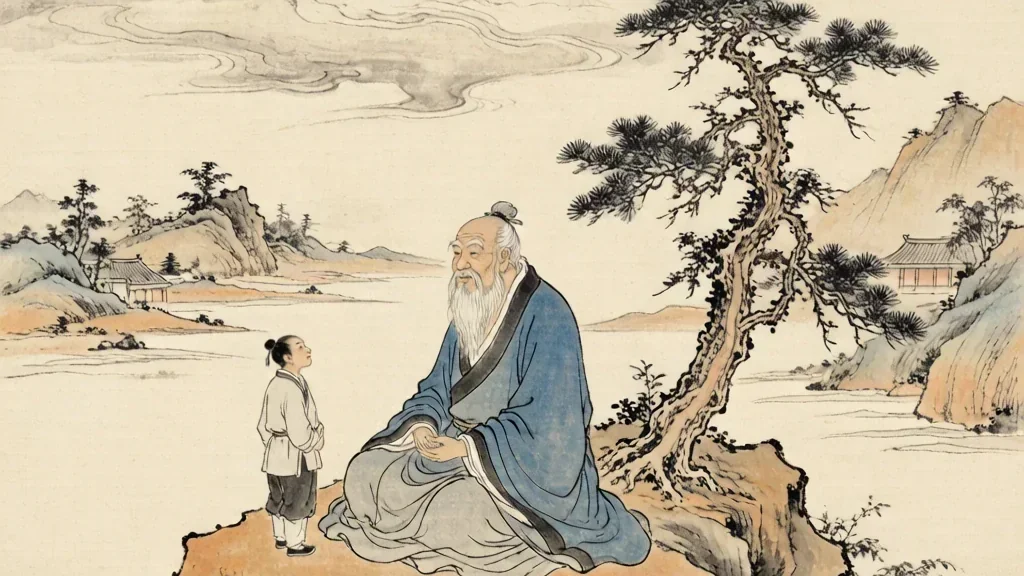
In the turbulent years of the Jurchen Jin Dynasty (1115-1234 CE), when northern China lay under foreign rule and traditional Daoist institutions had fragmented, a visionary reformer named Wang Chongyang (王重阳, 1113-1170 CE) founded a new Daoist movement that would fundamentally reshape Chinese religious culture. The Quanzhen School (全真教), meaning Complete Perfection or Complete Truth, synthesized the meditative practices of Daoism, the monastic discipline of Buddhism, and the ethical teachings of Confucianism into a unified path of spiritual cultivation. Unlike the Celestial Masters tradition, which emphasized communal ritual and hereditary priesthood, Quanzhen advocated celibate monasticism, internal alchemy, and direct personal realization of the Dao. Within a century of its founding, Quanzhen had become one of the most influential religious movements in Chinese history.
Wang Chongyang: The Founder and His Vision
Wang Chongyang, born Wang Zhe in 1113 in Xianyang, Shaanxi Province, began his adult life as a minor official and military officer before experiencing a series of transformative spiritual encounters. According to Quanzhen hagiographies, Wang met two mysterious immortals — identified as the Daoist deities Lü Dongbin and Zhongli Quan — in a tavern in 1159 CE. These immortals transmitted secret alchemical teachings to Wang and instructed him to abandon his worldly life. Wang retreated to a grave he dug for himself on Zhongnan Mountain, where he meditated for three years in what he called the Tomb of the Living Dead. In 1167, Wang emerged from seclusion and traveled to Shandong Province, where he began his public teaching career. His central insight was the doctrine of the Three Teachings as One, which held that Daoism, Buddhism, and Confucianism were not competing traditions but complementary paths to a single truth.
Wang's character and methods were as unconventional as his teachings. He was known for his eccentric behavior — he would shout in the streets, laugh inexplicably, and perform what appeared to be mad acts, all of which his followers interpreted as manifestations of his enlightened state. He composed poetry on the walls of taverns and inns, using verse as a medium for his teachings. One of his most famous poems declares, "The three teachings are one family, why distinguish them?" This verse became the motto of the Quanzhen movement. Wang's chosen name Chongyang, meaning "Double Yang," referred to the ninth day of the ninth lunar month in the Chinese calendar, a date associated with the ascension of immortals. His self-dug grave, the Tomb of the Living Dead, symbolized his rejection of conventional identity and his embrace of spiritual transformation through symbolic death and rebirth.
The Three Teachings as One: Quanzhen's Syncretic Philosophy
The doctrine of the Three Teachings as One (Sanjiao Heyi) was Wang Chongyang's most original and influential contribution to Chinese religious thought. In an age of political fragmentation and cultural anxiety under foreign rule, Wang's message of unity and reconciliation resonated deeply. He required his disciples to study not only Daoist texts like the Dao De Jing but also the Buddhist Heart Sutra and the Confucian Classic of Filial Piety. The Quanzhen precept of complete perfection meant integrating the strengths of all three traditions: Daoist meditation techniques for bodily cultivation, Buddhist monastic discipline for mental purification, and Confucian ethics for social harmony. Wang expressed this synthesis in his Fifteen Articles on the Establishment of the Teaching, which outlined the rules for Quanzhen monastic life and remains the foundational text of the school. The articles prescribed strict vegetarianism, celibacy, daily scripture recitation, and manual labor, creating a balanced regimen of spiritual, intellectual, and physical cultivation.
Wang's syncretic approach was not merely theoretical but had practical implications for religious life in medieval China. By creating a monastic institution that honored all three traditions, Quanzhen provided a model of religious coexistence that contrasted sharply with the sectarian conflicts that had characterized earlier periods. The Quanzhen emphasis on personal cultivation over elaborate ritual attracted educated elites who had grown disillusioned with the formalism of established religious institutions. At the same time, the movement's accessibility — any sincere practitioner could aspire to spiritual perfection regardless of social background — appealed to commoners. This broad appeal enabled Quanzhen to spread rapidly across northern China during the Jin Dynasty and into the Mongol Yuan period, establishing a network of monasteries that served both as spiritual centers and as havens of Chinese culture under foreign rule.
The Seven Perfected Ones and the Expansion of Quanzhen
The seven principal disciples of Wang Chongyang each founded their own lineages, contributing to the rapid expansion and diversification of the Quanzhen movement. The most famous of the seven was Qiu Chuji (1148-1227 CE), also known as Master Changchun ("Eternal Spring"), whose political engagement with Genghis Khan would secure Quanzhen's place in Chinese history. In 1220, the 73-year-old Qiu undertook an epic three-year journey from Shandong to the Hindu Kush mountains in present-day Afghanistan to meet the Mongol conqueror. When Qiu finally met Genghis Khan in 1222, he boldly advised the world's most powerful ruler to abstain from killing, practice moderation, and respect the sanctity of life. Impressed by Qiu's spiritual authority, Genghis Khan granted Quanzhen clergy exemption from taxation and corvée labor, and placed all Daoist clergy in the Mongol empire under Qiu's supervision.
The other six disciples were equally remarkable in their own right. Ma Yu (1123-1183), the senior disciple, established the Yuxian lineage and was known for his strict observance of monastic rules. Tan Chuduan (1123-1185) was a celebrated painter whose landscapes are considered masterpieces of Jin Dynasty art. Liu Chuxuan (1147-1203) founded the Suishan lineage, known for its emphasis on alchemical texts. Wang Chuyi (1142-1217) was renowned for his skill in martial arts and became the teacher of Emperor Shizong of the Jin Dynasty, bringing Quanzhen to imperial attention. Hao Datong (1140-1212) was a master of the Book of Changes who applied trigram divination to alchemical practice. The only female member of the Seven Perfected Ones, Sun Bu'er (1119-1182), was Ma Yu's wife before both took monastic vows. She founded a lineage specifically for women's internal alchemy, pioneering a female spiritual path within the Daoist tradition. Her writings on female neidan practice continue to be studied by women in Daoist communities today, and she is revered as a model of female spiritual attainment.
Quanzhen Monastic Life, Architecture, and Cultural Heritage
The Quanzhen tradition created a distinctive form of monasticism that combined the rigors of Buddhist vinaya discipline with Daoist alchemical practice. Quanzhen monasteries were typically built in remote mountain locations, following principles of feng shui that aligned buildings with the flow of beneficial qi energy. The standard monastery complex included a main hall dedicated to the Three Pure Ones, a meditation hall, a scripture library, and separate dormitories for monks and nuns. Daily life followed a strict schedule: rising before dawn for meditation, chanting scriptures, performing manual labor, studying texts, and engaging in neidan practice. Unlike Buddhist monks who depended entirely on alms, Quanzhen monastics were expected to support themselves through farming, herbal medicine, and manuscript copying. This economic self-sufficiency made Quanzhen monasteries remarkably resilient during periods of political upheaval.
The cultural contributions of Quanzhen monasticism extended far beyond religion. Quanzhen monasteries became centers of scholarship, preserving and transmitting classical Chinese texts when the Jin and Yuan governments neglected education. The Quanzhen commitment to calligraphy and painting produced some of the finest examples of Daoist art from the Jin and Yuan periods. The Quanzhen monk Tan Chuduan (1123-1185) was renowned for his landscape paintings that depicted mountain hermitages with extraordinary precision, and his works are preserved in major museum collections today. Quanzhen monasteries also played a crucial role in medical care, with monks operating free clinics that provided herbal medicine and acupuncture to surrounding communities. The Yongle Palace in Shanxi Province, built by Quanzhen patrons in the 13th century, contains over 1,000 square meters of Yuan Dynasty frescoes depicting Daoist deities — one of the most important surviving examples of Chinese mural painting.
Internal Alchemy and Quanzhen Spiritual Practice
The distinctive spiritual practice of the Quanzhen tradition is neidan, or internal alchemy, a sophisticated system of meditation designed to transform the practitioner's body and mind into an immortal spiritual body. Unlike the external alchemy of earlier Daoist traditions, which sought to produce physical elixirs of immortality through laboratory processes, Quanzhen neidan works entirely with the energies of the practitioner's own body. The practice proceeds through three stages: refining essence into breath, refining breath into spirit, and refining spirit to return to the Dao. Key techniques include embryonic breathing, in which the practitioner breathes so subtly that a feather placed before the nostrils does not move, and the microcosmic orbit, which circulates energy through the governing vessel and conception vessel along the spine and front of the torso. The ultimate goal is the formation of the sacred embryo — a spiritual body that survives physical death — and the yang spirit, which can travel freely beyond the physical body.
Quanzhen in Wuxia Culture: Fact, Fiction, and the Martial Imagination
No discussion of the Quanzhen School's legacy would be complete without addressing its remarkable presence in Chinese martial arts fiction. The wuxia novels of Jin Yong (Louis Cha, 1924-2018), the most widely read Chinese-language author of the 20th century, brought Quanzhen to a global audience. In his epic "Condor Trilogy" — The Legend of the Condor Heroes (1957), The Return of the Condor Heroes (1959), and The Heaven Sword and Dragon Saber (1961) — Jin Yong portrayed the Quanzhen Seven Masters as formidable martial artists, each wielding distinctive swordsmanship techniques that corresponded to their historical personalities. Qiu Chuji appears as a wandering hero who befriends Genghis Khan, while Wang Chongyang is depicted as the supreme martial artist of his generation, the victor of a legendary martial tournament on Mount Hua.
The historical basis for Quanzhen's martial association lies in the movement's emphasis on physical cultivation and its historical role during the turbulent Jin-Yuan transition. Quanzhen monasteries, located in remote mountain fortresses, naturally served as defensive strongholds during periods of invasion. The rigorous physical discipline of Quanzhen monastic life — including manual labor, martial exercises, and demanding meditation postures — produced physically robust practitioners. Some Quanzhen monks did practice martial arts for self-defense, though the elaborate fighting systems depicted in wuxia fiction are literary inventions. Jin Yong's novels have been adapted into countless films, television series, and video games, making the Quanzhen Seven Masters household names throughout the Chinese-speaking world. The Chongyang Palace, Quanzhen's historical headquarters, has become a pilgrimage site for fans of the novels, and tour guides at the White Cloud Temple in Beijing routinely recount the legends of Quanzhen martial arts alongside the school's religious history.
Quanzhen in Ming-Qing China and the Modern Era
The Ming Dynasty (1368-1644) saw the relative decline of Quanzhen's political influence as the Zhengyi school regained imperial favor, but the tradition maintained its spiritual vitality in remote monastic centers. The White Cloud Temple in Beijing became the administrative headquarters of the Quanzhen Longmen lineage. During the Qing Dynasty, the seventh-generation Longmen master Wang Changyue (1594-1680) revitalized the tradition through public ordination ceremonies, ordaining over 10,000 monks and nuns. However, since the 1980s, the Chinese government has permitted the gradual revival of Daoist institutions. The Chinese Daoist Association, reestablished in 1980, operates under Quanzhen leadership. In 2008, Quanzhen neidan practices were included in China's national intangible cultural heritage list. The Secret of the Golden Flower, a Quanzhen text translated into German by Richard Wilhelm in 1929 with commentary by Carl Jung, introduced Western readers to Daoist internal alchemy.