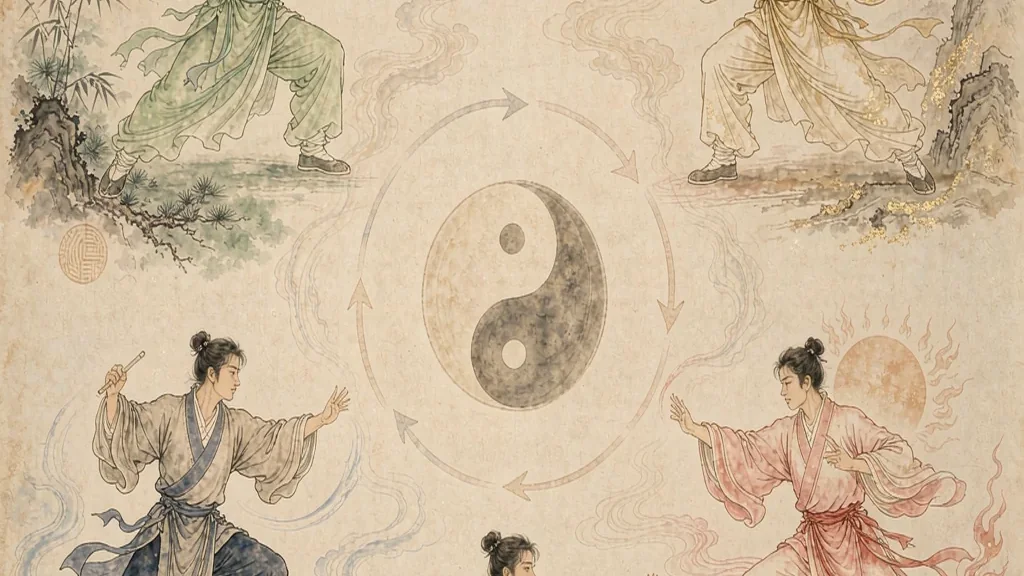
Xingyi Quan, often translated as "Form-Intention Boxing" or "Shape-Mind Boxing," is one of the great internal martial arts of China, alongside taiji and baguazhang. Rather than the flowing circles of taiji, Xingyi is known for direct, explosive linear attacks that resemble the movements of animals and the five classical elements. Its training aims to unite thought and action so tightly that intention alone drives the strike. With roots traditionally traced to the strategist Yue Fei and later codified by the Li family of Hebei, Xingyi is prized for simplicity, power, and practical self-defense. This article explores its history, core theory, animal forms, and modern practice.
Origins and Lineage
Tradition attributes Xingyi's creation to Yue Fei, the Song-dynasty general, who is said to have distilled battlefield striking into a concise system. As with many such legends, this is best understood as honoring a cultural hero rather than firm history.
The art's clearer modern shape comes from Ji Longfeng of the late Ming or early Qing period and, crucially, from Li Luoneng of Hebei in the nineteenth century, who spread the style and trained many key students.
From Hebei the art traveled to Shanxi and Henan, producing regional variations while keeping the same core of direct, intent-driven movement.
The Five Elements Theory
Xingyi is organized around the Five Elements — metal, wood, water, fire, and earth — each mapped to a corresponding fist: split, crush, drill, pound, and cross. These are the building blocks of the entire system.
Each element fist has a distinct body mechanics and tactical idea: the metal split cuts downward, the fire pounding drives straight, the earth cross binds, and so on. Together they cover the main lines of attack and defense.
This elemental framework gives the art a tidy logic: once a student knows the five fists, more complex sequences are understood as combinations and variations of the same principles.
Animal Forms and Their Spirit
Beyond the elements, Xingyi includes "twelve animals" such as the dragon, tiger, monkey, horse, rooster, and eagle, each capturing a quality of movement — the tiger's crush, the dragon's coiling, the monkey's leaping.
The animals are not imitations in a theatrical sense; they are ways to embody a kind of power and attitude. A student "becomes" the tiger to access committed, ground-driven force.
Different branches preserve different animal sets, but all share the idea that form follows intention: the mind shapes the body, and the body expresses the chosen animal's spirit.
The Principle of Directness
Where many arts circle around an opponent, Xingyi moves straight in along the center line, seeking the shortest path to the target. This "one step, one punch" economy is its signature.
The body advances behind the strike so the whole mass drives forward, producing power far beyond what the arm alone could generate. Retreat and re-attack are equally direct.
This straight-ahead logic makes Xingyi feel blunt compared with taiji's yielding, yet practitioners argue that its simplicity is exactly what makes it effective under pressure.
Santi Shi and Standing Practice
The fundamental posture of Xingyi is Santi Shi, the "three-body posture," a balanced, slightly bowed stance that aligns the spine, sinks the shoulders, and prepares the whole body to issue power.
Students spend long periods simply standing in Santi Shi to build structure, root, and the calm needed to act without hesitation. It is the quiet foundation beneath the explosive fists.
From this posture the five-element fists are launched, so that every technique carries the same aligned, rooted quality rather than relying on local muscle.
Breath, Intent, and Power
Xingyi teaches that intention leads and the body follows: the mind decides, and the strike arrives almost without a separate act of willing the arm. This is the "form-intention" of the name.
Breath supports power — a sharp exhale on the strike, a full inhale on recovery — linking the diaphragm to the issuing of force. Over time the breath and movement become one rhythm.
The goal is "whole-body power," where the feet, legs, waist, and arms act together so the strike feels like the earth itself pushing through the practitioner.
Training Methods and Forms
Practice begins with the five-element fists repeated as single drills, then linked into short linking forms. The animal forms are added once the basics are solid.
Two-person work, such as "fist matching," lets students test timing and distance against a partner, applying the elements in a live exchange with controlled contact.
Conditioning the shins, palms, and stance rounds out training, though traditional Xingyi emphasizes skill and structure over harsh body toughening.
Xingyi as an Internal Art
Xingyi is classed as "internal" because it prioritizes the cultivation of intent, breath, and connected structure over outward muscular tension. Yet it looks more external than taiji because of its explosive delivery.
This blend can confuse newcomers: the art is calm in preparation and ferocious in execution, uniting the soft cultivation of neijia with decisive, hard application.
Many practitioners value Xingyi precisely for this balance — it trains health and stillness while remaining a frankly combat-minded system.
Health and Modern Practice
The standing and slow structural work of Xingyi supports posture, leg strength, and relaxed breathing, making it popular with older students seeking gentle exercise with depth.
In the modern era the art is taught worldwide, both as a traditional lineage practice and as part of wushu, with demonstrations highlighting its crisp, linear power.
Whether studied for fitness, self-defense, or philosophy, Xingyi offers a clear path: simplify, align the body, and let intention move it.
❓ Frequently Asked Questions
What does Xingyi Quan mean?
It means "Form-Intention Boxing," reflecting the idea that the mind's intention shapes the body's movement.
Is Xingyi an internal or external art?
It is classed as internal because it cultivates intent and structure, yet it delivers power explosively and directly.
What are the five elements?
They are five foundational fists — split, crush, drill, pound, and cross — mapped to metal, wood, water, fire, and earth.
Why is Santi Shi important?
It is the aligned standing posture that builds root, structure, and the calm needed to issue whole-body power.
How does it differ from taiji?
Xingyi is linear and direct, attacking on the shortest line, while taiji emphasizes circular yielding and redirection.
Can beginners learn Xingyi?
Yes; its simple, repeatable fists make a clear entry point, though a teacher helps with stance and breath.