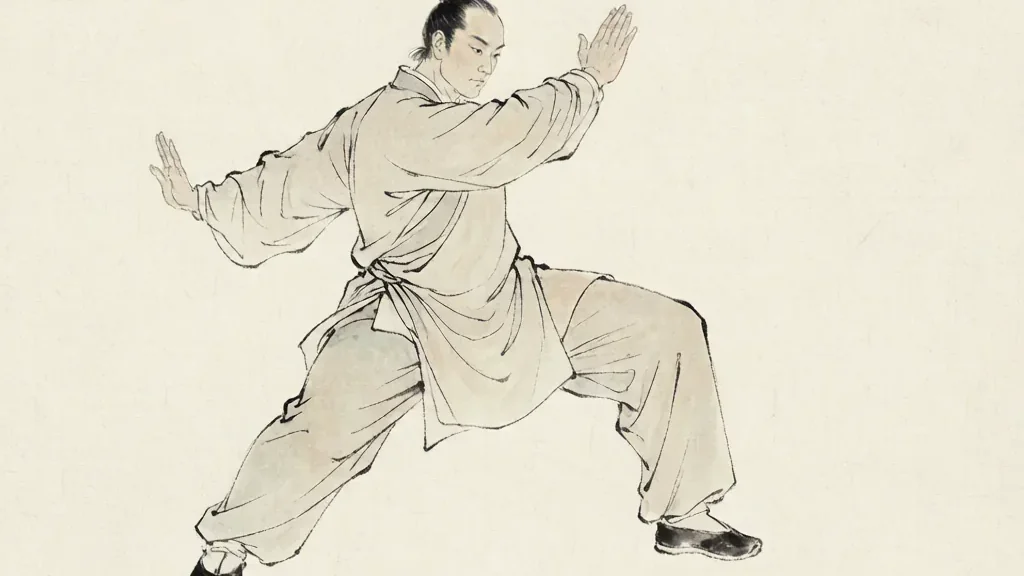
Imagine a fighter who never meets your strike head-on, who glides in a ceaseless circle around you, slipping past every attack while his open palms seem to appear from impossible angles. This is Baguazhang (八卦掌, ), the "Eight-Trigram Palm," one of China's great internal martial arts. Built on the cosmic diagrams of the Yijing (I Ching) and the practice of walking the circle, Baguazhang turns philosophy into movement. It matters because it teaches a radically different logic of combat: rather than crushing force with force, the practitioner uses footwork, evasion, and spiral rotation to redirect, unbalance, and defeat a stronger opponent. For anyone curious about the thinking behind Chinese martial culture, Baguazhang is where metaphysics meets the fighting body.
Origins and the Legend of Dong Haichuan
Baguazhang is generally traced to Dong Haichuan (董海川), a nineteenth-century master said to have taught in the households of the Qing aristocracy in Beijing during the reign of the Xianfeng and Tongzhi emperors. Historical records describe him as a wandering adept who, after years of Daoist training in the mountains of Anhui and Henan, appeared in the capital with a circle-walking art unlike anything seen in the northern plains. Whether the style descended from earlier roaming "jang" practitioners or was synthesized by Dong himself, his students codified what we now recognize as Baguazhang, spreading it through the princely courts and eventually to the wider public.
What makes the lineage remarkable is how faithfully the art preserved its core method. Dong's senior disciples—men such as Yin Fu, Cheng Tinghua, and Liang Zhenpu—each emphasized slightly different palm shapes and transitions, yet all retained the defining circle walk and the eight mother palms. This branching produced living "families" of Baguazhang that still compete and exchange today. The style's survival through the late Qing and Republican unrest testifies to its effectiveness and to the loyalty of its practitioners, who guarded the art as both a fighting system and a health practice.
The Circle Walk and Eight Trigrams
At the heart of Baguazhang lies zou quan (走圈), the circle walk: the student steps along the rim of an imaginary ring, torso upright, one palm guarding the chest and the other extended, constantly changing direction. This is not mere aerobic conditioning. The circle is the physical embodiment of the bagua (八卦), the eight trigrams of the Yijing that map the fundamental orientations and transformations of the cosmos. By walking the circle, the practitioner trains the body to remain centered while the world around it turns—a lesson in balance that transfers directly to combat.
The eight trigrams also give the art its vocabulary of movement. Each trigram inspires a "palm change" (), a set of linked movements that express a different quality: opening, closing, rising, sinking, extending, or coiling. Mastery means being able to flow from one palm change to the next without breaking the circle, so that the body becomes a continuously rotating system. In application, this means you are never static; you are always moving to the opponent's side or rear, the positions from which an attack is hardest to defend.
Palm Techniques and the Spiral Body
Unlike many striking arts that favor the fist, Baguazhang is a "palm" method. The open hand delivers a surprising variety of strikes—horizontal cuts, upward lifts, downward chops, and threaded probing motions that seek the opponent's joints and soft targets. The power behind these palms does not come from the arm alone. It is generated by the whole body spiraling: the waist turns, the weight sinks, the legs drive, and the force travels up the spine and out through the fingertips in a single coordinated wave.
This whole-body spiraling is the reason Baguazhang looks so fluid yet hits so hard. A palm that appears gentle in the dojo can, when properly rooted, displace an opponent several feet or collapse his structure. Practitioners also train linking sequences called "forms" () that chain dozens of movements, conditioning the nervous system to improvise. The art deliberately blurs the line between solo practice and partner work, so that the circle-walking solo drill and the two-person "pushing hands" exchange feel like the same activity viewed from different distances.
Internal Principles: Qi, Silk-Reeling, and Stillness
As an internal art (), Baguazhang shares with Taijiquan and Xingyiquan a concern for cultivating qi (vital energy) and coordinating intention () with movement. The signature internal quality is often described as "silk-reeling" (): a continuous, unbroken spiral that never lets tension freeze the joints. The practitioner learns to keep the joints "open" yet connected, so energy can pass through rather than pile up in the shoulders or hips.
Stillness is the counterpart of all this motion. Advanced students discover that the faster and more complex the external pattern becomes, the quieter the mind inside must remain. Baguazhang training thus doubles as a moving meditation, and its health benefits—improved balance, joint mobility, circulation, and mental calm—are why many people practice it today without any interest in fighting. The martial and the therapeutic were never separate in the Chinese view; a body that moves correctly is both effective and long-lived.
Baguazhang in Modern Practice and Film
Today Baguazhang is practiced worldwide, both as a component of contemporary wushu and as a traditional art taught in family lines. In China it remains a pillar of the internal styles taught alongside Taiji and Xingyi, and it features in national wushu demonstrations. Its distinctive circular footwork and whirling palms have made it a favorite of choreographers and filmmakers, appearing in wuxia cinema where a fighter spins through a crowd of enemies with impossible grace.
The modern classroom usually begins students with the basic circle walk and a single palm change, gradually adding the full set of eight and then the two-person exercises. Serious students still seek out lineage holders for corrections that cannot be learned from books or video. What endures is the art's central promise: that by walking the circle patiently, the ordinary body can be reorganized into something evasive, rooted, and quietly powerful—a living expression of the eight trigrams in motion.
How Baguazhang Compares to Other Internal Arts
Students often ask how Baguazhang differs from its internal siblings. Taijiquan emphasizes slow, rooted yielding and a relatively stationary stance; Xingyiquan is linear, explosive, and elemental; Baguazhang is the wandering one, defined by continuous circling and open-hand skill. Where Xingyi charges in a straight line like a spear, Baguazhang circles like a wheel, always seeking the flank. Many traditional masters trained in two or even all three, believing the arts complement one another—straight intent, yielding softness, and circular evasion forming a complete fighter.
This complementarity explains why Baguazhang is so often studied alongside the other internal systems rather than in isolation. A well-rounded internal practitioner might use Xingyi's direct power to close distance, Taiji's sticking sensitivity to control contact, and Baguazhang's footwork to reposition. The distinctions are real, but the underlying internal principles—relaxation, whole-body power, and intention leading the body—unite them. Understanding Baguazhang thus opens a window onto the entire internal tradition of Chinese martial arts.
The Eight Palms And Mother Palms
Baguazhang organizing vocabulary begins with the Eight Palms, a set of eight distinct palm postures that correspond loosely to the Eight Trigrams of the I Ching. Each palm expresses a different quality of movement: opening, closing, rising, sinking, threading, drilling, extending, and withdrawing. From these eight, the Single Palm Change and the Double Palm Change act as the 'mother' techniques from which countless variations grow. A practitioner walks the circle in a low, twisting stance and performs a palm change at each diameter, so the body continuously spirals and switches direction. This structure makes the art highly modular: once the eight palms and the two changes are internalized, a teacher can link them into flowing sequences of any length. The trigram association is more than symbolism; it gives students a mnemonic map for where energy and intention should travel through the torso and limbs during each rotation.
Circle Walking As Moving Meditation
The defining drill of Baguazhang is circle walking, in which the student steps along the rim of an imaginary ring with the knees bent and the torso coiled. Done slowly at first, the walk builds unusual leg strength and teaches the hips, waist, and shoulders to rotate as a single unit. As skill grows, the walk becomes a moving meditation: attention stays on the breath, the foot placement, and the steady spiral of the spine, much like seated Chan practice translated into motion. Advanced students add palming, turning, and partner drills while never leaving the circle. Because the direction reverses constantly, the nervous system learns to stay balanced and alert in any orientation. Practitioners value this training not only for self-defense but also for its calming, centering effect, which is why modern students often describe Baguazhang as 'walking qigong' with martial intent.
❓ Frequently Asked Questions
📝 Chinese Vocabulary
八卦掌 — : Eight-Trigram Palm, the name of the art.
走圈 — : "walking the circle," the core circle-walking drill.
内家 — : internal family of martial arts.
缠丝劲 — : silk-reeling power, the continuous spiral force.
掌法 — : palm techniques or palm-change methods.
单换掌 — : Single Palm Change, the foundational Baguazhang turning movement
双换掌 — : Double Palm Change, a core rotational palm technique
八卦 — : the Eight Trigrams of the I Ching that give the art its name
🎉 Fun Facts
- Baguazhang's eight palm changes correspond to the eight trigrams of the Yijing, the same ancient text used for divination and cosmology.
- The founder Dong Haichuan is said to have served as a eunuch-attendant in the household of a Qing prince, teaching martial arts to the court.
- Because practitioners continually circle to the opponent's blind side, Baguazhang is sometimes called the "art of attacking from behind."
- Many Baguazhang forms are performed while the practitioner holds a weapon in each hand, such as the deer-horn knives ().
- Baguazhang masters traditionally carry a small gourd or wine cup while walking the circle to test and train their balance.
- The art is the only major Chinese internal style built almost entirely around continuous turning rather than linear stepping.