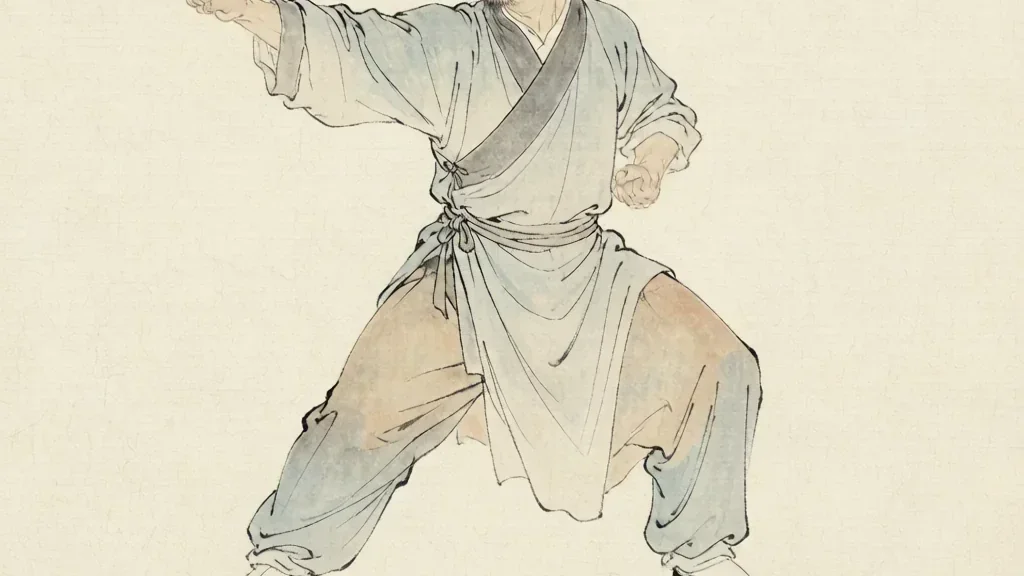
There is a martial art in China that looks less like dancing and more like a spear thrust made flesh. It advances in straight lines, strikes with the simplicity of a hammer, and is built around five elemental movements that mimic metal cutting wood and water drilling stone. This is Xingyiquan (形意拳, ), "Form-Intent Boxing." As one of the three great internal arts of China, alongside Taijiquan and Baguazhang, Xingyiquan matters because it distills combat into its barest essentials: a single intention, expressed as a single explosive motion. For students of Chinese martial culture, it reveals how Daoist and military thinking merged into a system prized by generals, bodyguards, and villagers alike.
History: From Ji Longfeng to Li Luoneng
Xingyiquan's founding is usually credited to Ji Longfeng (姬龙峰), also called Ji Jike, a seventeenth-century master from Shanxi who is said to have developed the art after studying spear technique. The legend holds that he transformed the thrusting logic of the spear into empty-hand form, so that the fist became a spear without the weapon. The art was refined and popularized in the nineteenth century by Li Luoneng (李洛能), who systematized the Five Elements and Twelve Animals and trained a generation of renowned masters in Hebei.
From these roots the style spread across Shanxi, Hebei, and Henan, each region developing its own flavor—Henan Xingyi, for instance, retains older linking forms, while Hebei Xingyi emphasizes the five elements and single-movement drilling. Despite regional variation, all branches agree on the core idea: the body should move as one unit, the mind should lead, and every technique should carry decisive intent. This clarity is why Xingyiquan was favored by escorts and guards who needed reliable, fight-ending skill under pressure.
The Five Elements and Twelve Animals
The conceptual skeleton of Xingyiquan is the Five Elements (): metal, wood, water, fire, and earth. Each corresponds to a fist technique with a distinct quality. Peng (劈, splitting, metal) is a downward chopping blow; Zuan (钻, drilling, water) is an upward spiraling punch; Beng (崩, crushing, wood) is a direct forward strike; Pao (炮, pounding, fire) is an upward block with a simultaneous punch; and Heng (横, crossing, earth) is a horizontal, neutralizing strike. These five are trained endlessly, alone and in pairs, because they contain the complete alphabet of the art's power.
Layered onto the elements are the Twelve Animals (): dragon, tiger, monkey, horse, water lizard, chicken, harrier, swallow, snake, tai bird, eagle, and bear. Each animal embodies a posture and attitude—the dragon stretches and coils, the tiger pounces and crushes, the monkey leaps and distracts, the bear stabilizes and shoulds. Practitioners imitate the spirit of the creature, not its literal anatomy, using the animal forms to expand their expressive range beyond the basic five. Together the elements and animals form a curriculum that is at once philosophical and brutally practical.
San Ti Shi: The Standing Posture
Before any movement, the Xingyi student learns San Ti Shi (三体式), the "Three-Body Standing Post." One foot steps forward at roughly a forty-five-degree angle, the weight sits mostly on the rear leg, the rear hand guards the body and the front hand reaches forward—a posture that looks deceptively like a simple guard. Held for minutes at a time, it builds the structural alignment, leg strength, and quiet concentration that everything else depends on.
San Ti Shi is far more than a stretch. It teaches the critical internal skill of "six harmonies" alignment—the coordination of mind, intention, and energy with the body's joints—and it ingrains the forward-leaning, root-and-release structure unique to Xingyi. Students often find that simply holding the post correctly for a few months transforms their striking power, because the posture encodes exactly how force should travel from the ground through the legs, hips, and spine into the fist. It is the quiet foundation beneath Xingyi's explosive surface.
Power Generation and the Straight Line
Xingyiquan is famous for "one glance, one step, one punch" (): a single committed attack delivered on a direct line to the opponent. Rather than circling like Baguazhang, Xingyi charges forward, using the rear leg to drive the whole body like a battering ram. The power is whole-body, generated by a sudden release of the coiled posture rather than by arm strength alone.
This straight-line aggression is balanced by precise internal mechanics. The spine must be upright yet springy, the hips must rotate subtly to add torque, and the intention must arrive an instant before the fist. Because the techniques are few and repetitive, the nervous system learns them so deeply that they become reflexive—ideal for real confrontations where there is no time to think. The result is an art that values decisiveness over variety: when Xingyi attacks, it commits completely.
Internal Principles and Health Benefits
Like the other internal arts, Xingyiquan cultivates qi and coordinates intention with movement, but it does so with unusual vigor. The standing post builds rooted calm, while the explosive drills train the breath to match the strike—inhale as you gather, exhale sharply ( or ) as you release. This breath-power coupling is central to both the health and the martial value of the art.
Medically minded practitioners prize Xingyi for strengthening the legs, spine, and digestive organs, and for the cardiovascular benefits of vigorous yet controlled practice. The emphasis on upright posture and grounded weight also supports joint health when taught correctly. Importantly, the internal and the external are never divorced: the same alignment that makes a strike powerful also makes the body resilient. This unity of fitness and fighting is a hallmark of the Chinese internal tradition, and Xingyi expresses it with uncommon directness.
Xingyiquan Today and Its Legacy
In the modern era Xingyiquan is practiced both as a traditional art and as a component of competitive wushu, and it has spread well beyond China through dedicated teachers. It remains particularly respected among martial artists who have cross-trained in other systems, because its principles of structure, intent, and whole-body power clarify almost everything else. Many contemporary internal stylists study Xingyi specifically to develop "peng jin," the buoyant, springy force common to Taiji and Bagua as well.
The art's legacy also runs through popular culture and the enduring image of the Chinese boxer who defeats a larger foe with a single, perfectly timed blow. Whether studied for self-defense, health, or cultural understanding, Xingyiquan offers a remarkably efficient path: few techniques, repeated with total focus, until intention and motion become one. For the curious reader, it is the clearest doorway into the internal martial mind.
The Five Elements As Combat Logic
Xingyiquan organizes its core striking around the Five Elements of Chinese cosmology, metal, wood, water, fire, and earth, each represented by a fist technique with a distinct direction and quality. The Splitting Fist falls like an axe, the Crushing Fist drives forward like artillery, the Drilling Fist rises like water, the Crossing Fist binds like earth, and the Pounding Fist explodes like fire. Importantly, the elements are taught as a cycle of mutual defeat, so each technique is the natural answer to the one before it, giving the fighter a built-in countersystem. This makes Xingyi unusually systematic: rather than a random bag of moves, it is a small closed logic that covers attack and response. Students drill the five in sequence until the transitions are automatic. The framework shows how Chinese internal arts borrowed cosmic theory not as decoration but as a practical manual for what to do next in a fight.
Twelve Animals And Direct Power
Beyond the Five Elements, Xingyiquan includes the Twelve Animals, forms that imitate creatures such as the dragon, tiger, horse, and eagle to develop particular attributes like coiling, leaping, or gripping. Together the elements and animals give the art both a clean striking core and a wider vocabulary of movement qualities. What unifies them is Xingyi's signature directness: almost every technique travels straight toward the target with the whole body behind it, and the stepping drives forward rather than circling. This linear aggression makes Xingyi feel different from the turning of Bagua or the slowness of Tai Chi, even though all three are internal. Training stresses a stable, squared stance and the instant issuance of power from a rooted step. For the learner, Xingyi offers the clearest proof that internal arts are not always soft or slow, some are blunt, fast, and overwhelmingly forward.
❓ Frequently Asked Questions
📝 Chinese Vocabulary
形意拳 — : Form-Intent Boxing, the art's name.
三体式 — : Three-Body Standing Post, the basic posture.
五行 — : the Five Elements (metal, wood, water, fire, earth).
十二形 — : the Twelve Animal forms.
崩拳 — : crushing fist, the wood-element strike.
劈拳 — : Splitting Fist, the metal-element core technique
钻拳 — : Drilling Fist, the water-element technique
横拳 — : Crossing Fist, the earth-element technique
🎉 Fun Facts
- Xingyiquan is said to have grown out of spear fighting, with the founder Ji Longfeng transforming spear thrusts into empty-hand punches.
- The Twelve Animals include a "water lizard" and a mythical "tai bird" alongside more familiar creatures like the tiger and dragon.
- Xingyi masters traditionally trained as armed escorts, guarding shipments along dangerous roads in late imperial China.
- The art is famous for its "one step, one punch" philosophy—delivering a decisive strike rather than a flurry of tentative ones.
- Xingyiquan is known for being the most direct and linear of the major internal styles, with few circular motions.
- Its Five Element fists are deliberately linked so each one counters the one before, like rock-paper-scissors.