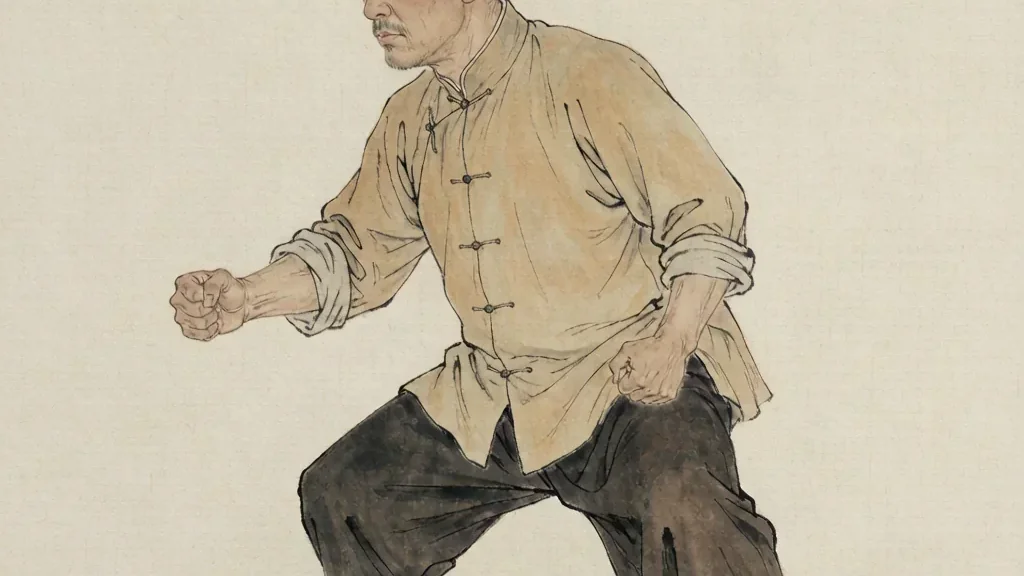
Some Chinese martial arts flow like water; others strike like a battering ram. Bajiquan (八极拳, ), the "Eight-Extremities Boxing," belongs emphatically to the second group. Renowned for short-range explosions of power and especially its devastating elbow, Bajiquan is the art that bodyguards trusted to protect emperors. It matters because it shows the other face of Chinese martial culture—not the contemplative circle walk, but raw, close-quarters lethality refined into a disciplined system. For anyone who thought kung fu was only graceful, Bajiquan is the thunderclap that corrects the impression.
Roots in Cangzhou and the Muslim Community
Bajiquan emerged from the Cangzhou region of Hebei province, a famous cradle of northern martial arts, during the late Ming and early Qing dynasties. A key early figure is Wu Zhong (吴钟), an eighteenth-century master whose teachings spread through both Han and Hui (Chinese Muslim) communities. The art's dense concentration among Hui families in places like Mengcun gave it a distinctive cultural home and helped preserve its rigorous, no-nonsense character.
The name "Eight Extremities" points to the art's ambition: to issue power to the eight directional extremes of the body and beyond, so that force radiates from the center to the furthest tips of the limbs and into the opponent. Historically, Bajiquan was taught as a complete fighting method rather than a performance art, which is why its forms look compact and aggressive rather than ornamental. Its survival through centuries of regional conflict owes much to its proven usefulness in tight, desperate situations.
The Signature Elbow and Short-Range Power
If Bajiquan has a trademark, it is the elbow. The ding zhou (顶肘, "toppling elbow") drives the point of the elbow straight forward like a spear, generating immense localized force at close range where punches lose their travel. Practitioners also use shoulder strikes, hip bumps, and knee attacks, all delivered from a stance so rooted that the body becomes a lever rather than a collection of separate limbs.
What makes these short techniques so powerful is "fa jin" (发劲), the explosive release of whole-body force in an instant. In Bajiquan this is trained with distinctive stomping steps and a shouted "heng" or "ha" that同步 synchronizes breath and power. The stomp drives the ground reaction up through the legs, the spine whips, and the elbow or shoulder detonates the energy into the target. Because the distance is so short, the opponent has almost no time to react—a defining advantage of the style.
Core Methods and the "Six Big Openings"
Bajiquan's curriculum centers on a small number of high-yield methods rather than a sprawling catalog of forms. Among the most important are the "Six Big Openings" (), a set of stretching and striking movements that teach the body to open and close like a bellows, building the elastic structure needed for explosive power. There is also the famous Pao Ge (炮胳膊) arm-conditioning and the "Eight Extremities Small Frame" () that beginners learn first.
Partner training is central. The Da Lei Tai and especially the "attack and defend" drilling teach students to bridge the gap, trap, and erupt with power against a resisting partner. Bajiquan also pairs naturally with Qinna (seizing and locking) and with weapons such as the saber and the spear, so a complete practitioner can fight empty-handed or armed. The unifying theme is always the same: close the distance, root, and release.
The Imperial Bodyguards and Modern Fame
Bajiquan earned its fearsome reputation partly through its association with the last imperial bodyguards. Masters such as Li Shuwen (李书文), active in the late Qing and early Republican period, were legendary for their unmatched elbow and spear skill, and the art was selected to train the guards of the Xuantong emperor Puyi. The logic was simple: in the cramped spaces of a palace corridor, a bodyguard needed a method that worked instantly at arm's length.
In recent decades Bajiquan has reached global audiences through film and television, most notably the Ip Man movie series, where the master ruminates on the art and its lethality. This popular exposure, while dramatized, captured a real truth: Bajiquan is respected even among other stylists for its close-range destructiveness. Today it is taught in China, Taiwan, and martial arts schools worldwide, often to students who want authentic, battle-tested internal-external power rather than sport-oriented sparring.
Training the Body: Stance, Breath, and Iron Shirt
The physical foundation of Bajiquan is a low, bow-like stance called ma bu (horse stance) variants and the art's own "hammer stall" postures that build leg strength and root. Students spend long sessions holding and transitioning these stances to develop the stable base from which explosions launch. Without this root, the signature power simply cannot manifest, no matter how strong the arms.
Breath and intention are trained alongside structure. The characteristic stomp-and-shout is not theatrics; it coordinates the diaphragm, the ground push, and the mental commitment required for fa jin. Some lineages also practice conditioning drills akin to "iron shirt" () training, toughening the limbs and torso to absorb and deliver impact. Done correctly under a qualified teacher, these methods produce a body that is both resilient and explosive—the practical heart of the Eight Extremities.
Bajiquan's Place Among Chinese Arts
Unlike the purely internal arts, Bajiquan is often described as "hard" or external in expression while sharing internal mechanics, placing it in a bridging category beloved by fighters. Its directness contrasts with the circular evasion of Baguazhang and the elemental linearity of Xingyiquan, yet it complements both. A student of the internal arts frequently studies Baji to acquire close-range power that the softer arts approach more indirectly.
This pragmatic reputation ensures Bajiquan's continuing relevance. In an era when many traditional styles are criticized as divorced from combat, Bajiquan's guardian tradition and its emphasis on explosive, verifiable results keep it credible. Whether one trains for self-defense, historical interest, or physical culture, the Eight-Extremities Boxing offers a concentrated lesson in how Chinese martial arts could be ruthlessly effective without sacrificing discipline and philosophy.
The Six Great Openings
Bajiquan structures its offensive theory around the Liu Da Kai, or Six Great Openings, a set of six methods for breaking an opponent's structure and entering their space. These are traditionally named as the elbow strike, the shoulder strike, the hip strike, the body bump, the spine whip, and the crossing close. Rather than a fixed list of techniques, the Six Openings describe six ways the whole body can be launched into an opponent to destroy their balance and root. Training emphasizes that any one opening can lead into another, so a defender who blocks the first is met by the second. This makes Bajiquan feel unpredictable and overwhelming at close range. Students drill the openings against a wooden post and with partners, learning to commit the entire mass of the body into each strike. The goal is not to push but to detonate: a sudden, whole-body collision that ends the exchange before it develops.
Training With The Wooden Post
Like several northern internal arts, Bajiquan relies heavily on a stout wooden training post set firmly in the ground. The post gives honest feedback: lean, bump, or strike it with poor structure and the recoil teaches the mistake immediately. Practitioners use the post to refine the Six Openings, learning exactly how the feet, knees, hips, and spine must align so that force travels cleanly into the contact point. Because the post cannot be moved, the student discovers whether true root and whole-body connection exist or whether the strike was merely arm strength. Over years, this repetitive, almost meditative pounding builds the tendons and fascia needed for the style's famous shock power. Many schools still begin every session with post training before moving to forms and partner drills, preserving a method that has changed little for generations.
❓ Frequently Asked Questions
📝 Chinese Vocabulary
八极拳 — : Eight-Extremities Boxing, the art's name.
顶肘 — : toppling or driving elbow strike.
发劲 — : explosive emission of power.
六大开 — : the Six Big Openings, core training methods.
铁布衫 — : "iron shirt," body-conditioning training.
顶肘 — : Top Elbow, an upward elbow strike driving from the ground
六大开 — : the Six Great Openings, Bajiquan's six principles of explosive entry
贴山靠 — : Lean Like a Mountain, a shoulder-body slam against the opponent
🎉 Fun Facts
- Bajiquan was the chosen art of the bodyguards protecting Puyi, the last emperor of China.
- The legendary master Li Shuwen was said to have never lost a duel and was feared even by other top martial artists of his era.
- The art's signature stomp is not just footwork—it helps generate the ground-reaction force behind the explosive strike.
- Bajiquan features prominently in the Ip Man films, where it is portrayed as one of the deadliest northern styles.
- Bajiquan is sometimes called 'the art of hitting with the whole body' because a single technique can chain elbow, shoulder, and hip into one impact.
- The style's signature shout, a short explosive 'hen' sound, is used to brace the torso and focus power at the moment of contact.