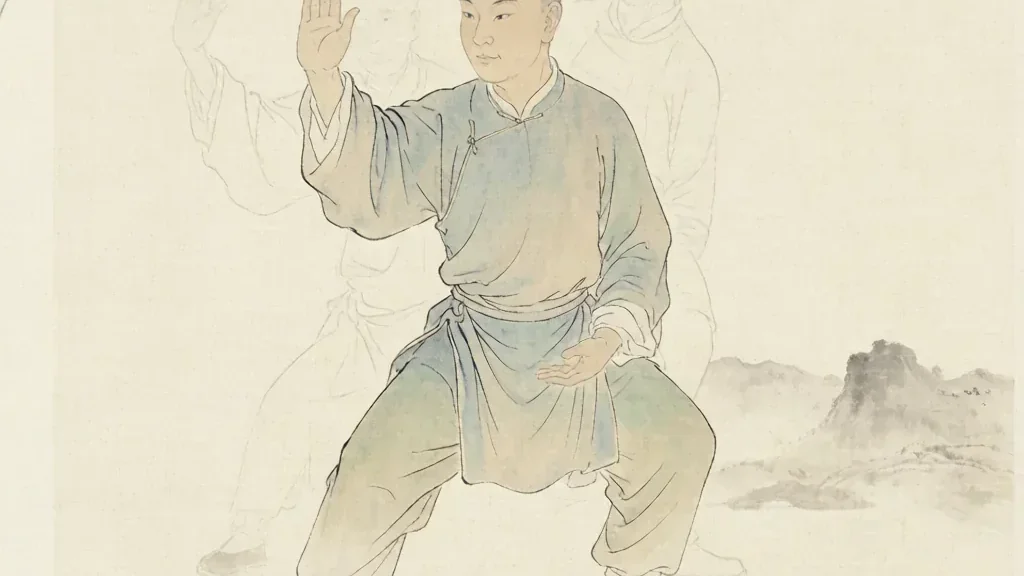
Every Chinese martial art preaches coordination, but one style makes it the entire philosophy. Liuhequan (六合拳, ), "Six-Harmony Boxing," is built on the principle that the body's six pairs of correspondences must unite into a single, efficient force. Found in both northern and southern traditions, it matters because it names explicitly what other styles only imply: that real power comes from harmony, not from isolated strength. For students of Chinese martial culture, Liuhequan is the clearest statement of how coordination itself became a system.
What the "Six Harmonies" Mean
The name refers to six internal-external unities. The "three internal harmonies" are mind with intention (), intention with energy (), and energy with power (). The "three external harmonies" are shoulders with hips, elbows with knees, and hands with feet. When all six align, the strike is not thrown by the arm alone but expressed by the whole person, from thought to toe.
This framework is ancient and influential; variations of the six harmonies appear in Xingyiquan, Bajiquan, and many northern styles. Liuhequan elevates the idea to the name and the curriculum, so every posture is checked against the list: are my elbows over my knees? Is my intention driving my breath? The result is a style that feels deliberately "connected," where no part moves without the others. It is less a fixed technique set than a standard of correctness applied to movement.
Northern and Southern Liuhe Traditions
Liuhequan exists in several regional forms. A well-known northern version traces to Henan and Hebei, associated with the broader internal and northern-pike traditions, emphasizing long, coordinated movements and the harmonized stances. A distinct southern "Liuhe" tradition flourished in Fujian and among the Hui (Muslim) communities, sometimes linked to the "Liuhe Men" schools that taught a complete empty-hand and weapon curriculum.
Despite differences, the southern and northern lines share the harmony principle and a reputation for pragmatism. The southern Liuhe especially is noted for compact, powerful forms and a close relationship with local Fujian boxing. The existence of the name across regions shows how a single organizing idea—sixfold coordination—could inspire separate but kindred arts, each adapted to local physique and needs. The shared name is a shared aspiration more than a single genealogy.
Posture, Stance, and Whole-Body Power
Training begins with the stance work that makes harmony possible. The horse stance and bow stance are held until the hips, knees, and feet settle into alignment; only then are the hands taught to move in concert with the legs. A signature check is that the hand and the same-side foot arrive together—step and strike as one event—so the ground reaction travels straight into the technique.
This "hands and feet together" rule is the external hallmark of Liuhequan. It sounds simple but is demanding: most beginners either step first and strike late, or strike and then scramble the foot. Correct repetition rewires the nervous system so the whole body fires as a unit. In application, a harmonized strike carries the weight of the legs and the rotation of the waist, not just the arm, which is why the style can be deceptively powerful for its modest appearance.
Forms and the Curriculum
Liuhequan forms are typically straightforward and repetitive, emphasizing correct alignment over flash. A basic set might chain a handful of punches, palm strikes, and low kicks, each performed with meticulous attention to the six harmonies. Advanced sets add weapons—staff, saber, and spear—where the same coordination principles apply at greater reach and speed.
Because the forms are not acrobatic, the style is accessible to older or less flexible students, which helped it survive as a community art. Two-person drills () let students test whether their harmony holds under resistance: a lock or strike only works if the body is truly unified. Teachers often say the form is "the question" and the partner drill "the answer," a neat summary of how Liuhequan uses solo practice to prepare for live interaction.
Health, Breath, and Internal Cultivation
Like other Chinese arts, Liuhequan is valued for health. The insistence on aligned posture straightens the spine, opens the joints, and encourages natural breathing, which benefits practitioners of all ages. The internal harmonies—mind, intention, energy—double as a moving meditation, training focus and calm alongside strength.
The breath work is explicit: inhalation gathers energy to the center, exhalation issues it with the strike, synchronized so that the "three internal harmonies" are felt, not just recited. Regular practice is said to improve balance, circulation, and digestive function, claims consistent with the art's low-impact, alignment-focused method. In this sense Liuhequan fulfills the traditional promise that the fighting art and the longevity art are one—harmony serves both the duel and the daily life.
Liuhequan's Place in the Martial Spectrum
Positioned among the "harmony"-based northern and southern systems, Liuhequan complements the more flamboyant animal and internal styles by returning to first principles. Where Baguazhang circles and Xingyi charges, Liuhequan simply insists that whatever you do, do it with the whole body in agreement. That makes it an excellent foundation art: students who learn harmony early carry it into any later style.
For the cultural learner, Liuhequan is also a lesson in Chinese conceptual thinking. Rather than cataloging techniques, it names a standard—six harmonies—and judges everything by it. This is the same habit of thought seen in yin-yang, the five elements, and the eight trigrams: organize reality into a small set of relationships, then apply them everywhere. Liuhequan is martial arts as applied philosophy, and a tidy entry point into the Chinese way of structuring movement.
The Six Harmonies Explained
Liuhequan is named for the Six Harmonies, a pairing system that links the body's actions inside and out. The three external harmonies join shoulder with hip, elbow with knee, and hand with foot, so that every strike is backed by the corresponding joint and no limb moves alone. The three internal harmonies join mind with intent, intent with qi, and qi with physical power, ensuring that thought leads energy and energy leads force. Together the six describe a body in which intention, breath, and movement are inseparable. Training drills repeat simple combinations until these pairings become automatic, at which point technique feels effortless and unified. The concept is ancient and appears in other Chinese arts, but Liuhequan makes it the explicit skeleton of the entire system. Understanding the six pairings is the key to reading why the form looks so clean and connected.
Northern And Southern Lines
Although Liuhequan is most often classed as a northern style with long, grounding stances and extended strikes, related Six Harmony systems exist in the south, producing a family of arts that share a name but differ in flavor. Northern lines tend to emphasize wide horse stances, broad stepping, and obvious whole-body power suited to open training halls. Southern-influenced versions keep more compact bridges and quicker hand exchanges while still invoking the same harmony principles. This spread means a student meeting Liuhequan in one province may learn forms quite different from another, yet both will stress coordination over flair. Teachers usually present a foundation set, a linked routine, and a weapon form such as the spear or saber. The variety shows how a single philosophical idea can organize many local expressions without losing its core identity as a harmony-based martial art.
❓ Frequently Asked Questions
📝 Chinese Vocabulary
六合拳 — : Six-Harmony Boxing.
六合 — : the six harmonies (three internal, three external).
心与意 — : mind with intention (internal harmony).
手与足 — : hands with feet (external harmony).
对练 — : two-person partner training.
外三合 — : the Three External Harmonies of shoulder-hip, elbow-knee, hand-foot
内三合 — : the Three Internal Harmonies of mind-intent, intent-qi, qi-power
六合步 — : Six Harmony Step, the coordinating footwork of the style
🎉 Fun Facts
- The six-harmonies principle appears in many other styles too, including Xingyiquan and Bajiquan, showing its foundational importance.
- A core Liuhequan rule is that the hand and the same-side foot strike as one event, so power comes from the ground up.
- Southern Liuhe traditions are strong among the Hui (Chinese Muslim) community and in Fujian province.
- Because its forms are non-acrobatic, Liuhequan has long been practiced by older students for both health and self-defense.
- Liuhequan is taught across both northern and southern China, so its forms vary widely by region while keeping the same harmony principle.
- The Six Harmonies concept also appears in Chinese medicine and archery, showing how shared the idea is across arts.