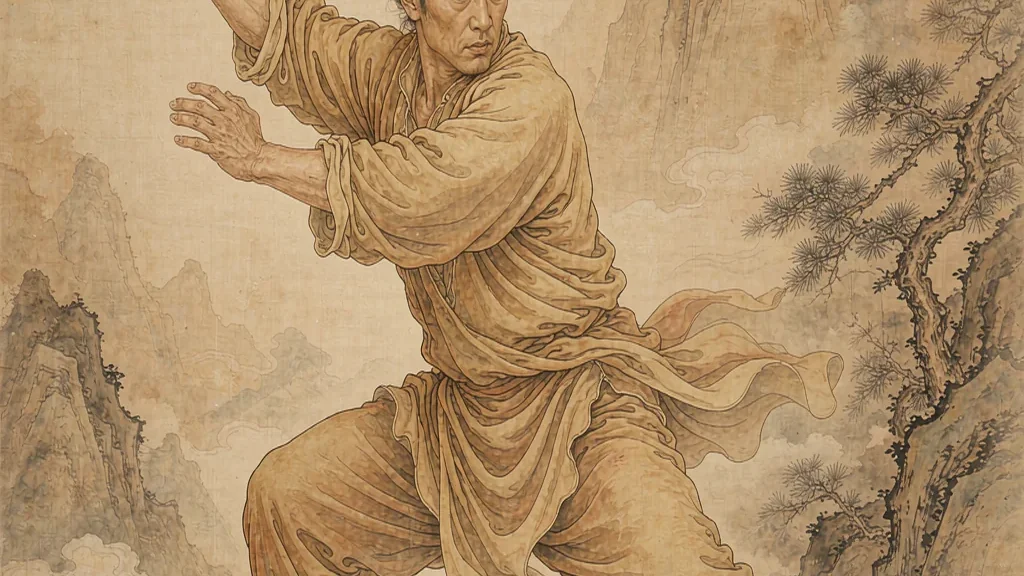
Baji Quan, often translated as "Eight Extremities Fist" or "Open Gate Eight Extremities Fist," is a northern Chinese martial art celebrated for its explosive, short-range power and its signature upward and forward elbow and shoulder strikes. Developed in the Hebei and Shandong border region, the style emphasizes issuing force in a single burst (fajin) and is associated in popular lore with the bodyguards of late imperial and republican-era leaders. Though less widely practiced than tai chi or wing chun, Baji Quan is respected among martial artists for its directness, its rooted stance work, and its ability to generate tremendous impact from seemingly compact movements.
Origins and Early History
The roots of Baji Quan are usually traced to the village of Mengcun in Cangzhou, Hebei province, a region long famous in China as a cradle of martial arts. Early oral tradition attributes the art to a wandering monk or lay master from the late Ming and early Qing period, though precise documentation is scarce and modern practitioners generally avoid fixing a single founder.
The name "Baji" (Eight Extremities) is drawn from classical Chinese cosmological language, evoking the eight directions and the idea that the practitioner's force reaches to the furthest limits of the body. The art was historically transmitted within family and village lineages, with strict protocols of apprenticeship and a strong culture of secrecy around its core methods.
During the Qing dynasty, Baji Quan circulated mainly in northern villages and was valued as a practical fighting method rather than a performance art. Its reputation grew as practitioners defended homes, escorted merchants, and demonstrated their skill in the regional martial contests that were common in Cangzhou.
Core Philosophy and Naming
The "eight extremities" refers metaphorically to the coordination of the body's power channels: the hands, elbows, shoulders, hips, knees, feet, and the combined torso and head. The ideal is that when one part moves, all parts move, so that force is not localized but conducted through the whole frame.
Baji Quan is often described as a "hard" or "external" art, but veteran teachers stress that its hardness is a product of relaxed, whole-body coordination rather than muscular tension. The stated goal is to strike like a catapult: the body loads, then releases in a single, unbroken instant.
This philosophy distinguishes Baji from slower, meditative arts. Where tai chi is practiced for health and gradual internal development, Baji Quan is unapologetically combative, prizing the ability to end a confrontation with one decisive burst of power.
Stance and Footwork
Foundation in Baji Quan begins with the "ma bu" (horse stance) and a distinctive "zhen shan" or door-opening posture that keeps the weight low and the pelvis tucked. Stances are wide and deeply rooted, training the legs to act as stable pillars from which the upper body can whip.
Footwork is deliberately compact. Practitioners do not chase distance with large steps; instead they close the gap with short, springy advances that keep the center of gravity low. This makes the style especially effective at the ranges where most real fights occur—close and clinch distance.
The "ka men" (open the gate) step is a hallmark: a sudden forward lunge that drives the shoulder or forearm into the opponent while the rear leg pushes like a bow releasing an arrow. Correct timing turns the entire body weight into the strike.
Signature Techniques: Elbow and Shoulder Strikes
The most recognizable Baji technique is the upward elbow smash (ding zhou) delivered with the body rising from a low stance, designed to drive into the chin or sternum. Equally important are the "hong quan" (crushing fist) and the shoulder bump (kao), which uses the whole torso as a battering ram.
What makes these techniques unusual is that they are thrown at extremely close range, often from a posture that looks almost like an embrace. The power comes not from a long wind-up but from the synchronized straightening of the legs and spine at the moment of contact.
Practitioners also train "pi zhang," a chopping palm strike descended from the related Pigua Quan, showing the historical exchange between the two northern arts. Many Baji lineages borrow Pigua's whipping arm methods to add reach and follow-up to their core elbows.
The "Six Great Openings" and "Eight Elbows"
Traditional Baji curriculum is organized around the "liu da kai" (Six Great Openings), fundamental movements that teach how to break an opponent's structure and enter. Each opening combines a stance, a strike, and a follow-up throw or lock, drilled thousands of times for instinctive response.
Complementing these are the "ba zhou" (Eight Elbows), a catalogue of elbow applications from different angles and heights. Together they form the technical skeleton of the style and are usually taught before any long solo form.
Modern schools sometimes present the Six Openings as a linked solo set, but in older training they were primarily two-person drills, practiced with a partner who offers realistic resistance so the student learns to apply force against a moving body.
Solo Forms and Drills
After the fundamentals, students learn the "xiao jia" (small frame) form, a compact sequence concentrating on the core elbows and shoulders. More advanced is the "da jia" (large frame), which expands the movements with greater extension and clearer expression of fajin.
Baji also preserves weapon forms, notably the spring-and-autumn saber (a single-edged broad blade) and the spear. The spear training is valued because it demands the same whole-body power as the empty-hand art and reveals any weakness in rooting.
Throughout form practice, the constant instruction is "shen zhan" (body extension): every posture should feel as though it could erupt into a strike. Forms are not danced; they are rehearsals of violence performed with full intent.
Connection with Pigua Quan
A famous saying in northern martial circles states, "Baji with Pigua, gods and demons are afraid." The two arts were paired for centuries because their strengths complement each other: Baji provides the close-range explosive entry, while Pigua supplies whipping, circular strikes at slightly longer range.
Many lineages require students to study both, and the combined "Baji-Pigua" system remains a standard in Cangzhou and among overseas practitioners. The cross-training smooths the Baji fighter's transition from the clinch to striking at arm's length.
This pairing also illustrates a broader Chinese principle: rather than treating one style as complete, masters historically borrowed methods that filled gaps in their own arsenal. Baji's openness to Pigua is a reason the art stayed effective across generations.
Baji Quan in the Twentieth Century
Baji Quan gained national attention in the Republican era when several masters served as martial arts instructors and bodyguards to political figures. Its reputation for protecting high-ranking officials cemented its image as a "bodyguard's art."
The establishment of the Central Guoshu Institute in the late 1920s, which standardized and promoted Chinese martial arts, gave Baji a platform alongside tai chi, xingyi, and bagua. Demonstrations and tournaments spread knowledge beyond Cangzhou.
After 1949, the style was preserved both within mainland sports academies and through overseas emigrant communities, particularly in Taiwan, Southeast Asia, and later Europe and North America, where dedicated lineages keep the traditional curriculum alive.
Training Method and Conditioning
Conditioning in Baji is grueling and unglamorous. Students spend long periods in stance training to build the leg strength and tendon resilience needed for fajin. Hitting the "mu ren zhuang" (wooden dummy post) is common, teaching the body to strike without flinching.
Breath training is integral: the characteristic shout "hei" or "yi" accompanies the release of force, coordinating exhalation with the explosive moment so the strike carries the whole body's energy. Held breath wastes power; released breath channels it.
Two-person "pushing and striking" drills develop sensitivity to an opponent's balance and timing. Unlike the gentle fixed-step push hands of tai chi, Baji's partner work is robust, with full-intensity entries used to test whether the technique actually disrupts the partner's structure.
Modern Practice and Legacy
Today Baji Quan exists in several branches, the Mengcun lineage being the most cited source, alongside offshoots carried by republican-era masters. Differences are mostly in form choreography and emphasis, not in the underlying principles of explosive short-range power.
The art has also entered popular culture through film and television, where its elbow and shoulder bursts read as viscerally powerful on screen. This exposure has drawn new students curious about a style that looks both ancient and brutally efficient.
For serious practitioners, Baji Quan remains first and foremost a fighting method. Its continued survival depends on teachers willing to demand the difficult, repetitive conditioning that transforms a set of movements into genuine "eight extremities" power.
❓ Frequently Asked Questions
What does "Baji Quan" mean?
It means "Eight Extremities Fist." The "eight extremities" refers to the coordinated power channels of the body, evoking force that reaches in all directions.
Is Baji Quan an internal or external art?
It is generally classed as external because of its hard, explosive strikes, but masters stress that the power comes from relaxed whole-body coordination rather than brute muscular tension.
Why is Baji paired with Pigua Quan?
The two complement each other: Baji gives close-range explosive entries, while Pigua adds whipping strikes at slightly longer range, covering more fighting distances.
How is Baji different from tai chi?
Tai chi is often practiced slowly for health and internal development, whereas Baji is an unapologetically combative style built around sudden, short-range bursts of power.
What are the "Six Great Openings"?
They are the six fundamental Baji movements teaching how to break an opponent's structure and enter, traditionally drilled as two-person applications before solo forms.
Where did Baji Quan originate?
It developed in the Cangzhou region of Hebei province, especially Mengcun village, and spread through village and family lineages in northern China.