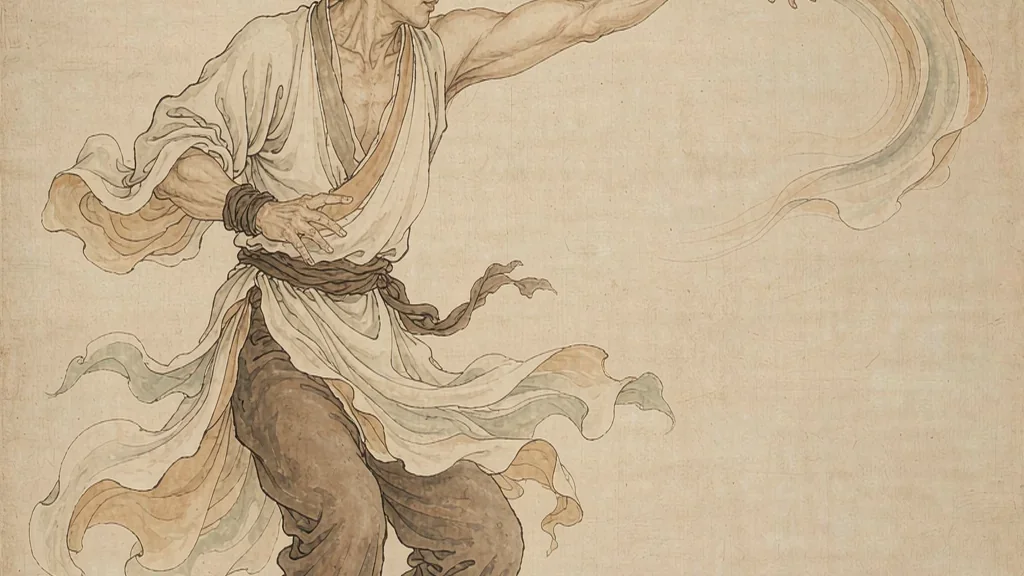
Pigua Quan, often translated as "Chopping and Hanging Fist" or "Slapping Palm," is a northern Chinese martial art renowned for its whipping, circular arm power and its close historical partnership with Baji Quan. Originating in the Cangzhou region of Hebei, the style emphasizes relaxed, swinging movements of the shoulders and arms that culminate in sudden, shattering strikes. Where Baji Quan supplies the close-range explosive entry, Pigua Quan provides the longer-range, scything blows—together forming one of the most respected combined systems in northern Chinese martial arts.
Origins in Cangzhou
Pigua Quan comes from the same martial crucible as Baji Quan: the Cangzhou area of Hebei province, long celebrated across China as a homeland of boxing. The art's early history is wrapped in village tradition, with several lineages claiming descent from Ming-dynasty masters.
Like many northern styles, Pigua was transmitted through family and teacher-student lines with little written record. What survived was the movement vocabulary itself, passed body-to-body through relentless repetition and correction.
The style's fortunes rose when it was paired with Baji in the republican era, as teachers recognized that the two complemented each other so well that a saying arose: "Baji with Pigua, gods and demons are afraid."
Name and Meaning
The name combines "pi" (to chop or split) and "gua" (to hang or drape). "Pi" refers to the downward chopping palm strikes that fall like an axe; "gua" refers to the hanging, whipping motion of the arms as they swing back and around before striking.
Together the terms describe the art's signature mechanics: a relaxed arm is "hung" and swung, then "chopped" down or across with accelerated force at the end of the arc. The imagery is agricultural—chopping and hanging—reflecting the rural world that produced the style.
Some translations render it "Slapping Palm" because the strikes often land with a loud, whip-crack sound when the body mechanics are correct, a useful audible cue for both student and teacher.
Whipping Power Mechanics
The central principle of Pigua is "fangsong" (total relaxation) followed by sudden acceleration. The arm is kept loose like a rope until the last instant, when the shoulder, elbow, and wrist sequentially snap to transmit power from the ground up through the torso.
This "whip" model means the force is generated not by the arm alone but by the whole kinetic chain: the rear leg pushes, the hip rotates, the spine twists, and the shoulder flings the arm. The hand is merely the tip of the whip.
Because the power is relaxed-until-impact, Pigua strikes feel deceptively soft in motion yet hit very hard. Training focuses on removing stiffness so the body can act as a continuous, flexible conduit for force.
Signature Strikes and Palms
The "pi zhang" (chopping palm) is the namesake technique: a palm-edge strike delivered downward or diagonally, often targeting the collarbone, neck, or shoulder. The "gua" motion sets it up by swinging the arm in a wide circle.
Practitioners also use "beng" (bursting) palm and "chan" (entwining) palm, the latter wrapping around an opponent's limb to off-balance them. The variety lets the stylist adapt to different ranges and angles within a single flowing sequence.
A distinctive feature is the use of both hands in alternation, one "hanging" while the other "chops," so the offense is continuous. This two-handed rhythm is drilled in the solo forms and in partner drills.
Stance and Body Use
Pigua uses mobile, moderately low stances that allow the hips to rotate freely. The "bow stance" and "empty stance" appear often, but the defining feature is the active, turning waist rather than a fixed posture.
Unlike the deeply rooted, door-opening stances of Baji, Pigua favors a more upright, springy body that can swing and step in one motion. This makes it feel lighter, though the conditioning is no less demanding.
Breath control is linked to the whip: a sharp exhalation coincides with the snap of the strike, helping the abdomen and ribs contribute to the blow. Held tension in the chest is explicitly corrected as it kills the whip effect.
Solo Forms
The basic Pigua form, sometimes called the "small frame," teaches the chop-and-hang rhythm with simple footwork. The advanced "large frame" expands the circles and adds leaping, turning variations that express the whip across greater space.
Forms are practiced for both conditioning and application study. Each palm technique is later decoded with a partner to reveal its target and follow-up, ensuring the choreography is not empty movement.
Because Pigua pairs so often with Baji, many schools teach a combined set in which the student alternates the two arts, learning to flow from a whipping palm at range into an explosive elbow at close distance.
Relationship with Baji Quan
The Baji-Pigua combination is the heart of the style's modern identity. Baji covers the in-fight with elbows, shoulders, and short bursts; Pigua covers the mid-range with swinging palms and the ability to disrupt structure at a distance.
Training both develops a complete fighter: the relaxed whip of Pigua builds the looseness that Baji's fajin needs, while Baji's rooting gives Pigua a stable base from which to swing. Teachers say the two are like opposite hands of one body.
This synthesis also reflects a wider Chinese martial principle—that no single style is sufficient, and the wise practitioner borrows what works. Pigua's willingness to merge with Baji is a model of such openness.
Conditioning and Training
Shoulder and waist flexibility are paramount. Students spend considerable time loosening the shoulder joint so the arm can swing freely without impingement, often through circular "windmill" drills.
Striking the air with audible whip-crack is a daily check; when the sound appears, the student knows the whole chain is working. Hitting pads and posts later confirms the power against resistance.
As with its sister art, Pigua demands patience. The relaxed whip cannot be forced; it emerges only after months of unlearning habitual tension, which many find the hardest part of training.
Legacy and Modern Practice
Today Pigua Quan survives strongly in Cangzhou and in the lineages descended from republican-era masters, as well as among overseas practitioners who learned it through the Baji connection. It appears in some wushu demonstrations though it is less standardized than flashier styles.
The art attracts students who appreciate its emphasis on natural body mechanics over brute strength, making it suitable for a range of body types. Its whip principle also informs many modern fitness and fight-training ideas.
For traditionalists, Pigua remains a pure expression of "soft producing hard"—a reminder that in Chinese martial arts, the most devastating power often comes from the loosest, most relaxed movement at the moment of release.
❓ Frequently Asked Questions
What does Pigua Quan mean?
It means "Chopping and Hanging Fist," referring to its downward chopping palm strikes and the whipping, hanging swing of the arms before impact.
How is Pigua different from Baji?
Pigua uses relaxed, swinging whipping palms at mid-range, while Baji uses short, explosive elbows and shoulders at close range; together they cover more distances.
Where does the power come from?
From a relaxed arm that snaps at the last instant via a kinetic chain through the legs, hips, spine, and shoulder—like the tip of a whip.
Is Pigua an internal or external art?
It is generally classed external, but its emphasis on relaxation and whole-body coordination shares ideas with internal arts, blurring the usual boundary.
Why do students make a whip-crack sound?
The sound signals correct whole-body mechanics; when the strike cracks, the student knows the relaxed whip is working through the full chain.
Where did Pigua originate?
It developed in the Cangzhou region of Hebei province, the same martial homeland that produced Baji Quan.