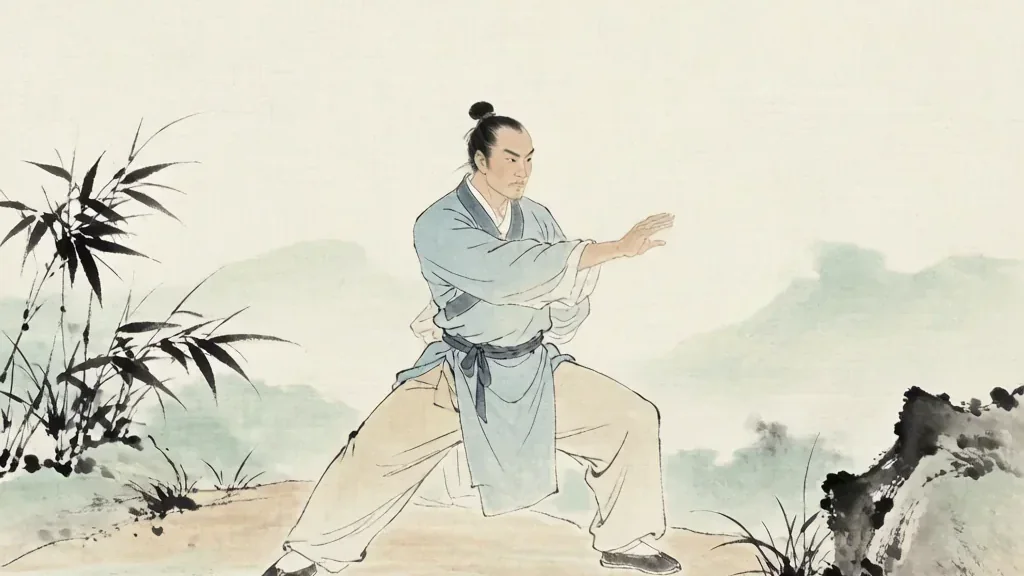
Some southern styles are compact and close; Choy Li Fut (蔡李佛, ) is the opposite—big, sweeping, and devastating at long range. Founded in 1836 by Chan Heung (陈享), it blends the Choy family's fist, the Li family's footwork, and the "Buddhist" (Fut) monk's techniques into one comprehensive system. It matters because it is a rare southern art that deliberately uses wide, circular, full-extension movements and long weapons, making it both a fearsome fighting method and a cultural institution in the Cantonese diaspora. For those who assumed all southern kung fu stays small, Choy Li Fut is the grand exception.
Chan Heung and the Founding of 1836
Choy Li Fut was created by Chan Heung in the town of Jingtou, in Guangdong's Xinhui county, in the year 1836. According to the lineage, Chan studied with three teachers who represented the three streams merged in the name: a master of the Choy (蔡) family boxing, a Li (李) style expert known for kicking, and the monk Qingyuan (or the "Fut" Buddhist tradition associated with the Southern Shaolin). Chan synthesized these into a single curriculum taught under his own banner.
The timing was significant. The early nineteenth century saw growing turmoil in the Qing empire, and village martial arts flourished as self-defense and community identity. Chan Heung's system spread quickly through the Pearl River delta and, later, with emigrants to Southeast Asia, North America, and Europe. Because many overseas Chinese communities originated in Guangdong, Choy Li Fut became one of the most widely practiced southern styles abroad—a bond of identity as much as a fighting art. Its founding date is unusually precise, a rarity in a field full of cloudy legends.
The Three Sources: Choy, Li, and Fut
The name itself is a syllabus. "Choy" contributes powerful hand techniques and the structured fist work associated with the Choy clan. "Li" contributes the kicking and leg methods, giving the style a lower, more mobile footwork than many southern arts. "Fut" (佛, "Buddha" or Buddhist monk) contributes the circular, flowing techniques attributed to the Shaolin monastic tradition, including the long-range swings and the staff work.
This combination yields a style that is unusually complete. It has the hand power of a southern system, the kicking of a more mobile one, and the circular reach of a monastic art. Practitioners often say Choy Li Fut "has the long arms of the north and the strong horse of the south." The synthesis was deliberate: Chan Heung wanted a method without the gaps that a single-source style might leave, able to fight at close, middle, and long range alike.
Big Circular Movements and Long Range
The visual signature of Choy Li Fut is its large, circular motion. Where Hongquan keeps the elbows in and fights on the centerline, Choy Li Fut swings the arms in wide arcs, generating momentum that adds weight to every strike. The torso rotates forcefully, the stance shifts broadly, and the hands describe loops that can deflect, redirect, and then crash into the target with accumulated speed.
These big movements are not clumsy; they are timed so that the full extension arrives exactly at impact, like a whip cracking. The style also favors low, stable stances that let the fighter rotate the hips and shoulders for maximum torque. Because the reach is long, Choy Li Fut practitioners can keep opponents at a distance and strike before they close. This long-range preference makes it one of the few southern styles that visually resembles the expansive northern arts, earning it the nickname of a "southern style with northern flavor."
Weapons and the Long Staff
Choy Li Fut is justly famous for its weapons, especially the long staff () and the twin swords, and its forms for the monk's spade and the broadsword. The wide, circular body mechanics that define the empty hand translate perfectly to long weapons, where leverage and momentum matter more than fine finger work. A Choy Li Fut staff form is a spinning, sweeping display of controlled power.
The weapon curriculum reinforces the art's philosophy of completeness: a student learns to defend with whatever is at hand, from bare fists to a fallen pole. Historically this mattered because villagers rarely carried swords but always had tools and staffs. The style's emphasis on the staff in particular connects it to the Southern Shaolin lore of the "six-and-a-half-point pole," a cornerstone of Cantonese martial training. Mastery of the staff is considered a mark of a mature Choy Li Fut fighter.
Training Structure and Forms
The curriculum begins with foundational stances and the "Small Pupil" and "Plum Blossom" staff forms, progressing through empty-hand sets of increasing complexity and then to weapons. Two-person sets () let students test the timing and bridging of techniques against resistance. Throughout, the emphasis stays on relaxed power—tension kills the whip-like snap that makes the big movements effective.
Like other traditional systems, Choy Li Fut values character as much as technique. Discipline, respect for teachers, and community responsibility are woven into training, reflecting the Confucian and Buddhist influences in its heritage. Many schools still open and close practice with ceremonial bows and lineage acknowledgments, keeping the student conscious of the long chain of teachers stretching back to Chan Heung. This cultural framing is part of why the art thrived as a diaspora institution.
Global Spread and Living Tradition
Today Choy Li Fut is practiced on every continent with a Chinese community, with particularly strong organizations in Hong Kong, Malaysia, Singapore, and the Americas. Its annual demonstrations and tournaments keep the art vibrant, and its clear lineage records help schools stay connected across oceans. The style's adaptability—equally at home as health exercise, cultural performance, and serious combat training—explains its durability.
For the cultural learner, Choy Li Fut is a model of synthesis. It shows how a nineteenth-century innovator could honor multiple teachers, fuse north and south, monk and lay, and produce something greater than its parts. In an age that prizes hybridization, the art's 1836 founding feels strikingly modern: a deliberate design, not a received relic. It remains one of the clearest examples of how Chinese martial arts are not frozen in the past but continually composed by skilled hands.
The Three Family Influences
Choy Lee Fut takes its name from the three traditions said to shape it: Choy Gar, Lee Gar, and Fut Gar, representing the contributions of its founder Chan Heung's teachers. From Choy Gar came rigorous boxing and stable stances; from Lee Gar came powerful kicks and agile stepping; from Fut Gar, associated with the monk Qingyuan, came Buddhist-rooted philosophy and staff technique. Chan Heung synthesized these into a single system in the 1830s, consciously building an art broader than any single lineage. This blending is why the style feels both grounded and remarkably mobile compared with narrowly specialized southern arts. The 'Fut' in the name also signals the Buddhist temple connection that lent the system its moral framework and its emphasis on discipline. Understanding the three roots helps explain the variety of forms, weapons, and training methods a single Choy Lee Fut school can contain.
Forms And Lion Dance Training
A complete Choy Lee Fut curriculum is vast, containing dozens of empty-hand forms, long and short weapons sets, and two-person sparring routines. Students typically progress from basic stance and bridge-hand drills into short foundation forms before tackling the longer, more demanding sequences that develop whipping power and endurance. Alongside combat training, many schools practice the Southern lion dance, which doubles as a demanding conditioning exercise for the legs, coordination, and rhythmic breathing. The lion's crouching, leaping, and balancing movements reuse the same stances found in the fighting forms, so the two reinforce each other. Performed at festivals and competitions, the lion dance also keeps the art visible and socially rooted in overseas Chinese communities. This combination of deep form work and living cultural practice is a hallmark of the Choy Lee Fut tradition.
❓ Frequently Asked Questions
📝 Chinese Vocabulary
蔡李佛 — : Choy Li Fut, the combined style's name.
陈享 — : Chan Heung, the founder (1836).
棍 — : the long staff, a signature weapon.
对练 — : two-person partner training sets.
佛 — : "Buddha," here the monastic source of the style.
桥手 — : Bridge Hand, the forearm used to feel and control an opponent
马步 — : Horse Stance, the wide foundational Southern stance
七星 — : Seven Stars, a footwork pattern named after the Big Dipper
🎉 Fun Facts
- Choy Li Fut's founding year, 1836, is recorded with unusual precision compared to the cloudy legends of many older styles.
- It is one of the most widely practiced southern styles in the Chinese diaspora, thanks to Guangdong emigration.
- The style's name literally names three teachers, a rare case of a founder crediting his sources in the art's title.
- Its long staff forms are considered among the most spectacular weapon demonstrations in southern wushu.
- Choy Lee Fut is unusual because it blends the powerful stances of Southern kung fu with the wider, more circular footwork typical of Northern styles.
- The art was designed from the start to be taught openly to villagers for self-defense, not kept inside one family.