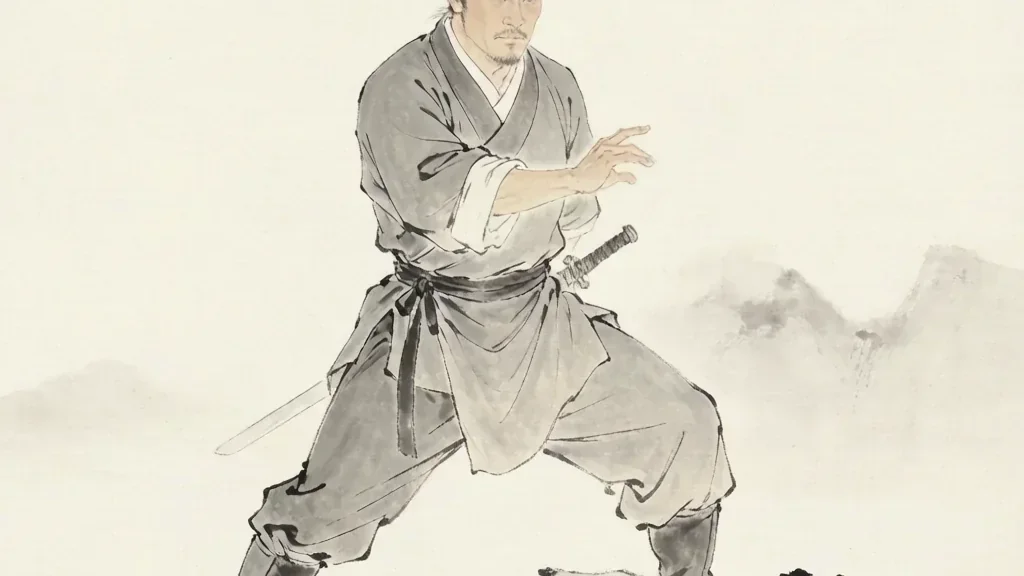
When southern China thinks of kung fu, one name rises above the rest: Hongquan (洪拳, ), the "Flood Boxing." Tied in legend to the anti-Qing resistance and made famous by the real-life master Wong Fei-hung (黄飞鸿), Hongquan is the archetypal southern style—low stances, powerful forearm bridges, and the celebrated Tiger-Crane forms. It matters because it embodies the spirit, patriotism, and theatrical vigor of southern Chinese martial culture, and because its influence runs through countless films, operas, and family lineages. To study Hongquan is to touch the popular heart of Cantonese kung fu.
Legend, Lineage, and the Shaolin Connection
Hongquan's mythology reaches back to the Southern Shaolin Temple and the stories of monks who survived its destruction and carried martial arts into the countryside. The name "Hong" is commonly linked to the anti-Qing "Hong" (red) resistance symbolism and to the monk Zhi Shan (至善) and the legendary Hong Mei (洪熙). While historians caution that these tales mix fact and wishful folklore, they gave the style a powerful identity as a people's art of resistance.
What is solid is the art's place in the Guangdong (Canton) region and its transmission through documented masters. The most celebrated figure is Wong Fei-hung (1847–1924), a physician, healer, and martial artist whose image—often portrayed wielding the broadsword or demonstrating the Tiger-Crane form—became the very icon of the southern master. Through his students, Hongquan entered the mainstream of Cantonese culture and later the global imagination via cinema. The blend of medicine, morality, and martial skill in his story reflects the traditional ideal of the complete gentleman-fighter.
Tiger and Crane: The Signature Forms
The most famous expression of Hongquan is the Hu He Shuang Xing (虎鹤双形), the "Tiger-Crane Double Form." The tiger represents muscular power, ferocity, and the strong bridge; the crane represents balance, precision, and the delicate but lethal pecking and wing-like deflections. Together they teach the student to be both forceful and refined, a balance prized in southern training.
In practice the tiger techniques use low stances, clenched strikes, and vigorous "bridge" contacts—the forearms smashing against an opponent's limbs to break his structure. The crane techniques rise onto one leg, deliver flicking finger or beak strikes, and emphasize evasion and timing over brute strength. A complete Hongquan practitioner is expected to embody both energies, switching between crushing power and light precision as the moment demands. This yin-yang pairing is the stylistic soul of the art.
Southern Bridges and Low Stances
Technically, Hongquan is built on "bridge hands" (): the forearms are used to block, feel, and control the opponent's arms at close range. Southern styles generally keep the hands closer to the centerline and the stance lower and more rooted than northern styles, reflecting the confined spaces of village and marketplace fighting. The famous "horse stance" () is drilled relentlessly to build the leg power that powers every strike.
Because the southern boxer does not rely on high kicks or wide movement, the bridge and the stance do the work. A strong bridge lets the fighter dominate the centerline, while a deep stance provides the root from which short, heavy punches launch. Hongquan also employs characteristic "lion's roar" shouts and vigorous expressions of energy, giving it a loud, confident presence. The emphasis on the upper body and the bridge is why southern kung fu is sometimes summarized as "nan quan bei tui"—southern fist, northern leg.
Weapons of the Hong Family
No account of Hongquan is complete without its weapons. The style is renowned for the broadsword (), the staff (), and especially the tiger-fork and the famous "shadowless kick" lore attached to Wong Fei-hung. Weapon training follows the same principles as the empty hand: strong bridge, rooted stance, and explosive commitment. The staff forms in particular are spectacular, combining spinning power with the low, stable base of the style.
Historically, weapons were not optional extras but the original core of village self-defense, since a staff or sickle was a tool before it was a weapon. Hongquan preserves many such "agricultural" weapons—the trident, the dual swords, the sky-ladle—reflecting its roots among working people. Training them reinforces the same body mechanics as the bare-hand forms, so the weapon becomes an extension of the bridge rather than a separate skill.
Wong Fei-hung and the Cinema Legacy
Wong Fei-hung's life bridged the late Qing and Republican eras, and his reputation as a healer and upright master made him a folk hero. Dozens of films have dramatized his deeds, with actors like Kwan Tak-hing and, more recently, Jet Li portraying him. These movies cemented Hongquan's global identity and spread its Tiger-Crane form to audiences who had never set foot in a training hall. The line between history and legend is thin here, but the cultural impact is real and enormous.
This cinematic fame has a double edge: it inspires millions to take up kung fu, yet it also flattens a deep tradition into a few iconic poses. Serious students still seek the lineage training passed down through Wong's disciples and the broader Guangdong community. The films are an invitation; the real art is found in the stance, the bridge, and the patient repetition that turns a student into a southern boxer.
Hongquan's Cultural Meaning Today
Today Hongquan is practiced as a cornerstone of southern wushu, in traditional family schools, and in the international diaspora where Cantonese identity traveled. It stands for more than fighting: the legends tie it to loyalty, resistance against oppression, and the Confucian virtues of respect and self-discipline. In this way the art carries the values of rujia (Confucianism) as much as the techniques of the Shaolin.
For the cultural explorer, Hongquan offers a perfect meeting point of myth, history, and movement. One can trace a line from the imagined Southern Shaolin, through the real Wong Fei-hung, to the movie screens of the world, and find at each step the same sturdy stance and the same tiger-crane breath. It is southern China's martial signature, written in muscle and story.
Stance And Bridge Power
Hongquan builds its strength from the ground up, beginning with deep, immovable stances that train the legs to root like a tree. The signature horse stance and bow stance are held far longer than in many other arts, conditioning the thighs and lower back until movement from a low base becomes effortless. From this foundation the 'bridge' arms develop: the forearms are used to block, feel, and strike simultaneously, absorbing an opponent's force and redirecting it. Practitioners drill bridge contact relentlessly so that the arms become both shield and weapon. This emphasis on a solid lower body paired with expressive upper-body power gives Hongquan its unmistakable southern look. The training is physically demanding but rewards patience, because the art insists that no technique is meaningful without first earning a stable root and a strong, sensitive bridge.
Tiger And Crane Expression
The tiger and crane are the two animal spirits at the heart of Hongquan's identity, and together they teach contrast. The tiger represents raw, ground-connected power: roaring strikes, clawing hands, and a fearless forward drive modeled on the beast pouncing from the mountain. The crane represents lightness, balance, and precision: poised on one leg, pecking and spreading wings with calm control. A complete Hongquan practitioner learns to switch between these qualities, using the tiger's force to overwhelm and the crane's finesse to evade and target. The famous Tiger-Crane paired form weaves the two together so the student feels how hardness and softness support one another. This animal logic makes the art visually clear and pedagogically elegant, giving each technique an image the body can remember and reproduce under pressure.
❓ Frequently Asked Questions
📝 Chinese Vocabulary
洪拳 — : Flood Boxing / Hong family fist.
虎鹤双形 — : Tiger-Crane Double Form.
桥手 — : bridge hands, forearm controlling/feeling.
马步 — : horse stance, the basic low stance.
南拳北腿 — : "southern fist, northern leg."
猛虎下山 — : Fierce Tiger Descends the Mountain, a signature Hongquan power technique
工字伏虎拳 — : Tiger Form in the Shape of the Character Gong, a foundational Hongquan set
铁线拳 — : Iron Wire Fist, an advanced Hongquan form for strength and breathing
🎉 Fun Facts
- Wong Fei-hung has been portrayed in more films than almost any historical martial artist, making him a global kung-fu icon.
- The "shadowless kick" (无影脚) attributed to Wong is more movie legend than documented technique, but it captures the style's kicking flair.
- Hongquan preserves many weapons derived from farm tools, reflecting its village-working-class origins.
- The tiger and crane are not just animals but embody the yin-yang balance of hard power and soft precision.
- Hongquan is one of the five family styles that formed the basis of the famous southern Chinese martial arts.
- Wong Fei-hung's real-life students spread Hongquan through Guangdong, and many of his forms are still named after him.