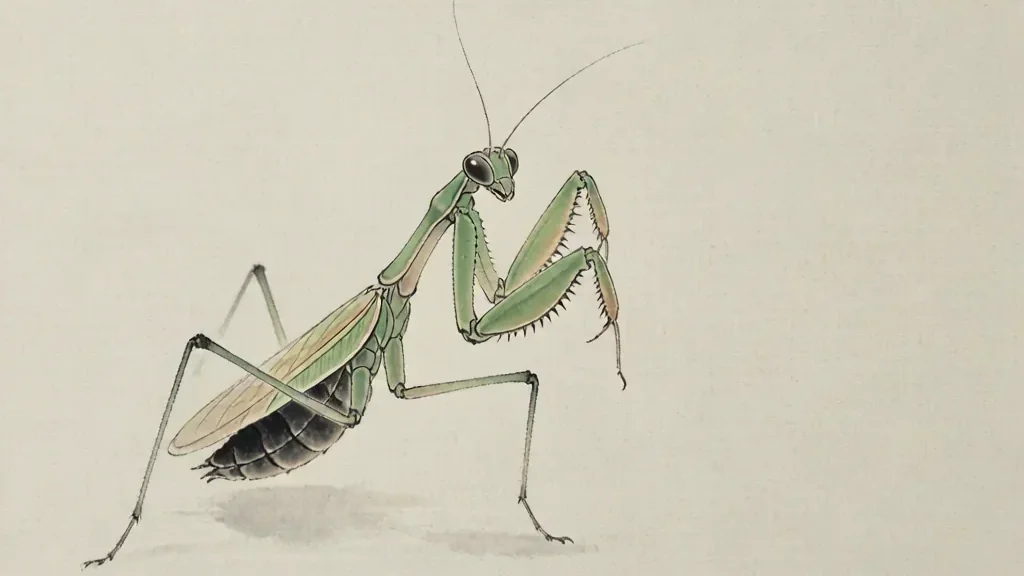
According to legend, the art was born when a man watched a praying mantis capture and subdue a far larger cicada, its hooked forelegs striking with perfect timing and leverage. That observer was Wang Lang (王朗), and the style he devised is Tanglangquan (螳螂拳, ), "Praying Mantis Boxing." One of the most distinctive northern Chinese martial arts, Tanglangquan matters because it translates the mechanics of a tiny insect into a complete human fighting system—proving that Chinese martial creativity drew inspiration from the natural world as much as from philosophy or war. It is a vivid example of how observation of nature became technique.
The Legend of Wang Lang and Mount Kunyu
The founding story places Wang Lang in the late Ming or early Qing period on Mount Kunyu (昆嵛山) in Shandong province. Frrated after losing bouts to other monks, the tale goes, he studied a mantis in combat and borrowed its hooked, pincer-like strikes and its patient, explosive timing. He blended these insights with the soft and hard methods he already knew, creating a style built around the "mantis hook" hand shape and rapid, continuous attacks.
While the legend is almost certainly embellished—few martial origin stories survive scrutiny—it captures the art's genuine character. Tanglangquan did arise in Shandong and became one of the region's signature northern styles. From there it branched into several major family lines, each interpreting the mantis idea differently. What unites them is the hook hand, the emphasis on seizing and striking in the same motion, and a rhythm of lure, trap, and burst that feels insect-like in its precision.
The Mantis Hook and Hand Shapes
The defining tool of Tanglangquan is the "mantis hook" ( or ), formed by curling the fingers into a claw-like shape that can hook, trap, gouge, and strike. Unlike a flat palm or a closed fist, the hook is versatile: it can catch an incoming wrist, rake across soft tissue, or deliver a focused blow with the second knuckles. This single shape embodies the art's blending of grab and strike.
Beyond the hook, the style uses a small, guarded posture with the hands held close to the body, ready to flick outward like a mantis foreleg. The strikes are often delivered in rapid bursts—three or more connected motions—rather than single committed blows. This "continuous attack" principle keeps the opponent from recovering, mirroring the way a mantis does not release its prey once it has latched on. The hands thus become both weapons and traps, a dual function central to the style.
Northern and Southern Branches
Tanglangquan is broadly divided into Northern Praying Mantis (associated with Shandong and further north) and a Southern tradition that traveled with migration to places like Hong Kong and Southeast Asia. The Northern branches include well-known lines such as the "Seven Stars" (七星), "Plum Flower" (梅花), and "Six Harmonies" (六合) mantis, each named for the shape of its footwork or the logic of its coordination. These names signal different emphases—some favor circular footwork, others straight penetrating power.
The Southern branches, sometimes simply called "Southern Praying Mantis," adapted the art to the closer, lower stances typical of southern Chinese boxing and often integrated it with local systems. Despite the geography, the mantis hook and the catch-and-strike philosophy persist everywhere the art is taught. This branching is a reminder that Chinese martial arts are living, evolving traditions; a style is less a fixed text than a family of related practices shaped by teachers and place.
Forms, Sticky Hands, and Two-Person Drills
As with most traditional Chinese arts, solo forms () carry the curriculum. Tanglangquan forms are typically brisk and intricate, threading hook strikes, low kicks, and sudden shifts of angle. They are not mere choreography; each sequence encodes a combat logic of entry, trap, and finish that the student is expected to unpack with a partner later.
Crucially, the art trains "sticky hands" () and other sensitivity drills in which two practitioners keep contact and respond to pressure and movement. These exercises develop the reflexes to hook, lock, and strike as soon as an opening appears. Combined with the forms, the two-person work makes Tanglangquan a genuinely interactive art rather than a solitary dance, and it explains why the style has remained effective across centuries of real use.
Philosophy of Borrowing Strength
Underneath the insect metaphor lies a serious principle: borrow the opponent's force. The mantis does not overpower the cicada; it uses superior angle, timing, and leverage. Tanglangquan therefore teaches the student to yield at the right moment, hook the attack, and redirect it into a counter. This is closer in spirit to the internal arts' yielding than to brute northem strength, even though the strikes themselves are hard and fast.
The philosophy extends to efficiency. A mantis wastes no motion, and neither should the boxer. Tanglangquan drills instill economy of movement and impeccable timing, so that a small practitioner can handle a larger one. In this sense the style is a practical lesson in Chinese strategic thought: victory comes not from matching the enemy's mass but from exploiting his weaknesses with precision. The mantis, after all, always wins against creatures many times its size.
Tanglangquan in the Modern World
Today Praying Mantis Boxing is taught across China, in the Chinese diaspora, and in international schools, often as part of the broader northern wushu curriculum. It appears in films and demonstrations precisely because its hook hands and rapid bursts are visually unmistakable. Enthusiasts value it for combining acrobatic northern footwork with the practical trapping of a seizing art, making it both beautiful to watch and sound to practice.
For the cultural learner, Tanglangquan is also a doorway into the Chinese habit of reading nature as a teacher. The same impulse that produced the twelve animals of Xingyiquan and the crane forms of southern styles appears here in its most literal form: a man becomes a mantis. That imaginative leap—observing a small creature and finding in it a complete human discipline—is one of the most charming and characteristic features of Chinese martial arts.
The Mantis Hand Shape
The signature of Praying Mantis boxing is the hooked hand, in which the fingers curl and the wrist forms a tight, bony curve like the insect's foreleg. This shape is far more than a symbol: it lets the hand perform several jobs at once. The curved wrist can hook and trap an opponent's arm, the ridge can strike like a short club, and the fingers can probe and control. Practitioners drill transitions between the hook, the open palm, and the fist so the hand constantly changes function as the fight flows. Because the hook is compact and close to the body, it suits the style's preference for fighting at short range where reach is less useful than sensitivity. Learning to form and use the hook correctly is therefore the first real test of a Mantis student. Once the hand shape is natural, the rest of the system, its steps, strikes, and locks, begins to make sense as variations on that single grasping idea.
Branches Of The Mantis Family
Over time Praying Mantis boxing split into several branches, each named for a distinguishing feature and each preserving the core mantis idea in a different accent. Seven Star Mantis emphasizes the seven vital points and a hard, direct attitude; Eight Step Mantis organizes footwork around eight stepping methods and a lighter feel; Plum Flower Mantis adds circular, flowing motions named for the blossom. Despite the differences, all branches share the hooked hand, the close-range trapping, and the quick successive strikes that define the art. This family structure is common in Chinese martial arts, where a single insight spawns local schools that later see themselves as cousins. For the learner it means there is no single 'correct' Mantis, but a shared grammar of hook, step, and strike running through every version. Recognizing the branches helps explain why two mantis demonstrations can look quite different yet feel related.
❓ Frequently Asked Questions
📝 Chinese Vocabulary
螳螂拳 — : Praying Mantis Boxing.
螳螂钩 — : the mantis hook hand shape.
七星 — : "Seven Stars," a major mantis branch.
黏手 — : sticky hands sensitivity training.
套路 — : forms or routine sequences.
七星 — : Seven Star, the most common Praying Mantis sub-style
八步 — : Eight Steps, a foundational footwork set of the style
崩拳 — : crushing fist, a sudden driving punch used in Mantis
🎉 Fun Facts
- The founding legend says Wang Lang lost fights to other monks before he learned from a mantis—humility before nature, not before men.
- Some mantis lines are named after celestial patterns like the "Seven Stars" of the Big Dipper.
- The mantis hook can function as a strike, a trap, a gouge, and a pressure-point probe all in one motion.
- Praying Mantis Boxing spread globally through Chinese migration, with strong Southern branches in Hong Kong and Southeast Asia.
- Praying Mantis is said to have been created after its founder watched a mantis catch a cicada with its hooked forelegs.
- The style has several branches, including Seven Star, Eight Step, and Plum Flower Mantis, each with its own flavor.