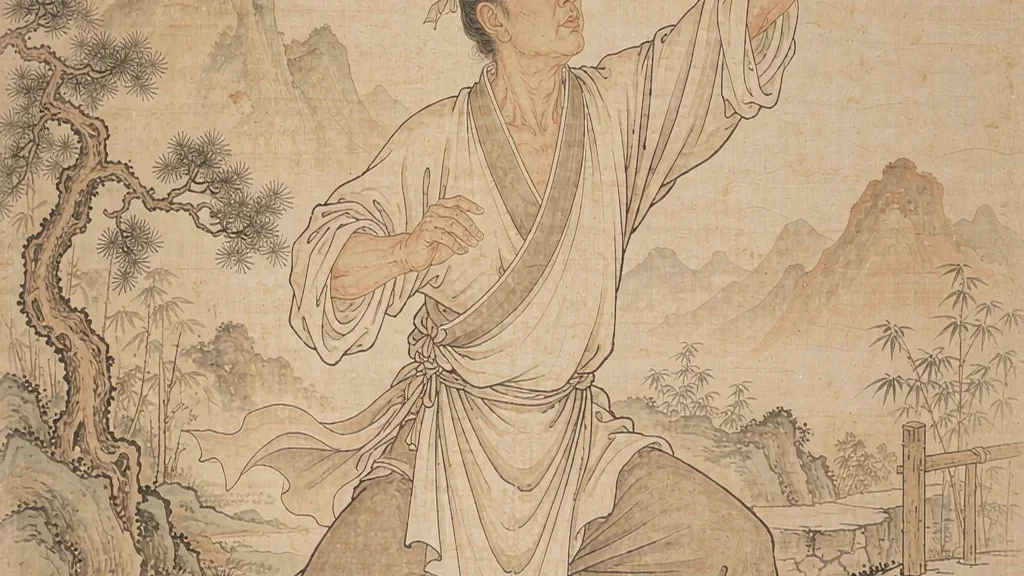
Tongbei Quan (通背拳, "through-the-back fist"), also written Tongbei Zhang, is a northern Chinese martial art built around the idea that power should flow from the back and shoulders through the arms like a whip, rather than being generated only by the limbs. Known for its long, whipping arm strikes, relaxed shoulders, and constant upper-body vibration, tongbei is sometimes grouped with "soft" external arts because of its looseness, yet it produces startling penetrative force. With several regional branches and a close cousin relationship to Pigua Quan, it remains a distinctive and respected tradition. This article surveys its principles, history, techniques, and training.
The Whipping Principle
The name "through-the-back" signals the core method: the practitioner drives force from the legs and torso, through a loosened spine and shoulder, into a cracking arm strike. By keeping the shoulder and elbow relaxed until the last instant, the forearm accelerates like the tip of a whip, delivering speed and shock without muscular rigidity.
This "song" (looseness) is not weakness but timed tension. The arm is soft in transit and firm at contact, so the strike both penetrates and recoils. Tongbei's signature sound—a sharp slap as the hand meets a target or pad—comes from this whip-like snap rather than from pushing.
Historical Background
Tongbei's origins are attributed to northern teachers of the late imperial period, with strong presence in Hebei and Beijing. Like many Chinese arts, its early history mixes documented lineage with legend, and several branches claim different founders. What is consistent is its identification as a "northern long-arm" art emphasizing reach and upper-body expression.
The art shares technique and philosophy with Pigua Quan ("chopping"), and some historians treat the two as closely related or even overlapping, with pigua's downward chops complementing tongbei's whipping extensions. Cross-training between them is traditional, and their combined drills are a hallmark of the Hebei martial scene.
Signature Strikes
Tongbei's arsenal centers on the "through-arm" strikes: the straight whip punch, the backhand "shan" slap, the forearm chop, and the continuous "drum-beating" flurries where both arms alternate like hammers. The hands often stay open or semi-open, using the palm and forearm more than a closed fist, which suits the whipping motion.
Because the strikes are relaxed and rebounding, a tongbei stylist can deliver many rapid hits, each with snap. The constant motion also keeps the guard mobile, making the style look busy and unpredictable compared with the grounded, wide stances of southern boxing.
Shoulder and Back Training
The defining conditioning is shoulder loosening: circles, shakes, and partner drills that teach the arm to hang and whip from the back. Practitioners spend long sessions simply vibrating the arms to build the elastic quality that generates power. A flexible, strong shoulder girdle is the engine of the art.
Spinal mobility and torso turning transmit the force; the waist acts like the handle of the whip while the arm is the lash. Stance is lighter and more mobile than in rooting styles, allowing the body to rotate freely and the strikes to flow without interruption.
Forms and Drills
Tongbei forms (taolu) are characterized by continuous, flowing sequences with little static posing; the body hardly stops moving. Solo sets build the whip rhythm, while two-person "linking" drills teach timing and distance. Some branches also use a small hammer or staff to develop the rebound feeling in the wrist and arm.
Repetition is the teacher. Students are told that the strike must become reflexive, issued from the back without conscious arm effort, and only countless repetitions build the neural pathway that lets relaxation convert into speed.
Relationship to Pigua Quan
Pigua Quan ("splitting-chop fist") emphasizes vigorous downward and outward chopping with the whole body, while tongbei emphasizes whipping extensions; together they are called "pigua tongbei" in some schools. The pairing is logical: pigua builds violent body-generated power, tongbei refines it into whip-like speed.
Historically the two were exchanged between the same regional teachers, and a student of one was often expected to learn the other. This complementary relationship is a good example of how Chinese arts cluster by region and principle rather than existing in isolation.
Tongbei in Modern Practice
Today tongbei survives in traditional schools across north China and among overseas kung fu associations, and elements appear in wushu demonstrations for their distinctive snap. It is less standardized than Olympic wushu, so regional styles vary in stance, forms, and emphasis, yet all share the through-the-back striking logic.
Its health benefits—shoulder mobility, spinal flexibility, and cardiovascular flow from continuous motion—make it attractive to older practitioners too. The relaxed, rhythmic movement is gentler on the joints than hard stomping styles while still building striking skill.
Training Advice
Newcomers should prioritize shoulder loosening over power; trying to hit hard before the whip forms only creates tension that kills speed. Light shadow practice, arm circles, and soft pad work build the feeling, and a teacher's hands-on correction of the shoulder is essential.
Pair the upper-body work with a mobile, balanced stance and core rotation, and be patient: tongbei's power is subtle and arrives late, after the body learns to relax under intent. Rushing to "look fast" produces superficial motion without the back-driven snap that defines the art.
Tongbei Among the Northern Long-Arm Arts
Tongbei belongs to a northern family of arts that prize reach, relaxed shoulders, and flowing upper-body expression, sitting alongside pigua, baji, and parts of chaquan. Its whipping logic distinguishes it from the ground-rooted, explosive power of baji, yet both value whole-body issuance from the waist.
Regional martial culture in Hebei and Beijing treated these arts as neighboring dialects, exchanged between the same teachers and sometimes learned together. A tongbei student might therefore absorb pigua chops or baji elbow work without ever leaving the local tradition, which valued practical result over brand.
This clustering helps explain tongbei's identity: not an isolated style but a node in a northern network of long-arm, body-driven striking methods, each shading into the next. Understanding that context prevents the mistake of treating any one northern art as wholly separate from its relatives.
Hand and Wrist Conditioning
Although tongbei strikes are relaxed, the repeated whipping demands durable hands and elastic wrists, so conditioning targets the forearm, wrist, and finger extensors with shaking and slapping drills. The aim is rebound resilience, not the kind of hardness sought by iron-palm training.
Some branches use a small hammer to strike the wrist gently, building the springy quality that lets the arm recover instantly after contact. Others practice "drumming" the arms together to develop synchronized vibration traveling up the back, reinforcing the whip image at the heart of the art.
This conditioning is gradual and recovery-aware; overdoing it leads to tendon irritation rather than strength. The body-driven philosophy means the hands are trained as the tip of a whip, not as isolated hammers, so patience in the small drills pays off in the larger strike.
❓ Frequently Asked Questions
What does "tongbei" mean?
It means "through the back," describing how force is generated from the legs and torso, through a relaxed back and shoulder, into a whipping arm strike.
Is tongbei hard or soft?
It is loosely "soft-external": relaxed and whippy in motion but delivering hard, penetrating strikes through timed tension at contact.
How is it different from pigua?
Pigua emphasizes downward chopping power; tongbei emphasizes whipping extensions. They are complementary and often taught together.
Why open hands?
Open and semi-open hands suit the whip motion and let the forearm and palm snap, producing speed and recoil better than a rigid fist.
Is it good for fitness?
Yes; continuous motion builds shoulder mobility, spinal flexibility, and cardiovascular health while being relatively gentle on the joints.
How should a beginner start?
Focus on shoulder loosening and light shadow practice before power; a teacher's correction of the relaxed whip is essential for real progress.