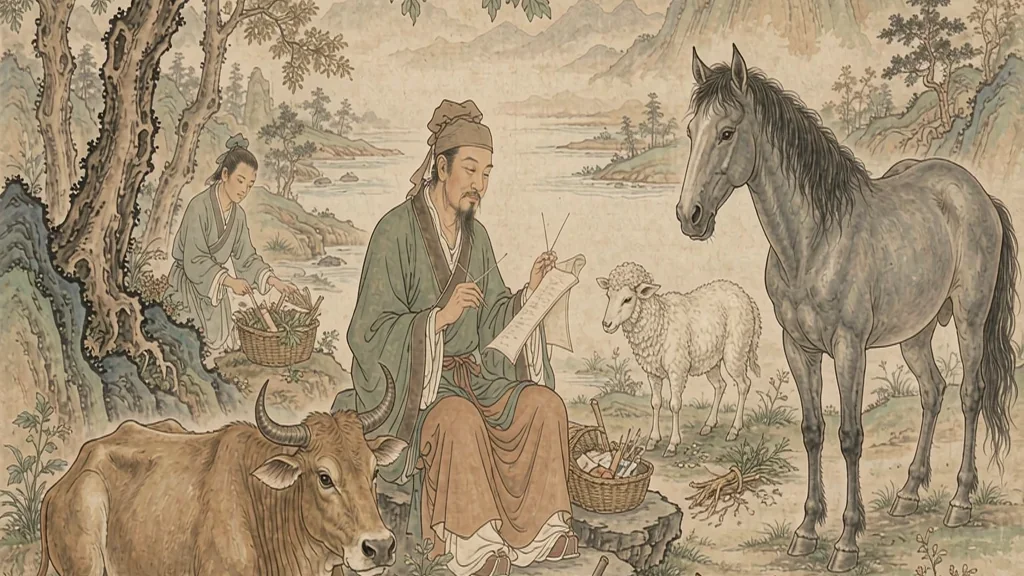
The Five Animals Play, known in Chinese as Wu Qin Xi (五禽戏), is a set of gentle, flowing exercises that imitate the movements of five creatures: the tiger, the deer, the bear, the ape, and the bird. It is traditionally attributed to Hua Tuo, a physician of the Eastern Han dynasty, and is one of the oldest named exercise systems in China as well as a cornerstone of the yangsheng, or health-preservation, tradition. More than a dance or a drill, it is a form of moving medicine: each animal's characteristic motion is distilled into a routine that loosens the joints, steadies the breath, and quietens the mind.
Hua Tuo and the Invention of the Five Animals Play
Hua Tuo (华佗) lived in the late Eastern Han dynasty, a period of near-constant warfare and upheaval. He is remembered in Chinese medical lore as a brilliant physician and, according to later historical tradition, a pioneer of anesthesia who used a herbal preparation to numb patients before surgery. The surviving ancient biographies preserve a passage in which Hua Tuo argues for prevention over cure: rather than treat illness only after it appears, a physician should keep the body in motion so that "the arteries and channels do not become congested."
He is said to have devised the Five Animals Play as exactly such preventive medicine. By copying the tiger's pounce, the deer's lightness, the bear's rooted weight, the ape's nimbleness, and the bird's open-winged breathing, the practitioner keeps every part of the body working. Whether or not Hua Tuo was the sole author, the attribution fixed the exercise's identity as a physician's prescription rather than a warrior's training, and it has anchored the art's medical reputation for nearly two thousand years.
The Five Animals: Tiger, Deer, Bear, Ape, and Bird
The heart of Wu Qin Xi is its five models. The tiger (虎, hǔ) trains power and courage through forceful stances, clawing hands, and a straight, upward gaze. The deer (鹿, lù) is light and springy, stretching the neck and spine and inviting the body to lengthen. The bear (熊, xióng) is slow, heavy, and grounded, turning from the waist to massage the middle of the body. The ape or monkey (猿, yuán) is quick and mischievous, reaching, swinging, and sharpening balance and coordination. The bird (鸟, niǎo), usually shown as a crane, stands on one leg with arms wide, opening the chest and regulating the breath.
Together the five cover the full range of human movement: strength, suppleness, stability, agility, and expansive breathing. None is meant to be a literal imitation of an animal; each is a stylized essence that the body learns and then carries into daily life. In practice a session moves from one creature to the next, so the practitioner shifts continuously between effort and ease, tension and release.
Roots in Daoyin: An Ancient Breath-and-Movement Tradition
Wu Qin Xi did not appear from nothing. It grew out of daoyin (导引), an ancient Chinese practice of "guiding and pulling" the body through stretches and breaths. The term already appears in the Zhuangzi (《庄子》), a Daoist text from the third or fourth century BCE, where it is listed among the activities of people who keep themselves supple and long-lived; the Huainanzi (《淮南子》), compiled in the second century BCE, also describes daoyin postures. Archaeological finds such as the silk "Daoyin Tu" diagram from Mawangdui, buried in the 2nd century BCE, show dozens of illustrated stretching figures.
Hua Tuo's innovation was to organize these free-form motions around five animal archetypes, giving an otherwise loose tradition a memorable, teachable structure. In this sense the Five Animals Play is both very old and a specific refinement of something older still: a thread of Chinese exercise that reaches back more than two thousand years and runs straight through to the qigong practiced in parks today.
Body, Breath, and Intent
Like other qigong, Wu Qin Xi works on three linked levels. The body performs the outward shape of each animal; the breath follows the movement, long and even, expanding on the open phases and gathering on the collected ones; and the mind holds a focused image, or yi nian (意念), of the animal being imitated. This mental concentration is not decoration — traditional teaching holds that imagining the tiger's strength or the crane's stillness helps the body settle into the right quality of motion.
The combination is why the routine feels both physical and calming at once. A session asks for attention rather than strain, and practitioners often describe a sense of lightness and warmth afterward. The intent links the exercise to the broader Chinese idea that the mind and breath move the vital energy, or qi, through the body.
Health Benefits and Yangsheng
The stated aim of the exercises is yangsheng (养生), the art of "nourishing life." In traditional terms each animal is said to tune a different part of the body and its associated function: the tiger strengthens the limbs and waist, the deer loosens the spine and joints, the bear steadies the center, the ape wakes up the mind and coordination, and the bird opens the chest and lungs. The modern reading is simpler but compatible: regular, low-impact, full-range movement supports circulation, joint mobility, balance, and a calmer nervous system.
Because the load is gentle, Wu Qin Xi suits a wide age range. It is commonly taught to older adults in parks and community centers, where the social side — exercising together each morning — is itself part of the benefit. The routine asks for nothing but a little space and a willing body, which is precisely why it has survived for so long.
From Han Court to Modern Standard
After Hua Tuo's lifetime the original routine was lost in the wars that ended the Han, but the idea survived in medical and Daoist writings and was rebuilt over the centuries. Later authors, especially from the Ming and Qing dynasties, recorded their own versions, so that what we practice today is a layered tradition rather than a single fixed text recovered from antiquity. In the early 2000s China's sports authority published an official standardized form, "Health Qigong · Wu Qin Xi," with fixed postures and a set sequence, so the exercise could be taught consistently in parks, schools, and clinics.
This standardization also secured the routine's place in heritage. Wu Qin Xi is recognized as part of China's intangible cultural heritage, linking the morning exercisers of today to a medical lineage more than seventeen hundred years old. The same official effort produced companion routines, so the Five Animals Play now sits within a small family of standardized health-qigong forms.
Practicing Wu Qin Xi Today
Today the Five Animals Play is practiced worldwide as a branch of qigong, in parks, gyms, and online classes. Beginners usually learn one animal at a time, repeating each motion until the shape and breath feel natural, then link them into a flowing set. No equipment is needed, and a session can last ten minutes or an hour. It is often paired with sister routines such as Ba Duan Jin (the Eight Brocades) and Yi Jin Jing (the Tendon-Changing Classic), which share the same gentle, breath-led philosophy.
What has not changed is the original premise: movement, done mindfully and often, is itself a form of care. By borrowing the ease of five animals, the practitioner turns ordinary attention into medicine for the joints, the breath, and the quiet of the mind — a folk remedy that has outlasted the dynasty that produced it.
❓ Frequently Asked Questions
Wu Qin Xi shows Chinese exercise at its most cheerful. By copying the tiger, deer, bear, ape, and bird, the practitioner borrows each animal's ease and turns it into medicine for the joints and breath. Five shapes, five temperaments, one routine: a folk remedy that asks nothing but attention to the living body and a little room to move.
📝 Chinese Vocabulary
五禽戏 — : the Five Animals Play; a classical health-qigong exercise set.
华佗 — : Hua Tuo, the Eastern Han physician credited with the routine.
导引 — : daoyin; ancient breath-and-movement stretching exercises.
养生 — : yangsheng; the art of health preservation or "nourishing life."
气功 — : qigong; the cultivation of vital energy through breath and motion.
虎 — : tiger; the animal of strength and courage.
鹿 — : deer; the animal of lightness and suppleness.
熊 — : bear; the animal of grounded stability.
猿 — : ape (monkey); the animal of agility and balance.
鸟 — : bird (the crane); the animal of open breathing.
意念 — : mental intent or focused attention used during practice.
健身 — : fitness; keeping the body strong and healthy.
🎉 Fun Facts
- Wu Qin Xi is named after five animals: the tiger, deer, bear, ape, and bird, each standing for a different quality of movement.
- Its principles descend from daoyin, a breath-and-stretch regimen described in the Zhuangzi over two thousand years ago.
- Hua Tuo is also remembered in Chinese tradition as a pioneer of anesthesia in surgery.
- A standardized "Health Qigong · Wu Qin Xi" form was issued by China's sports authority in the early 2000s.
- Wu Qin Xi is recognized as part of China's intangible cultural heritage.
- Each animal play pairs outward movement with a mental image, or yi nian, of the creature being imitated.
- It is practiced around the world today as a gentle qigong routine, often alongside Ba Duan Jin and Yi Jin Jing.