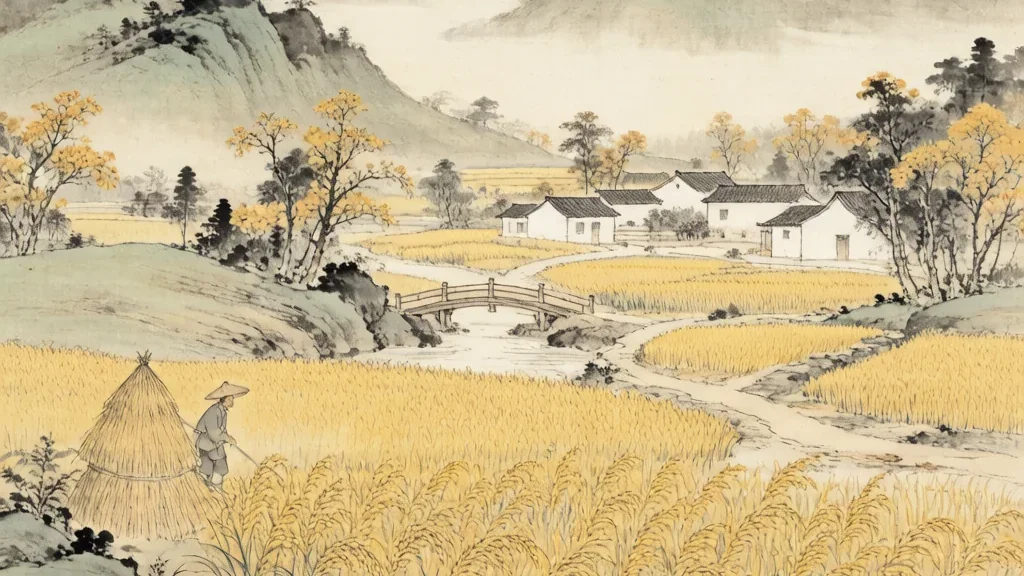
Liqiu, "Beginning of Autumn," is the thirteenth of the twenty-four traditional Chinese solar terms and usually falls on August 7 or 8. It announces the start of the autumn season in the traditional calendar, though in much of China the weather remains hot for weeks afterward. Liqiu sits between Dashu (Greater Heat) and Chushu (End of Heat). Rather than a sudden cooling, the term marks a turning point in the sun's path: the longest days are behind, and the slow descent toward winter begins. Culturally, Liqiu is a moment to acknowledge the year's work — the summer grains are filling, and the harvest, though not yet gathered, is now certain enough to celebrate.
First of the Autumn Terms
Liqiu opens the autumn portion of the solar calendar, the first of six autumn terms leading to the winter sequence. The sun reaches a celestial longitude of 135 degrees at its start. In the classical cosmology, it is when the metal element begins to rise and the yang energy starts its annual retreat.
Despite the name, Liqiu is often one of the hottest points of the year in southern China, because the land and water retain summer's heat. The term is therefore less a description of temperature than a marker of the sun's position — a calendrical fact that the season has officially turned.
The Three Pentads of Liqiu
Liqiu's pentads describe the first hints of autumn amid lingering summer. The first is "cold air arrives" (liang feng zhi), though the cool breeze may be faint. The second is "white dew grows on the earth" (bai lu sheng), as moisture condenses in the cool of night. The third is "cicadas sing of autumn" (han chan ming), the insects whose song now carries a different tone.
These observations show the term as a study in subtlety. The changes named are small and easily missed in a single hot day, but across the weeks they accumulate into the unmistakable arrival of autumn.
The Lingering Heat of Late Summer
A defining feature of Liqiu is the gap between name and experience. In the lower Yangtze and the south, the weeks after Liqiu are often called the "autumn tiger" period, when temperatures can rival midsummer. The heat is dry rather than humid, but it is heat nonetheless.
This mismatch gave rise to practical caution. Farmers knew that a premature sigh of relief could ruin crops; the rice still needed warmth and water, and the fruit still needed time. Liqiu thus taught patience: the season had turned on paper, but the earth had not yet caught up.
Agriculture at the Turning Point
Liqiu is a critical farm term. In the south, the single- and double-cropping rice systems mean fields are at various stages; some rice ripens for harvest while other paddies are transplanted. In the north, corn, sorghum, and soybeans swell under the late-summer sun.
It is also a time to guard against pests and disease, which thrive in the lingering warmth. The term's rituals and proverbs often focused on protecting the nearly-ready crop, because the difference between a full granary and a short one was decided in these weeks.
The Custom of Weighing Children
A charming folk custom associated with Liqiu in some regions was weighing children on a scale. The practice stemmed from a belief that the summer heat caused weight loss and weakness, and that autumn was the time to recover. After weighing, families would feed the child richer foods to "make up" the lost weight.
Though the medical reasoning is folk rather than scientific, the custom reveals a keen seasonal awareness of the body. It also shows how the solar terms shaped not only farming but the intimate rhythms of family care.
Eating Autumn and "Biting the Autumn"
Many places observed "biting the autumn" (yao qiu) by eating specific foods at Liqiu. Watermelon was commonly eaten, both as a last taste of summer and, in some accounts, to "bite" away the heat. In other regions, foods like dumplings or scallion pancakes were traditional.
The act of eating at the term's start was partly celebratory and partly prophylactic — a way to mark the transition and, in traditional belief, to strengthen the body against the coming dry season. The foods themselves varied by locality, but the gesture was shared.
Imperial and Official Observances
In imperial times, Liqiu was one of the terms marked by state ritual. The emperor and his officials performed ceremonies welcoming autumn, often at the western gate of the capital, since west was associated with the autumn (metal) direction. These rites affirmed the harmony between the ruler's conduct and the cosmic calendar.
Such official observances reinforced the idea that the solar terms were not merely farmers' lore but the framework of a well-ordered realm. When the ruler honored the turn of the season, he aligned human government with the order of heaven and earth.
Poetry and the Mood of Liqiu
Chinese poets frequently used Liqiu to reflect on time and transience. The term's mix of heat and approaching coolness, of fullness and decline, suited meditations on life's middle age and the inevitability of change. Autumn, in classical literature, is both melancholy and clarifying.
These poems helped encode the term in emotional memory. To know Liqiu was not only to know the farm schedule but to feel a particular mood — the slight sadness and relief of summer's ending, captured in a single word on the calendar.
Liqiu in the Modern Year
Today Liqiu is noted mostly through food and social media, with posts about "biting the autumn" and photos of the still-hot streets. Agribusiness still tracks the term, and weather services mention it in forecasts, but for most city dwellers it is a cultural marker more than a lived climate event.
Yet its old message remains useful: pay attention to the turning. Even when the day is hot, the light is shifting, the cicadas are changing their song, and the year is quietly moving toward its close.
❓ Frequently Asked Questions
When does Liqiu occur?
Liqiu usually begins around August 7 or 8, when the sun reaches a celestial longitude of 135 degrees.
Is it actually cool at Liqiu?
Not usually; southern China often stays very hot for weeks after, in the so-called "autumn tiger" period.
What does "biting the autumn" mean?
It is a custom of eating seasonal foods such as watermelon at Liqiu to mark the season's start.
What are Liqiu's three pentads?
They are the arrival of cool breeze, the growth of white dew, and cicadas singing of autumn.
What farm work happens around Liqiu?
Rice is harvested or transplanted, and northern crops like corn and soybeans continue to fill.
How was Liqiu observed by rulers?
Imperial courts held autumn-welcoming ceremonies, often at the western gate of the capital.