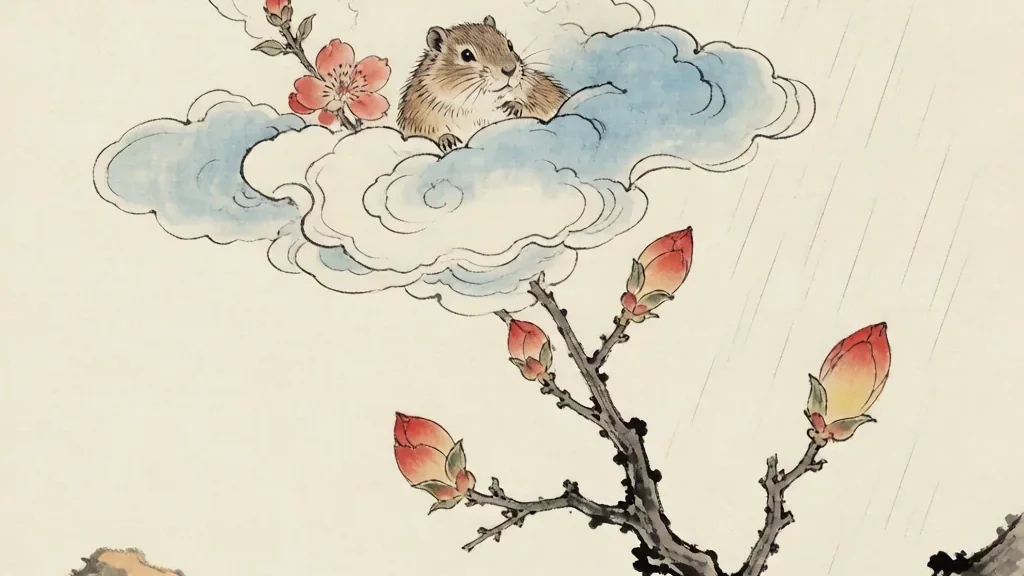
There comes a moment each year, usually around March 5th or 6th, when the sky breaks open. A deep rumble rolls across the land, and with it, the earth seems to exhale. This is Jingzhe — the Awakening of Insects — the third solar term in the Chinese calendar and one of the most dramatically named. Its two characters, 惊蛰 (jīng zhé), translate literally to "startled" and "hibernating insects," evoking the image of countless tiny creatures jolted awake by the season's first thunderclap.
The Science Behind the Thunder
While the ancient Chinese attributed Jingzhe's thunder to celestial dragons stirring in the clouds, modern meteorology offers a more grounded explanation. As the sun's position shifts and spring advances, warm, moist air masses begin their annual northward migration, colliding with lingering cold fronts. These collisions generate the atmospheric instability that produces the season's first thunderstorms. The timing is no coincidence — the ancient calendar's creators had observed over centuries that thunder reliably arrives when the sun reaches 345 degrees of celestial longitude.
The warming soil that follows these storms triggers a cascade of biological awakenings. Earthworms, which have spent winter coiled deep below the frost line, begin their upward migration, aerating the soil as they go. Beetles, moths, and countless other insects emerge from their winter dormancy, responding not to the thunder itself but to the rising soil temperature and lengthening daylight that Jingzhe announces. This mass emergence transforms the silent winter landscape into a buzzing, crawling, humming world almost overnight.
The Pear-Eating Tradition
Among Jingzhe's most distinctive customs is the eating of pears. This practice, widespread across northern and central China, carries layers of practical and symbolic meaning. On a practical level, early spring is a season when the dry winter air lingers, and the human respiratory system is vulnerable to irritation. Pears, with their high water content and natural sweetness, provide soothing relief for dry throats and coughs — a kind of seasonal preventive medicine.
But the symbolism runs deeper. The Chinese word for pear, 梨 (lí), shares its pronunciation with the word for "separation" or "departure" — 离 (lí). By eating a pear on Jingzhe, people symbolically consume and internalize the concept of separation, hoping thereby to separate themselves from illness, misfortune, and the lingering lethargy of winter. It is a form of linguistic homeopathic magic, where consuming the homophone of a feared thing provides protection against that very thing.
Families prepare pears in various ways for Jingzhe: some eat them raw and crisp, appreciating the refreshing crunch; others steam them with rock sugar and Chinese medicinal herbs like fritillary bulb (川贝, chuān bèi) to create a warming, therapeutic dessert. In Shanxi province, there is a saying: "Eat a pear on Jingzhe, and you will be spirited all year long" — a testament to how deeply this simple fruit has become woven into the fabric of the solar term.
Spring Plowing Begins
For China's agrarian civilization, Jingzhe carried an urgent message: the time for preparation is over, and the time for action has arrived. The proverb "过了惊蛰节,春耕不停歇" captures this perfectly — "After the Jingzhe festival, spring plowing never rests." Farmers who had spent winter repairing tools and planning crop rotations now returned to their fields in earnest. The soil, warmed by the strengthening sun and softened by spring rains, was ready to receive seeds.
In the rice-growing regions of southern China, Jingzhe marked the beginning of seedbed preparation. Farmers would flood their paddies, turning the hard winter earth into glistening mirrors of water and mud. In the north, wheat farmers checked their winter wheat for signs of greening, applying the first fertilizers of the season. The entire countryside, from the terraced hills of Yunnan to the vast plains of Henan, stirred with renewed agricultural activity.
Traditional farming wisdom encoded in Jingzhe's phenological signs guided these activities with remarkable precision. The peach tree blossoms (桃始华, táo shǐ huá), the orioles begin to sing (仓庚鸣, cāng gēng míng), and eagles transform into doves (鹰化为鸠, yīng huà wéi jiū) — these three pentads of Jingzhe, observed and recorded over millennia, told farmers exactly when to plant which crops. The blooming of peach trees signaled that frost danger had passed for most regions, while the return of migratory birds confirmed that warmer days had truly arrived.
Worshipping the White Tiger
Jingzhe brings with it an intriguing folk religious practice: the worship of the White Tiger (祭白虎, jì bái hǔ). According to Chinese folk belief, the White Tiger is the guardian of the western direction and a creature that brings disputes and conflicts. On Jingzhe, it is said to emerge from its lair, hungry and irritable after the long winter, ready to bite anyone who crosses its path — metaphorically bringing lawsuits, arguments, and interpersonal strife.
To appease the White Tiger, worshippers prepare paper effigies of the beast, typically painted with a wide, fierce mouth. These effigies are offered sacrifices of pork fat, which worshippers smear across the paper tiger's mouth. The fat serves a dual purpose: it satisfies the tiger's hunger and, more importantly, greases its mouth shut, preventing it from biting or causing trouble. Some traditions also involve smearing lard on the mouths of actual stone tiger statues at local temples.
This ritual, while fading in modern urban China, reveals the sophisticated psychological framework of traditional folk religion. The White Tiger is not worshipped as a deity to be loved but as a potential threat to be managed — a remarkably practical approach to the supernatural that mirrors the pragmatic spirit of Chinese folk belief.
The Insect-Repelling Rituals
Given that Jingzhe literally means "awakening of insects," it is unsurprising that the solar term features numerous insect-related customs. With the awakening of beneficial creatures comes the awakening of pests, and traditional households took proactive measures. Families would burn mugwort and other aromatic herbs in every corner of their homes, filling rooms with smoke that drove out overwintering insects before they could establish themselves.
In many regions, people practiced the custom of "beating the villains" (打小人, dǎ xiǎo rén), which on Jingzhe took on a particular character. Paper cutouts representing harmful insects and pests were placed on the ground and symbolically beaten with shoes or sticks. Over time, this practice evolved to include paper figures representing troublesome people, transforming an agricultural pest-control ritual into a form of folk psychological release. The rhythmic slapping and the accompanying incantations allowed people to vent frustrations and symbolically drive away both literal and metaphorical pests from their lives.
In the Hakka communities of southern China, Jingzhe was the traditional day for "stir-frying insects" (炒虫, chǎo chóng). Families would gather to stir-fry a mixture of beans, corn, and grains in a hot wok, the popping and crackling sounds representing the destruction of crop-destroying pests. After the symbolic cooking, the beans were shared and eaten, transforming the feared insects into nourishing food — yet another example of the Chinese cultural tendency to transmute threats into sustenance through ritual action.
Today, as China's population becomes increasingly urban, Jingzhe's agricultural urgency has faded for many. Yet the solar term retains its poetic power. City dwellers might not hear the first thunder from their fields, but they can still feel the shift in the air — the sudden warmth, the scent of wet earth after a spring shower, the first brave blossoms on city trees. Jingzhe reminds us that no matter how insulated we become from the natural world, we remain creatures attuned to its ancient rhythms, startled awake each spring along with the insects.
The Three Pentads of Jingzhe
Jingzhe is traditionally divided into three pentads that guided farmers with remarkable precision. In the first, peach trees begin to blossom, a sign that the danger of frost has passed for most regions. In the second, the oriole starts to sing, its song taken as confirmation that warmer days have truly arrived. In the third, ancient texts say the hawk transforms into the dove, reflecting the observation that large raptors grow scarce while smaller, gentle birds reappear. Together these signs told farmers exactly when to plant which crops and when the soil was ready. The pentads show how a single solar term compressed an entire natural calendar into observable, teachable moments that linked sky, tree, and field.
Jingzhe in the Farming Almanac
Within the traditional Chinese farming almanac, Jingzhe is the alarm that ends winter's pause. The proverb 'after the Jingzhe festival, spring plowing never rests' captures the sudden shift from preparation to action. The almanac paired the term's thunder with concrete tasks: flood the rice seedbeds in the south, check and fertilize winter wheat in the north, and ready tools that were repaired during the cold months. Traditional medicine also keyed to Jingzhe, advising lighter foods and calm temperament so the liver would not be overheated by the season's rising energy. In this way the term functioned less as a date than as a coordinated instruction for the body, the farm, and the household.
Thunder Deities in Folklore
The first thunder of Jingzhe was more than weather; it was a cosmic event charged with meaning. Folk belief peopled the clouds with thunder deities who, awakened from their winter sleep, rolled across the sky to rouse the hibernating world. This awakening was double-edged: just as insects stirred, so too did the potential for conflict and misfortune, which is why Jingzhe also features rites to pacify irritable spirits such as the White Tiger. The seasonal thunder thus sat at the meeting point of astronomy, agriculture, and religion, a single sound that told farmers to plant, doctors to adjust regimens, and households to manage both literal and metaphorical pests with equal seriousness.
❓ Frequently Asked Questions
📝 Chinese Vocabulary
- 惊蛰 (jīng zhé) — The Awakening of Insects; the third solar term
- 梨 (lí) — Pear; eaten on Jingzhe for health and to "separate" from illness
- 祭白虎 (jì bái hǔ) — Worship of the White Tiger; a ritual to prevent conflict
- 打小人 (dǎ xiǎo rén) — "Beating the villains"; a folk ritual to drive away pests and troubles
- 炒虫 (chǎo chóng) — "Stir-frying insects"; a symbolic pest-control custom using beans and grains
🎉 Fun Facts
- In ancient times, people believed that if thunder did not arrive by Jingzhe, it portended a year of poor harvests and widespread illness — the thunder was seen as nature's necessary wake-up call.
- The Hakka "stir-frying insects" tradition was so important that families would rise before dawn to begin cooking, believing that the earlier they "killed" the pests, the more effective the protection would be.
- Some traditional Chinese medicine practitioners still recommend a Jingzhe health regimen that includes eating lighter foods, avoiding excessive anger (which "heats the liver"), and sleeping with windows slightly open to acclimate to the warming air.
- Jingzhe was originally called Qizhe, meaning 'the opening of hibernation,' and was renamed Jingzhe during the Han Dynasty to emphasize the startling spring thunder.
- The pentad sign 'hawks transform into doves' reflects the ancient observation that raptors grow scarce while smaller birds reappear, a poetic misunderstanding of seasonal migration timing.
- In some rural areas, Jingzhe is considered an unfavorable day for major construction or weddings, because the awakened insects and restless energy were thought to bring instability.