More About This Solar Term
This solar term has been observed in Chinese culture for thousands of years. Ancient Chinese farmers relied on these seasonal markers to plan their agricultural activities with remarkable precision. The 24 solar terms, originating in the Yellow River basin during the Zhou Dynasty (1046–256 BCE), represent one of humanity's earliest systematic approaches to understanding seasonal change.
In 2016, UNESCO recognized the Twenty-Four Solar Terms as an Intangible Cultural Heritage of Humanity, acknowledging their enduring importance in Chinese cultural identity and agricultural wisdom. Each solar term reflects a specific astronomical event or natural phenomenon — the sun's position at 15° intervals along the ecliptic — dividing the year into 24 equal segments of approximately 15 days each.
Traditional Chinese medicine closely aligns health practices with the solar terms. During each term, specific foods, exercises, and lifestyle adjustments are recommended to maintain harmony with nature. This philosophy, known as "yang sheng" (养生), or the art of nurturing life, remains widely practiced across China today. Seasonal ingredients are chosen not just for flavor but for their perceived medicinal properties — warming foods in winter, cooling foods in summer.
In literature and art, the solar terms have inspired countless poems, paintings, and musical compositions throughout Chinese history. Tang Dynasty poets like Du Fu and Li Bai frequently wove seasonal imagery into their verses, using the specific characteristics of each solar term to evoke mood and meaning. The famous Song Dynasty scroll painting "Along the River During the Qingming Festival" (清明上河图) takes its very name from one of the 24 solar terms — Qingming — capturing the vibrant life of a Chinese city during this spring moment.
Today, the solar terms continue to guide daily life in China. Farmers still consult the traditional calendar for planting and harvesting. Families observe customs passed down through generations — eating spring pancakes at Lichun (Start of Spring), honoring ancestors at Qingming (Clear and Bright), and gathering for family feasts at Dongzhi (Winter Solstice). Schools teach children about the solar terms, ensuring this ancient knowledge system remains alive for future generations. Weather forecasts on Chinese television often reference the current solar term, connecting modern meteorology with traditional wisdom.
The Spring Equinox (春分, Chūnfēn) represents one of the most poetically balanced moments in the Chinese solar calendar — the day when light and darkness stand as equals, when yang and yin achieve perfect equilibrium. Falling annually between March 20th and 22nd, Chunfen marks the fourth solar term and the true midpoint of spring. For the ancient Chinese, this was far more than an astronomical curiosity; it was a moment of cosmic harmony that offered profound lessons about balance in all aspects of life, from agriculture to health to governance.
The name Chunfen speaks directly to its essence: 春 (chūn) means spring, and 分 (fēn) means "to divide" or "to separate equally." The character 分 depicts a knife dividing something into two equal parts — a visual metaphor for the sun's position directly above the equator, splitting the day into equal portions of light and darkness. This moment of celestial balance occurs when the sun reaches 0 degrees of celestial longitude, and for a brief instant, the entire planet experiences roughly twelve hours of daylight and twelve hours of night. After this pivot point, the northern hemisphere tilts increasingly toward the sun, and the days begin their steady lengthening toward the summer solstice.
The Celestial Balance: Astronomy and Philosophy
The astronomical precision of the Spring Equinox fascinated Chinese scholars for millennia. As early as the Shang Dynasty, royal astronomers tracked the sun's movement against the background stars using bronze instruments and carefully aligned observation towers. The equinox was one of the four cardinal points of the solar year — along with the summer solstice, autumn equinox, and winter solstice — that formed the backbone of the Chinese lunisolar calendar. By the Han Dynasty, astronomers could predict the equinox with remarkable accuracy, and the emperor himself performed solemn rituals to align the empire's governance with this moment of cosmic balance.
In Chinese philosophy, the Spring Equinox embodies the principle of 阴阳平衡 (yīnyáng pínghéng) — the harmonious balance of yin and yang forces. Spring itself is associated with rising yang energy, but at the equinox, yang has not yet overwhelmed yin; the two forces stand in temporary equilibrium. This philosophical concept extends far beyond astronomy: traditional Chinese medicine teaches that human health depends on maintaining a similar balance within the body, and the equinox served as a reminder to assess and adjust one's lifestyle to maintain this internal harmony. The Yellow Emperor's Classic of Internal Medicine, one of the foundational texts of Chinese medicine, specifically advises practitioners to pay attention to the equinoctial periods as times of heightened susceptibility to illness, when the body's energies are in transition.
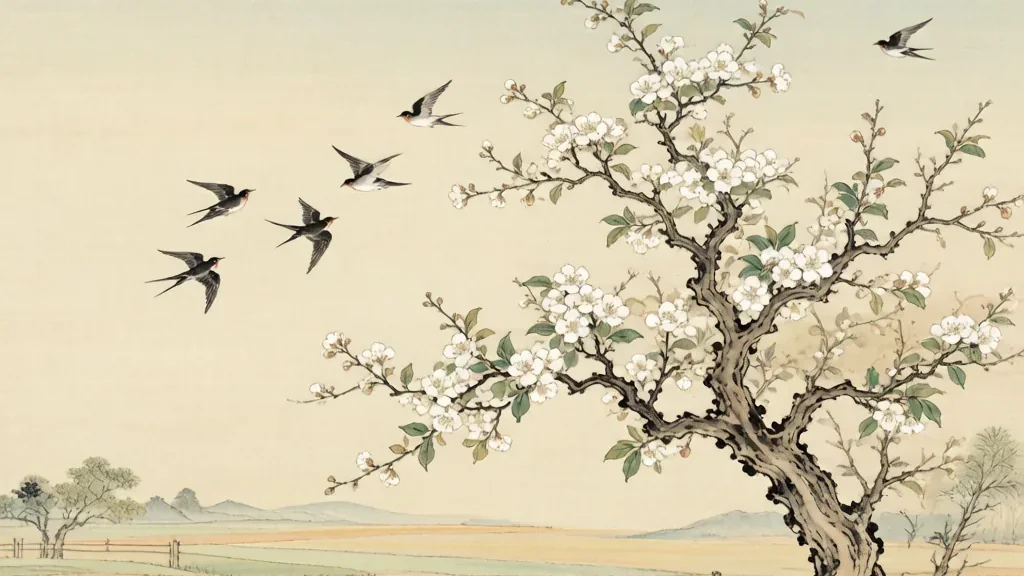
Ancient Chinese astronomers identified three phenological signs marking the arrival of Chunfen. In the first pentad, the mysterious "dark bird" — generally identified as the swallow — arrives, its forked tail and graceful flight announcing the full arrival of spring. In the second pentad, thunder begins to rumble, as the warming atmosphere generates the first convective storms of the season. By the third pentad, lightning flashes across the sky, completing the triad of spring atmospheric phenomena. These careful observations, recorded in the classical text "The Monthly Ordinances" (月令), reveal a civilization deeply attuned to the subtle signals of seasonal change.
The Egg-Standing Tradition: Gravity and Good Fortune
Perhaps the most famous and widely practiced Chunfen custom is the egg-standing game (立蛋, lì dàn). On the day of the Spring Equinox, people across China — and increasingly around the world — attempt to stand raw eggs upright on their ends on flat surfaces. The tradition holds that the equinox's unique gravitational balance makes this feat easier than on any other day of the year, though modern science suggests that any day works equally well with patience and a steady hand. What matters more than physics is the symbolic meaning: successfully standing an egg represents bringing life into balance and inviting good fortune for the year ahead.
The origins of the egg-standing tradition trace back over four thousand years to ancient spring fertility rituals. Eggs, as symbols of new life and potential, were natural offerings to welcome the growing season. Archaeological evidence suggests that decorated eggs were used in spring ceremonies during the Zhou Dynasty, and by the Tang Dynasty, the practice of standing eggs on the equinox had become a popular folk custom. In some regions, the challenge was turned into a community competition, with neighbors gathering to see who could stand the most eggs, the victor earning bragging rights and the promise of a particularly fortunate year.
The custom carries deeper cultural significance than mere entertainment. The egg's perfect oval shape, containing the potential for life within its shell, mirrors the cosmos in miniature — the yolk representing the earth, the white the heavens, and the shell the boundary between the two. Standing the egg upright symbolizes aligning oneself with the balanced forces of the universe at this unique moment. Parents teach the tradition to children as a way of connecting them to the rhythms of nature, and the shared activity strengthens community bonds as families and neighbors participate together in this gentle spring ritual.
Spring Sacrifices and the Sending of the Spring Ox
Historically, the Spring Equinox was a time of solemn ritual and imperial ceremony. The most important of these was the spring sacrifice (春祭, chūn jì), when the emperor himself would travel to the Temple of the Sun (日坛, Rìtán) in Beijing to offer sacrifices to the solar deity. Dressed in ceremonial red robes — the color associated with the sun and yang energy — the emperor would perform elaborate rituals of thanksgiving, praying for abundant harvests and the wellbeing of the realm. This state ceremony reinforced the emperor's role as the intermediary between heaven and earth, responsible for maintaining cosmic harmony through proper ritual conduct.
At the village level, a beloved Chunfen tradition involved the distribution of spring ox pictures (春牛图, chūn niú tú). These colorful woodblock prints depicted an ox — the farmer's essential partner — alongside a shepherd boy, with annotations indicating the year's agricultural calendar, including optimal planting dates and weather predictions. Traveling performers would go from village to village, singing auspicious songs and presenting these pictures to each household. The arrival of the spring ox picture bearers was a cause for celebration, as families eagerly examined the prints for guidance about the coming farming season.
The spring ox pictures were far more than decorative art; they functioned as a form of traditional agricultural extension service. The color of the ox's body, the direction of the shepherd's whip, and even the number of feet visible in the print all encoded information about that year's predicted weather patterns and optimal farming practices. This system, developed over centuries of careful observation and passed down through generations of folk artists, represented a sophisticated integration of astronomical knowledge, meteorological experience, and artistic expression. Today, these prints are prized by collectors and museums as examples of China's rich folk art heritage.
Kite Flying and Seasonal Foods
The gentle, steady breezes of the Spring Equinox create ideal conditions for one of China's most cherished pastimes: kite flying. During Chunfen, the skies above cities and villages fill with kites of every imaginable shape — butterflies and dragonflies, mythical phoenixes and soaring eagles, elaborate centipede kites stretching dozens of meters long, and simple diamond kites made by children from bamboo and paper. The tradition of spring kite flying dates back over two thousand years, and some of the earliest kites were used not for recreation but for military signaling and measuring distances.
In many regions, kite flying during Chunfen carries specific ritual significance. Some families write their worries and misfortunes on paper and attach them to kites, then cut the string once the kite is high in the air, symbolically releasing their troubles to the wind. Others fly kites as an offering to the gods, believing that the higher the kite soars, the more likely their prayers will be heard. The famous Weifang International Kite Festival, held in Shandong Province, draws its inspiration from these ancient spring traditions, attracting kite enthusiasts from around the world to celebrate the art and joy of kite flying.
Chunfen cuisine emphasizes the fresh, tender vegetables of early spring. Wild herbs and greens — shepherd's purse (荠菜, jìcài), Chinese toon (香椿, xiāngchūn), and young bracken fern — are gathered and prepared in simple dishes that showcase their delicate flavors. In southern China, families prepare spring vegetable soup, combining a variety of seasonal greens with tofu and a light broth. In the north, spring vegetables are chopped and mixed with minced pork as filling for dumplings, their bright green color visible through the translucent wrappers. Eating these fresh spring foods is believed to harmonize the body with the season's rising yang energy and to cleanse the system after a winter of heavier, preserved foods.
Health Wisdom and Cultural Legacy
Traditional Chinese medicine offers detailed guidance for maintaining health during the Spring Equinox period. The balanced nature of the equinox makes it an ideal time to focus on the liver and gallbladder, the organs associated with the wood element and the spring season. Practitioners recommend consuming mildly sour and sweet foods to support liver function — fresh berries, young greens, and sprouts are ideal. Light exercise, particularly outdoor activities like walking, tai chi, and qigong, helps circulate qi and blood. The emotional dimension is equally important: spring's rising energy can manifest as irritability or frustration if not properly channeled, and the equinox's theme of balance offers a natural reminder to cultivate emotional equilibrium.
Chinese poets have long been inspired by the Spring Equinox's themes of balance and renewal. The Tang Dynasty poet Du Fu wrote movingly of the season's flowers blooming after rain, while Song Dynasty masters composed verses about the return of swallows and the greening of willow branches. In the famous "Twenty-Four Solar Terms Song" (二十四节气歌), passed down through generations, Chunfen occupies a central position, its mention serving as a mnemonic anchor for the entire agricultural calendar. Even today, Chinese social media fills with equinox-themed posts, as urban residents share photographs of blooming flowers, standing eggs, and spring foods, maintaining a connection to traditions that have persisted for millennia.
As China has modernized, the Spring Equinox has adapted while retaining its essential character. Schoolchildren still attempt the egg-standing challenge in classrooms, families still prepare spring vegetable dishes, and traditional medicine practitioners still adjust their seasonal recommendations. The equinox's message of balance resonates perhaps even more powerfully in the fast-paced modern world, offering a moment to pause, observe the natural world, and remember that human wellbeing has always depended on living in harmony with the seasons. In 2016, when UNESCO recognized the Twenty-Four Solar Terms as an Intangible Cultural Heritage of Humanity, the Spring Equinox stood as one of its most universally understood and appreciated components.
Spring Outings and Treading the Green
As the weather settles into mild, equal-length days, Chunfen is the season for ta qing, the custom of leaving the house to walk among the new green. Families picnic under budding willows, children fly the first kites of the year, and poets climb hills to watch the land turn from brown to jade. The outing is both recreation and a kind of alignment with the season, a way to let the body feel the rising yang energy instead of resisting it indoors. In a culture that reads the calendar in the body, a simple walk in the spring fields is a small act of harmony with the turning year.
The Equinox in Poetry and the Arts
Few moments of the solar year inspired more verse than the Spring Equinox. Du Fu wrote of flowers opening after rain, and Li Bai of the returning swallows and greening branches that mark the balanced day. The theme of equilibrium also entered painting, where balanced compositions and paired swallows echoed the cosmic evenness of the date. Because UNESCO listed the Twenty-Four Solar Terms as heritage in 2016, the equinox now travels beyond China as a shared image of balance. Its presence in so many art forms shows how a astronomical fact became a lasting cultural feeling.
❓ Frequently Asked Questions
📝 Chinese Vocabulary
- 春分 (chūn fēn) — Spring Equinox; literally "spring division," the fourth solar term
- 立蛋 (lì dàn) — Egg-standing; the traditional equinox custom of standing eggs upright
- 春祭 (chūn jì) — Spring sacrifice; the imperial ritual of offering to the sun deity
- 春牛图 (chūn niú tú) — Spring ox pictures; traditional woodblock prints distributed at the equinox
- 阴阳平衡 (yīn yáng píng héng) — The harmonious balance of yin and yang energies
🎉 Fun Facts
- The Spring Equinox is one of only two days in the year when the sun rises exactly in the east and sets exactly in the west everywhere on Earth — a fact ancient Chinese astronomers documented centuries before their European counterparts.
- The tradition of standing eggs on the equinox is said to bring a full year of good luck, and the custom has spread internationally, with egg-standing events held in cities from Tokyo to New York.
- The swallow (燕子, yànzi) is the symbolic bird of the Spring Equinox — its return from southern migration traditionally signals that warm weather has truly arrived.
- Ancient Chinese astronomers used gnomon shadow measurements at the equinox to calibrate their calendars, as the equinoctial shadow length provided a precise reference point for the solar year.
- In some rural areas Chunfen is the day to begin transplanting rice seedlings, since the warming soil and balanced daylight suit the young plants.
- The equinox's balance made it a favored date for honoring the dead at ancestral graves in certain regions, blending the seasonal midpoint with family remembrance.