More About This Solar Term
This solar term has been observed in Chinese culture for thousands of years. Ancient Chinese farmers relied on these seasonal markers to plan their agricultural activities with remarkable precision. The 24 solar terms, originating in the Yellow River basin during the Zhou Dynasty (1046–256 BCE), represent one of humanity's earliest systematic approaches to understanding seasonal change.
In 2016, UNESCO recognized the Twenty-Four Solar Terms as an Intangible Cultural Heritage of Humanity, acknowledging their enduring importance in Chinese cultural identity and agricultural wisdom. Each solar term reflects a specific astronomical event or natural phenomenon — the sun's position at 15° intervals along the ecliptic — dividing the year into 24 equal segments of approximately 15 days each.
Traditional Chinese medicine closely aligns health practices with the solar terms. During each term, specific foods, exercises, and lifestyle adjustments are recommended to maintain harmony with nature. This philosophy, known as "yang sheng" (养生), or the art of nurturing life, remains widely practiced across China today. Seasonal ingredients are chosen not just for flavor but for their perceived medicinal properties — warming foods in winter, cooling foods in summer.
In literature and art, the solar terms have inspired countless poems, paintings, and musical compositions throughout Chinese history. Tang Dynasty poets like Du Fu and Li Bai frequently wove seasonal imagery into their verses, using the specific characteristics of each solar term to evoke mood and meaning. The famous Song Dynasty scroll painting "Along the River During the Qingming Festival" (清明上河图) takes its very name from one of the 24 solar terms — Qingming — capturing the vibrant life of a Chinese city during this spring moment.
Today, the solar terms continue to guide daily life in China. Farmers still consult the traditional calendar for planting and harvesting. Families observe customs passed down through generations — eating spring pancakes at Lichun (Start of Spring), honoring ancestors at Qingming (Clear and Bright), and gathering for family feasts at Dongzhi (Winter Solstice). Schools teach children about the solar terms, ensuring this ancient knowledge system remains alive for future generations. Weather forecasts on Chinese television often reference the current solar term, connecting modern meteorology with traditional wisdom.
Among all twenty-four solar terms, Qingming (清明) occupies a unique position — it is simultaneously an astronomical marker, a traditional festival, and one of China's most emotionally resonant occasions. Falling annually between April 4th and 6th, this fifth solar term arrives when spring is at its most radiant, when the landscape has been washed clean by gentle rains and the world appears fresh, bright, and full of promise. The name itself captures this quality: 清 (qīng) means clear, pure, or clean, while 明 (míng) means bright or luminous. Together they describe the luminous clarity of the spring world — the light that seems to shine from within new leaves, the transparency of streams swollen with snowmelt, and the sense of renewal that permeates the season.
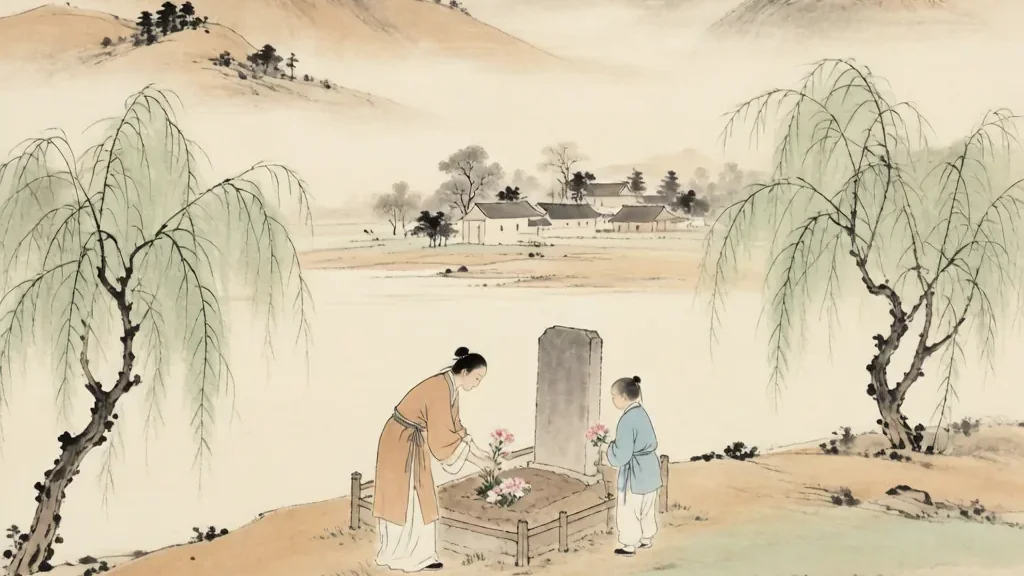
Qingming carries a dual emotional character that makes it unlike any other solar term. It is at once a solemn occasion for honoring the dead and a joyful celebration of spring's abundant life. Families visit ancestral graves to sweep, clean, and make offerings, maintaining the Confucian virtue of filial piety across the boundary between the living and the dead. Yet these same families also embark on spring outings, fly kites in the fresh breezes, and enjoy the outdoors after a winter of confinement. This combination of reverence and celebration, of grief and joy, of past and present, captures something essential about the Chinese understanding of life — that death and renewal are not opposites but partners in the eternal cycle of existence, and that honoring those who came before is inseparable from embracing the life that continues.
The Origins and History of Qingming
The origins of Qingming stretch back over two and a half thousand years, intertwining astronomy, agriculture, and legend into a tradition that has shaped Chinese culture since the Zhou Dynasty. Astronomically, Qingming occurs when the sun reaches 15 degrees of celestial longitude, marking the moment when spring's energy has fully established itself after the tentative beginnings of earlier solar terms. The weather during this period is characteristically clear and mild — the "Qingming rain" (清明雨) that falls in fine, persistent drizzle is as famous in Chinese poetry as the bright days that follow, creating the ideal conditions for the burst of vegetative growth that transforms the landscape.
The festival dimension of Qingming is traditionally traced to the story of Jie Zitui, a loyal retainer of Duke Wen of Jin during the Spring and Autumn Period. According to legend, Jie saved his starving lord by cutting flesh from his own thigh to make soup. When Duke Wen later became ruler and distributed rewards to his followers, Jie declined all honors and retired to a mountain forest with his mother. The duke, seeking to compel Jie's return, ordered the mountain set on fire — only to find Jie and his mother dead beneath a willow tree, having refused to emerge. Overcome with remorse, the duke declared that no fires should be lit on the anniversary of Jie's death, and the Cold Food Festival (寒食节, Hánshí Jié) was born. Over time, the Cold Food Festival merged with the Qingming solar term, and the traditions of tomb sweeping and ancestral veneration became central to the occasion.
By the Tang Dynasty, Qingming had become one of the most important festivals in the Chinese calendar. Emperor Xuanzong, concerned that extravagant ancestral rites were becoming a burden on the common people, issued an edict in 732 CE standardizing the observance of tomb sweeping at Qingming, making it an official holiday. The Song Dynasty saw the full flowering of Qingming culture, immortalized in the famous scroll painting "Along the River During the Qingming Festival" (清明上河图) by Zhang Zeduan, which depicts the bustling life of the capital city during this spring celebration. The painting, one of the most treasured works of Chinese art, captures the vibrant energy of Qingming — the crowds, the commerce, the boats on the river, the camels entering the city gates — in a panoramic vision of Chinese civilization at its medieval peak. Today, Qingming remains a public holiday in China, Taiwan, Hong Kong, and Macau, and its traditions continue to be observed by Chinese communities worldwide.
Tomb Sweeping and Ancestral Veneration
The practice of tomb sweeping (扫墓, sǎo mù) lies at the emotional heart of Qingming. In the days surrounding the solar term, families across China journey to ancestral gravesites, carrying offerings of food, wine, flowers, and incense. The tombs are cleared of winter's accumulation of weeds and debris, the headstones are cleaned, and fresh earth is sometimes added to repair any damage from the winter weather. This physical act of care for the resting places of the dead expresses a profound Chinese cultural value: that the relationship between the living and the dead does not end with death, and that the deceased continue to be members of the family, deserving of respect, remembrance, and practical care.
The offerings made at Qingming follow traditional protocols that vary by region but share common elements. Food offerings typically include the favorite dishes of the deceased — a whole chicken, a piece of pork, bowls of rice, and fruit — arranged before the grave on plates or in bamboo baskets. Wine or tea is poured into small cups and placed alongside the food. Incense sticks are lit and planted in the earth before the headstone, their fragrant smoke believed to carry the family's prayers and messages to the spirit world. Paper money, known as "spirit money" (冥币, míngbì), is burned in a small fire, the smoke carrying its value to the ancestors in the afterlife. In recent years, the tradition has evolved to include paper replicas of modern items — cell phones, cars, and even paper credit cards — reflecting the belief that the dead continue to need the comforts of the living world.
The emotional experience of Qingming tomb sweeping is complex and deeply personal. For many, it is a time of genuine grief, the annual visit to the grave reopening wounds that time has only partially healed. For others, it is a time of quiet reflection and connection, an opportunity to speak to parents and grandparents who are no longer physically present but whose influence continues to shape the lives of their descendants. Families often share stories of the deceased during these visits, passing memories from the older generation to the younger, ensuring that the ancestors live on not only in spirit but in the collective memory of the family. In this way, Qingming serves as a mechanism of cultural transmission, preserving family histories and reinforcing the bonds of kinship across the generations.
Spring Outings and the Celebration of Life
Alongside the solemnity of tomb sweeping, Qingming embraces the joy of spring through the tradition of spring outings (踏青, tà qīng) — literally "treading the green." After the graves have been tended and the offerings made, families do not return immediately home but instead venture into the countryside to enjoy the beauty of the spring landscape. This custom reflects a deep Chinese understanding that honoring the dead does not require the living to deny life's pleasures — indeed, celebrating the vitality of spring is itself a form of respect for the ancestors, who wished for their descendants to live fully and joyfully.
The spring outings of Qingming take many forms. In rural areas, families spread picnic blankets in meadows carpeted with wildflowers, sharing the food that was offered at the graves in a communal meal that symbolically includes the ancestors. In cities, parks fill with families flying kites — the Qingming sky alive with colorful shapes dancing on the spring breeze. Kite flying during Qingming carries its own symbolic meaning: some families write their worries on paper and attach them to kites, then cut the string, releasing their troubles to the wind. Others fly kites simply for the pleasure of it, the soaring flight a metaphor for the spirit's liberation from winter's confinement. In southern China, where the weather is already warm, Qingming outings may include boating on lakes and rivers, the water reflecting the fresh green of willow branches and the bright colors of spring blossoms.
The tradition of wearing willow branches (插柳, chā liǔ) during Qingming adds another layer of meaning to the spring celebration. Willow branches, with their flexible strength and early spring greening, are believed to possess protective powers. Families tuck willow twigs into their hair or attach them to the eaves of their houses, following the belief that the willow wards off evil spirits and disease. The custom may also connect to the Jie Zitui legend, in which the loyal retainer died beneath a willow tree. In some regions, willow branches planted on Qingming are believed to grow into trees that will shade and protect the family for generations. The willow, with its association with both death and renewal, perfectly captures the dual nature of Qingming itself.
Qingtuan: The Taste of Qingming
No food is more intimately associated with Qingming than qingtuan (青团, qīngtuán) — "green rice balls" that are as beautiful to behold as they are delicious to eat. These round, jade-green dumplings are made from glutinous rice flour mixed with the juice of mugwort or barley grass, which gives them their distinctive color and a subtle, herbaceous fragrance. The green dough is wrapped around a filling — most traditionally sweet red bean paste, though modern variations include black sesame, salted egg yolk, and even meat floss — then steamed until the exterior becomes glossy and translucent, the green deepening to the color of new spring leaves.
The origins of qingtuan stretch back over a thousand years to the Cold Food Festival, when the prohibition on cooking fires meant that families needed foods that could be prepared in advance and eaten cold. Glutinous rice dumplings, which remain soft and palatable even when cool, were the perfect solution. The green color, derived from wild spring herbs, connected the food to the season's renewal and, according to traditional medicine, helped clear heat and detoxify the body after winter's heavier diet. Over centuries, qingtuan evolved from a practical necessity into a beloved seasonal delicacy, and the anticipation of their brief spring appearance — they are typically available only in the weeks surrounding Qingming — has become part of their charm.
Today, qingtuan has transcended its humble origins to become a cultural phenomenon. Bakeries and restaurants across China begin selling qingtuan weeks before Qingming, and the competition to create innovative fillings has produced everything from durian qingtuan to matcha qingtuan to cheese-filled qingtuan. Yet the traditional red bean paste version remains the most beloved, its sweetness balanced by the subtle bitterness of the mugwort, its soft, chewy texture a sensory pleasure that evokes spring itself. Making qingtuan at home remains a cherished family tradition in many households, the process of grinding the mugwort, kneading the green dough, and wrapping each ball by hand connecting the family to generations of ancestors who performed the same ritual. Eating qingtuan during Qingming is thus far more than a culinary experience — it is a taste of history, a sensory link to the past, and a celebration of the season's renewal in edible form.
Qingming in Poetry, Art, and Cultural Memory
Qingming has inspired some of the most famous works in Chinese literature and art. The Tang Dynasty poet Du Mu's quatrain on Qingming is perhaps the most widely known seasonal poem in the Chinese language: "清明时节雨纷纷,路上行人欲断魂。借问酒家何处有,牧童遥指杏花村。" — "During Qingming, the rain falls in a fine drizzle; travelers on the road feel their spirits falter. May I ask where a tavern can be found? A shepherd boy points to Apricot Blossom Village in the distance." In just four lines, Du Mu captured the melancholy beauty of the season — the persistent rain, the emotional weight of remembering the dead, and the simple human comfort of a warm drink at a village inn. The poem is memorized by every Chinese schoolchild and has shaped the emotional experience of Qingming for over a thousand years.
The visual arts have similarly celebrated Qingming. Zhang Zeduan's "Along the River During the Qingming Festival," painted during the Song Dynasty, is perhaps the most famous Chinese painting in history. The handscroll, nearly five meters long, depicts the capital city of Bianjing (modern Kaifeng) during the Qingming celebrations with astonishing detail — over eight hundred figures, dozens of buildings, boats of every size, camels, horses, and street vendors — all rendered with a precision that has allowed historians to reconstruct the material culture of Song Dynasty China. The painting has been copied, adapted, and reinterpreted countless times over the centuries, and its title has become synonymous with Qingming itself. Today, the original scroll, housed in the Palace Museum in Beijing, remains one of China's most treasured cultural artifacts.
In contemporary China, Qingming continues to evolve while maintaining its essential character. The Chinese government designated Qingming as a public holiday in 2008, restoring official recognition to a tradition that had been discouraged during certain periods of the twentieth century. Modern observances incorporate new elements — online memorial websites where people can light virtual incense and leave digital offerings for distant graves, eco-friendly burial practices that replace paper money burning with flower planting, and public ceremonies honoring revolutionary martyrs alongside family ancestors. Yet the core of Qingming remains unchanged: it is a day when the boundary between past and present grows thin, when families gather to remember, and when the beauty of spring reminds us that life, in its endless cycle of death and renewal, continues. In this way, Qingming serves as an annual invitation to reflect on what endures — family, memory, the turning seasons — and to find, in the midst of grief and joy alike, the luminous clarity that gives the solar term its name.
Willow Branches and Seasonal Symbols
Willow is the signature plant of Qingming, and the custom of inserting willow branches in doors, gates, and even hair is among the term's oldest rites. The flexible green branch stood for the returning vitality of spring and was also believed to keep away evil influences, since willow was thought to confuse wandering spirits. Combined with the season's other symbols, the freshly swept grave, the green rice ball, and the bright kite in the sky, the willow captures Qingming's double character: a day of remembrance that is also irreducibly alive. These small objects turned an abstract season into something tangible a family could carry, plant, eat, and fly.
Qingming Proverbs and the Farming Year
Although Qingming is best known as a festival of graves and outings, it is also a farming marker, and proverbs tie it to the land. Sayings note that after Qingming the rain falls like oil for the seedlings, and that the season is the moment to transplant rice and sow late spring crops. Others warn that Qingming weather forecasts the year, reading wind and cloud as omens. In this way the term belongs both to the ritual calendar and the agricultural one, a day when a family might sweep an ancestor's grave in the morning and be back in the fields by afternoon, joining reverence for the dead with care for the living crop.
❓ Frequently Asked Questions
📝 Chinese Vocabulary
- 清明 (qīng míng) — Pure Brightness; the fifth solar term and the Tomb Sweeping Festival
- 扫墓 (sǎo mù) — Tomb sweeping; the central ritual of cleaning and maintaining ancestral graves
- 踏青 (tà qīng) — Spring outing; literally "treading the green," the custom of enjoying spring outdoors
- 青团 (qīng tuán) — Green rice balls; the quintessential Qingming food made with glutinous rice and mugwort
- 寒食节 (hán shí jié) — Cold Food Festival; the precursor to Qingming, when cooking fires were forbidden
🎉 Fun Facts
- Qingming is the only solar term that is also a traditional Chinese festival and public holiday — a unique status among the twenty-four terms.
- The famous Song Dynasty painting "Along the River During the Qingming Festival" is over five meters long and contains more than 800 human figures, making it one of the most detailed artworks in Chinese history.
- The tradition of wearing willow branches during Qingming is believed to ward off evil spirits, and in some regions, failing to wear willow is said to result in reincarnation as a yellow dog.
- Qingtuan's green color originally came from the juice of a wild herb called "mouse grass" (鼠曲草), though modern versions typically use mugwort or artificial coloring.
- Qingming outings historically included cuju, an ancient form of football, and kite flying, with some kites cut loose so their strings carried away misfortune.
- The Cold Food Festival, which immediately preceded Qingming, required households to extinguish their kitchen fires for a day or two, so Qingming meals were traditionally eaten cold or reheated only after the fires were relit.