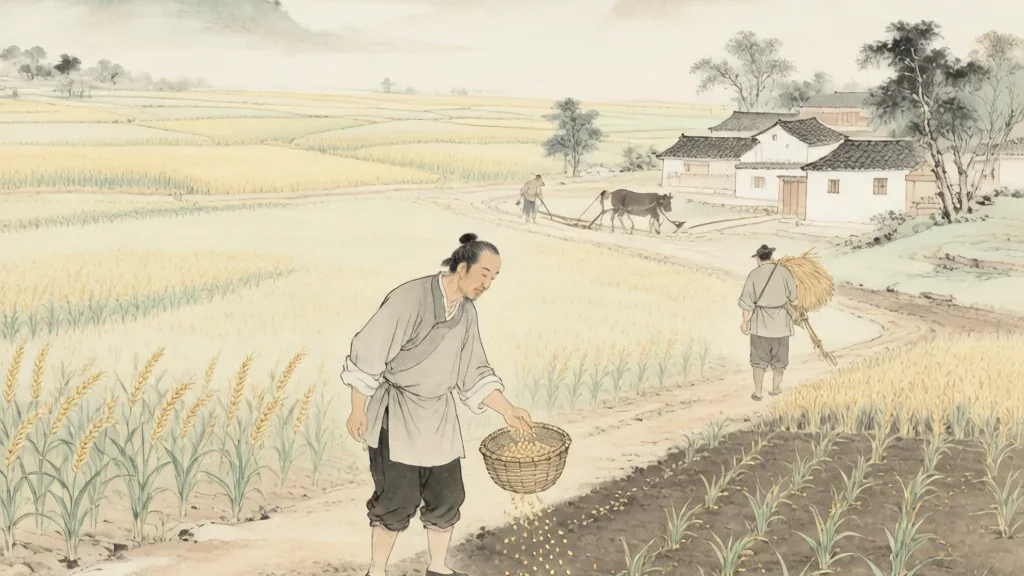
Mangzhong, or "Grain in Ear" (芒种), is the ninth solar term in the traditional Chinese calendar, usually arriving around June 6. The name refers to the awns—the bristle-like tips—on ripening cereal grains, and to the sowing of crops, combining mang (awn) with zhong (to sow seed). It marks one of the busiest moments of the farming year: in the south, rice seedlings must be transplanted, while in the north, the winter wheat with its golden awns is harvested. Falling just before the Summer Solstice, Mangzhong embodies the intense, overlapping labor of reaping and planting that gives it the reputation as the most hectic term. For rural China, it was a race against the rains and the rising heat, a time when the whole community labored from dawn to dusk. The term compresses the drama of the farming year into a few short weeks of overlapping urgency.
Name and Calendar Position
Mangzhong is the third summer term, following Xiaoman (Grain Buds) and preceding Xiazhi (Summer Solstice). It typically falls around June 6, with the sun at 75° of ecliptic longitude.
The character mang denotes the awn on grains like wheat and barley; zhong means to plant. Together the name captures both the mature, awned crop and the seeds going into the ground—harvest and sowing at once.
The "Grab Summer" Harvest
In the north, Mangzhong was the climax of wheat harvest. The grain, now fully awned and ripe, had to be cut quickly before storms or heat could spoil it. This rush was called "grab summer" (夏收), a race against time.
Families worked from first light, swinging sickles and hauling sheaves. A delayed harvest risked grain shattering or rotting in humidity. The term's pressure made it among the most physically demanding of the year.
Rice Transplanting in the South
South of the Yangtze, Mangzhong meant transplanting rice seedlings into flooded paddies. Barefoot workers bent all day setting the young plants in precise rows, a task requiring speed and skill before the rains grew heavy.
The two regions thus mirrored each other: north reaped what it had sown the prior autumn, while south sowed what it would reap in late summer. Mangzhong was the term where the agricultural wheel turned fastest.
"Busy as Grain in Ear"
A common saying holds that "at Grain in Ear, nobody is idle" (芒种忙忙种), underscoring the term's reputation as the year's most crowded with work. Both fields and farmyards buzzed with activity.
Children and elders joined in whatever they could—carrying water, watching birds, drying grain. The communal effort strengthened village bonds and made the term a shared ordeal and achievement.
Weather and the Plum Rains
Mangzhong often overlaps with the east Asian plum-rain (梅雨) season along the Yangtze, a period of steady humidity and showers. The moisture aided rice but threatened the wheat harvest with mold.
Farmers therefore watched the sky anxiously, trying to cut wheat between rains and to transplant rice with enough water but not flooding. The term's weather was a daily negotiation between opportunity and risk.
Customs and Foods
In some regions, Mangzhong was linked to honoring the "flower goddess" (送花神) as spring blooms faded, a literary custom described in classic novels. It marked the close of the flowering season and the full arrival of summer.
Foodwise, the term's fresh wheat inspired newly harvested-flour dishes, and green plums were picked and processed, sometimes soaked in wine. These small customs celebrated the season's produce amid the labor.
Health and Seasonal Care
Traditional health advice for Mangzhong warned of dampness and heat, recommending light, easily digested foods and caution against the humidity-borne ailments of the plum-rain period.
Because the work was exhausting, rest and steady pacing were urged. The term's regimen balanced the demand for maximum effort with the need to protect health through a strenuous stretch.
Literary and Cultural Echoes
Mangzhong appears in poetry as an image of hurried abundance—fields gold and green at once, the air loud with labor. It symbolized the fertility and urgency of early summer.
In works like the novel Dream of the Red Chamber, the term's flower-goddess farewell lent it a tender, fleeting quality, reminding readers that even in busy seasons, beauty passes and deserves notice.
Mangzhong Today
Modern machinery has eased the term's labor, yet Mangzhong remains a key agronomic marker, featured in farming forecasts and almanac apps. Rural communities still time planting and harvest to it.
For city dwellers, the term survives through seasonal articles and the occasional literary reference. It stands as a vivid reminder of the rhythm that once governed Chinese life: reap quickly, plant promptly, and trust the turning year.
Mangzhong in Proverb and Song
Mangzhong inspired a vivid folk vocabulary of urgency. Sayings described the term as a race, warned that a delayed day meant a lost measure of grain, and praised those who finished both reaping and planting before the rains. Such proverbs condensed hard experience into memorable lines.
Work songs sung in the fields during the term gave rhythm to the exhausting labor, coordinating the movements of reapers and transplanters and lifting spirits through long days. The music of Mangzhong was the sound of a community pulling together at peak demand.
This oral culture shows how the term was not merely observed but lived collectively. The pressure of Mangzhong produced some of the richest seasonal lore in the calendar, a testament to how deeply the agricultural year shaped language, song, and shared memory.
The term also taught a lesson about timing that reached beyond farming. Its insistence that reaping and sowing must happen together, without delay, became a metaphor for seizing the right moment in any endeavor. To be "busy as Grain in Ear" is still to evoke focused, purposeful effort at a critical juncture—a piece of agricultural wisdom carried into everyday speech.
❓ Frequently Asked Questions
When does Mangzhong occur?
Mangzhong typically falls around June 6, when the sun reaches 75° of ecliptic longitude.
What does the name Mangzhong mean?
It combines mang (awn, the bristle on grain) and zhong (to sow), marking grain in ear and sowing time.
Why is Mangzhong so busy?
It overlaps wheat harvest in the north with rice transplanting in the south—reaping and planting at the same time.
What is the plum-rain season?
A humid, showery period along the Yangtze around Mangzhong that helps rice but threatens the wheat harvest with mold.
What comes before and after Mangzhong?
It follows Xiaoman (Grain Buds) and precedes Xiazhi (Summer Solstice).
Is Mangzhong still important today?
Yes, as an agronomic marker in farming forecasts and almanacs, though machines have eased its once-intense labor.