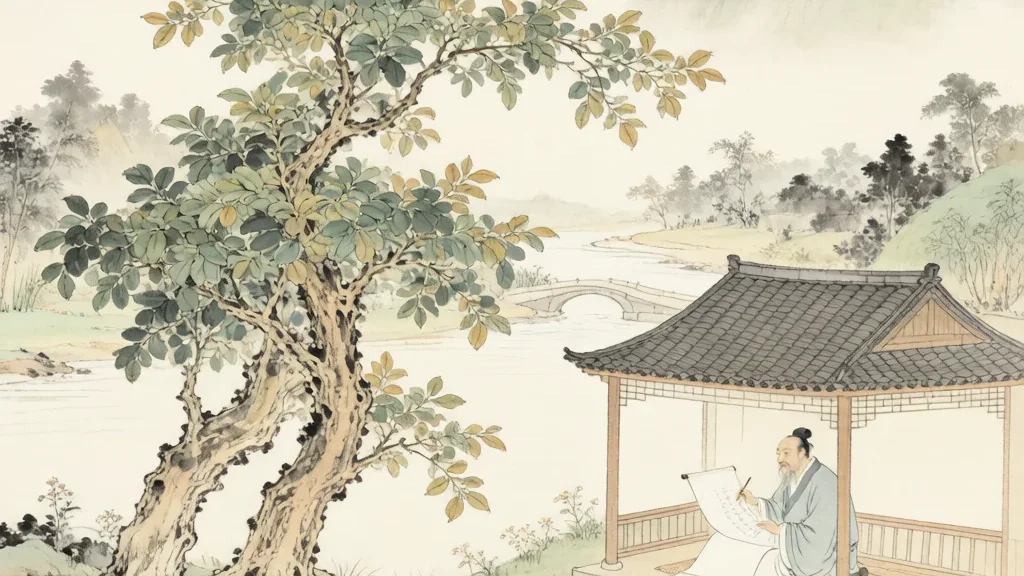
Xiazhi, or the "Summer Solstice" (夏至), is the tenth solar term in the traditional Chinese calendar and the moment of the year's longest daylight in the Northern Hemisphere, usually falling around June 21. When the sun reaches the ecliptic longitude of 90 degrees, its noontime shadow is the shortest of the year, a fact recorded and measured in China for more than two thousand years. The name combines xia (summer) and zhi (to arrive, extreme), indicating that summer has reached its height. Although Xiazhi brings the most sun, it does not bring the hottest weather—that comes later at Dashu—because the earth's accumulated heat lags behind the sun's angle. In Chinese tradition, the solstice was a time of both celebration and caution, marking the turn from growing light to growing dark.
Astronomical Definition
Xiazhi is anchored to the sun's position at 90° of ecliptic longitude, the point at which the Northern Hemisphere tilts most directly toward the sun. On this day the sun rises and sets at its farthest-north points, giving the longest daylight and shortest noon shadow.
Ancient Chinese astronomers used a gnomon—a vertical pole or standard—to measure the shadow at noon. The solstice's remarkably short shadow was a key observational marker, proof that the term was defined by precise celestial measurement rather than mere feeling.
"Yang Reaches Its Peak, Yin Begins"
In the cosmology of yin and yang, Xiazhi is the extreme of yang—light, warmth, activity—yet it is also the instant when yin, the cool and receptive principle, begins to return. The saying "yang is at its height and yin is born" (阳至极,阴始生) captures this turning.
This dual idea made the solstice a moment of balance within extremity. Just as the day is longest, the slow reversal toward darkness begins. The concept reassured people that no condition, however intense, is permanent, and it shaped how the term was observed.
The Longest Day and Ancient Measurement
Historical records show that shadow measurement at the solstice was institutionalized early, with the standard gnomon length and resulting shadow recorded in calendrical treatises. These observations supported the creation of accurate calendars used for agriculture and ritual.
The solstice's predictability also made it a natural anchor for the year. In the Zhou and Han periods, officials calibrated timekeeping instruments against it, and its observation was woven into the state's duty to align human order with heaven's patterns.
Eating Noodles and "Summer Solstice Soup"
A widespread northern custom was eating cold noodles (凉面) on Xiazhi, a refreshing meal suited to the heat and a way to mark the season with a shared dish. The practice gave rise to sayings linking the solstice to noodles.
In some southern areas, people ate "summer solstice soup" or special rice dishes, and certain localities had their own solstice cakes. These foods blended practical relief from heat with festive acknowledgment of the term's importance in the calendar.
Customs of Rest and Reverence
Because the solstice marked a cosmic turning, some traditions advised easing labor and observing restraint. In certain regions, women returned to their parental homes for a visit, a rare seasonal allowance that strengthened family ties.
Farmers, though busy with the early summer crop, treated the day as one to note carefully, since the light's slow decline after Xiazhi signaled that the growing season's most favorable window was passing. The term thus carried both celebration and quiet watchfulness.
Agricultural Life at the Solstice
Around Xiazhi, northern wheat harvested at Lixia and Mangzhong was being processed, while southern rice fields demanded constant water management under the strengthening sun. The intense light accelerated growth but also raised the risk of drought and pests.
Proverbs urged vigilance: the longest day was also a reminder that heat would build toward Dashu. Managing irrigation and protecting seedlings became the farmer's central task, making the solstice a practical as well as symbolic milestone.
Weather Lore and Proverbs
Many sayings connected Xiazhi weather to later conditions. "If it rains at the solstice, there will be good weather at the dog days" and similar rhymes expressed hopes and fears about the coming heat and rains.
Observers also tracked the "dog days" (三伏), the hottest period calculated relative to the solstice and the next two geng days in the calendar. This system shows how Xiazhi anchored a wider framework of seasonal timing beyond the single term.
Xiazhi in Literature and Art
Poets wrote of the solstice's blazing sun, the chorus of cicadas, and the lotus in full bloom, using the longest day as a stage for meditations on abundance and transience. The lotus, flowering exactly in deep summer, became its floral emblem.
Painters depicted lotus ponds and humming insects to evoke the season's vitality. Such works show the solstice not only as a scientific instant but as a rich sensory and emotional experience in Chinese culture.
Xiazhi Today
In modern China, Xiazhi survives mainly through food customs, almanac apps, and science-education articles explaining the astronomy. Schools and planetariums sometimes use it to teach about Earth's tilt and the seasons.
While large public solstice rites are rare, the term remains a beloved calendar moment, reminding people to notice the light, eat a cooling bowl of noodles, and reflect on the steady turning of the year from brightness toward balance.
Xiazhi and the Measurement of Time
Beyond its role as a seasonal marker, Xiazhi was a pillar of traditional timekeeping. Because the solstice's short shadow was so precisely measurable, it allowed astronomers to check the accuracy of calendars and the drift of intercalary months, keeping the lunar-solar system aligned with the heavens.
The term also anchored the calculation of the "dog days," the hottest period, which was determined by counting from the summer solstice through specific "geng" days in the sexagenary cycle. This linkage shows how a single astronomical event radiated into a whole sub-calendar of seasonal timing used by farmers and physicians alike.
In this sense Xiazhi was both a moment and a measurement—a fixed point from which other intervals were reckoned. Its reliability made it a tool as much as a festival, illustrating how the solar terms fused observation, mathematics, and daily life into one coherent framework.
❓ Frequently Asked Questions
When does Xiazhi occur?
Xiazhi typically falls around June 21, when the sun reaches 90° of ecliptic longitude and daylight is longest in the north.
Why is the hottest weather after the solstice?
The earth stores heat, so temperatures keep rising for weeks; the peak heat arrives later at Dashu, the "dog days."
What food is eaten at Xiazhi?
Cold noodles are a common northern custom, while some southern regions have their own solstice soups and rice dishes.
How did ancient Chinese measure the solstice?
They used a gnomon (a vertical standard) to measure the noon shadow, which is shortest at the summer solstice.
What does yin-yang say about Xiazhi?
It is yang's extreme, but the instant when yin begins to return—the cosmic turn from light toward dark.
Is Xiazhi the middle of summer?
It is the astronomical peak of summer light, but in the solar-term system summer continues through Dashu before autumn begins.